Wiwaxia Scientific Classification
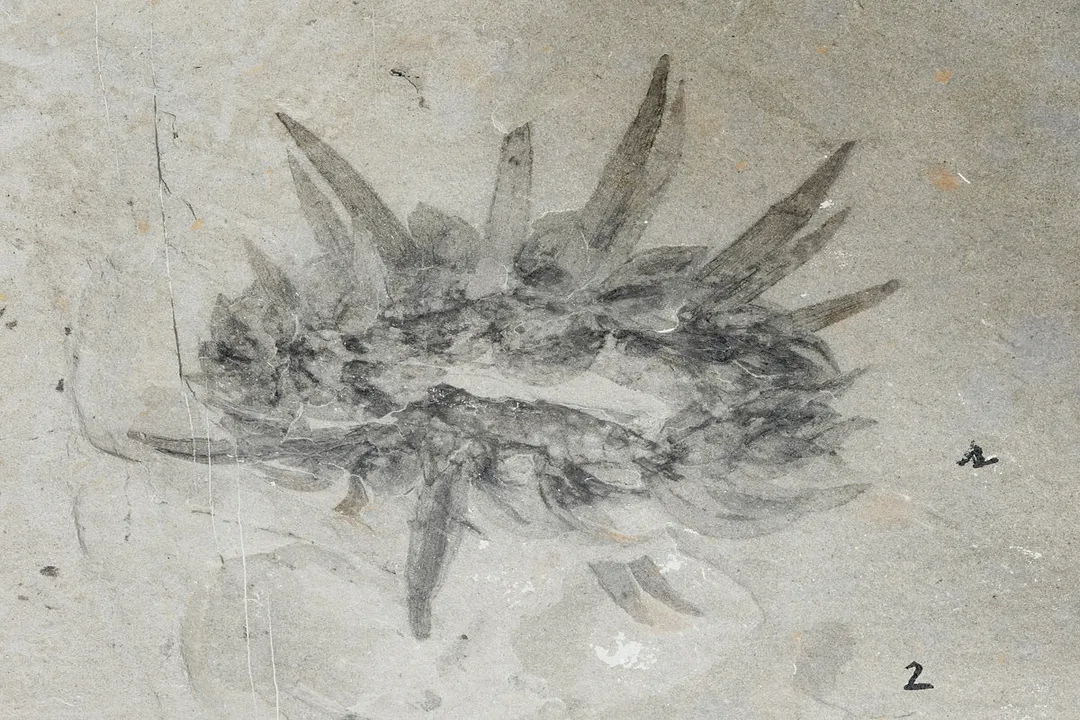
Wiwaxia corrugata, a small, scaly denizen of the ancient seafloor, presents one of the most intriguing taxonomic puzzles stemming from the spectacular fossil beds of the early Cambrian period. [6] Discovered in the famous Burgess Shale deposits, this organism challenges neat categorization within modern animal groups, forcing paleontologists to grapple with the very roots of major animal lineages. [1] Its unique morphology, characterized by rows of overlapping scales and prominent spines projecting from its body, offers tantalizing but ultimately inconclusive evidence regarding its precise placement in the grand hierarchy of life. [6] The very existence of Wiwaxia underscores a time when animal body plans were experimenting wildly before the major phyla settled into their recognizable modern forms. [8]
# Cambrian Discovery
The fossils of Wiwaxia date back to the Middle Cambrian epoch, approximately 508 million years ago. [6] Recovered primarily from the Stephen Formation in British Columbia, Canada, which hosts the Burgess Shale fauna, this organism was a relatively small invertebrate. [6] Estimates suggest individuals typically measured between one and four centimeters in length. [3] What makes Wiwaxia so distinctive, and so difficult to classify, is its exterior covering. [1]
The animal possessed numerous flattened, scale-like plates, known as sclerites, arranged in rows along its back. [1][6] These sclerites, which appear to be the most robust parts of the animal and thus the best preserved in the fossil record, formed an armor-like covering. [6] Furthermore, paired arrays of long, rigid spines emerged from between these sclerites, potentially serving a defensive function against predators. [1][3] These spines are often preserved in sharp relief, indicating they were significant structures in the animal’s life. [6] The overall impression is of a slow-moving, perhaps somewhat slug-like creature protected by an elaborate array of hard parts. [3]
# Placement Debate
The scientific classification of Wiwaxia has been a subject of significant debate almost since its description, as it fits uncomfortably into established groups. [1] Its peculiar combination of features—scales, spines, and an overall soft-bodied appearance except for the armor—has led to suggestions spanning several major animal phyla. [8]
One long-standing hypothesis, now often viewed with skepticism but historically significant, proposed placing Wiwaxia within the Phylum Mollusca. [7] Proponents of this view suggested potential affinities with certain soft-bodied mollusks that lack external shells in the modern era, such as the Solenogastres. [1] The rationale behind this connection often centered on the structure of the sclerites, drawing comparisons to the scales found on some primitive mollusks. [7] However, this association remains contentious within the broader paleontological community due to the lack of other definitive molluscan characteristics in the fossil evidence. [1]
Alternatively, some researchers have considered connections to the Phylum Annelida, the segmented worms. [8] This consideration stems perhaps from the perceived overall body shape or arrangement, although the defining characteristic of annelids—clear metameric segmentation—is not strongly demonstrated in Wiwaxia fossils in the way it is in, say, Canadia from the same formation. [8]
A third, and increasingly favored, interpretation positions Wiwaxia outside these established groups, suggesting it might represent an early-branching, extinct lineage within the Bilateria, or perhaps even warranting a separate phylum altogether. [8] It is often described as belonging to an extinct group known simply as Wiwaxia. [1] This perspective acknowledges that the Cambrian Explosion produced many evolutionary experiments that did not leave direct descendants, making Wiwaxia a representative of an early, specialized evolutionary cul-de-sac. [8] When we consider that the fossil record only preserves hard parts well, the classification often defaults to what can be seen—the scales and spines—rather than the entirety of the animal's anatomy, clouding definitive placement. [6]
# Ranking Specificity
Despite the overarching uncertainty at the Phylum level, various classification schemes have attempted to place Wiwaxia into the Linnaean hierarchy, leading to some divergence in modern databases. [2][5] For instance, one assessment places Wiwaxia firmly within Kingdom Animalia, but its placement below that diverges, showing the lack of consensus. [5]
For comparison, here is a look at how different sources categorize the genus Wiwaxia:
| Taxonomic Rank | View A (e.g., Mindat) [5] | View B (e.g., iNaturalist) [2] | View C (Historical/Controversial) [7] |
|---|---|---|---|
| Kingdom | Animalia | Animalia | Animalia |
| Phylum | Mollusca | Unranked clade Cambrian Arthropods | Mollusca |
| Class | Wiwaxia | (Not specified clearly at this level) | (Implied a class within Mollusca) |
| Order | Scleropoda | - | - |
| Family | Wiwaxiidae | - | - |
It is striking to note the difference between View A, which anchors it in Mollusca and assigns it orders and families like Scleropoda and Wiwaxiidae, and View B, which suggests an association with Cambrian Arthropods. [2][5] The iNaturalist placement within the "Unranked clade Cambrian Arthropods" is a strong counterpoint to the Mollusca hypothesis, perhaps suggesting that the sclerites and spines share a closer homology with the external skeletons of early arthropods or panarthropods. [2] This fundamental disagreement over the sister group—whether it is closer to the ancestors of slugs and clams, or to the lineage leading to insects and crustaceans—is what makes Wiwaxia such a focal point in evolutionary biology. [1]
# Morphological Evidence
The classification difficulty is directly traceable to the specific structures that make up the animal’s anatomy. The presence of sclerites is key, yet these structures have analogs across different invertebrate groups. [6] If these sclerites are homologous to the scales found on chaetodermomorphs (a group of solenogastre mollusks), the Mollusca link is strengthened. [1] However, if they are interpreted as primitive external skeletal elements akin to early arthropod cuticles or placodes, the classification shifts drastically. [2]
The spines add another layer of complexity. They emerge laterally, suggesting a different developmental pathway than the primary shell structures of most mollusks. [6] The absence of a clear internal visceral mass, foot, or clear segmentation—features that would definitively seal its placement in Mollusca or Annelida, respectively—means that interpretation relies heavily on the potentially misleading preservation of its external armor. [8] The implication here is that the fossil record, while spectacular for preserving Wiwaxia, captured only a fraction of the necessary anatomical data to resolve its phylogenetic position with certainty. [6]
# Evolutionary Insights
The struggle to place Wiwaxia is more than just an academic exercise in sorting specimens; it speaks to the branching pattern of the earliest animals. If Wiwaxia represents a very early, highly divergent branch of the Mollusca, it tells us that the ancestral mollusk was far stranger and more armored than previously imagined, possessing external plates long before the derived, coiled shells we commonly associate with the phylum appeared. [1][7] This would suggest that the Cambrian diversification of mollusks was rapid and produced specialized, extinct side branches early on. [7]
Conversely, if the arthropod association holds even a kernel of truth, it suggests a much earlier acquisition of chitinous or sclerotized integument among the various bilaterian groups than current models might allow, positioning Wiwaxia as a bizarre offshoot near the base of the Ecdysozoa (the group containing arthropods and nematodes). [2] This scenario would imply a case of convergent evolution where separate lineages independently evolved similar-looking external armor—the sclerites—but derived from different genetic toolkits. [8] Given the deep divergence required for the various interpretations, examining Wiwaxia is essentially examining the morphological landscape of a time when the blueprint for several major animal futures was still being drawn and discarded. [1] It acts as a living (or fossilized) reminder that evolutionary pathways are not always straight lines leading directly to modern forms.
# Data Representation
To better illustrate the classification challenge, we can conceptualize the organism based on the conflicting evidence regarding its primary affinities. The fundamental differences lie in the proposed germ layers and symmetry associated with the hypothesized phyla. While all sources agree it is a Kingdom Animalia member, [2][5] the split below that is deep. [8]
Consider this comparison derived from the available data points:
- Mollusc Affinity: Implies a specific developmental heritage related to extant snails and clams, with sclerites interpreted as modified dermal structures. [7]
- Arthropod Affinity: Suggests a relationship with segmented animals, implying the sclerites are analogous to primitive exoskeleton components, possibly placing it closer to crown-group arthropods than the current understanding of their origin suggests. [2]
- Stem Bilaterian/Extinct Phylum: This approach admits complete taxonomic failure with existing groups, seeing Wiwaxia as a unique solution to benthic life in the Cambrian, sharing only the most distant ancestry with modern lines. [1][8]
The fact that a single, relatively small fossil can generate such varied high-level taxonomic assignments, from a specialized mollusk class (Wiwaxia, Scleropoda) to an unranked clade near Arthropods, speaks volumes about the ambiguity inherent in interpreting problematic fossils from the earliest parts of the fossil record. [2][5] The very term "problematic fossil" applies perfectly here, demanding that we accept a degree of uncertainty in our paleontological classifications when the soft anatomy necessary for confirmation is missing. [6]
# Future Study
Resolving the Wiwaxia enigma requires either the discovery of new fossils preserving soft-tissue structures not yet seen, or the application of advanced analytical techniques to the existing sclerites that might reveal ultrastructural details linking them definitively to known biomineralization pathways in either mollusks or arthropods. [1] Until such a breakthrough occurs, Wiwaxia corrugata remains a placeholder—an important, named group representing a successful but ultimately extinct experiment in Cambrian survival, categorized provisionally by the most persuasive or database-convenient hypothesis available at the time. [8] For those studying the Cambrian, Wiwaxia serves as an excellent case study in humility, demonstrating that even the smallest, best-preserved fossils can resist easy placement within the tree of life. [6]
Related Questions
#Citations
Wiwaxia - Wikipedia
Wiwaxia corrugata - iNaturalist
Wiwaxia corrugata - A-Z Animals
Wiwaxia - Fossiilid.info
Wiwaxia - Mindat
Wiwaxia corrugata - The Burgess Shale - Royal Ontario Museum
The Wiwaxia (1911) Phylum : Mollusca Class : Halwaxiida Family ...
Wiwaxia
Articulated Wiwaxia from the Cambrian Stage 3 Xiaoshiba lagerstätte