Willow Flycatcher Physical Characteristics
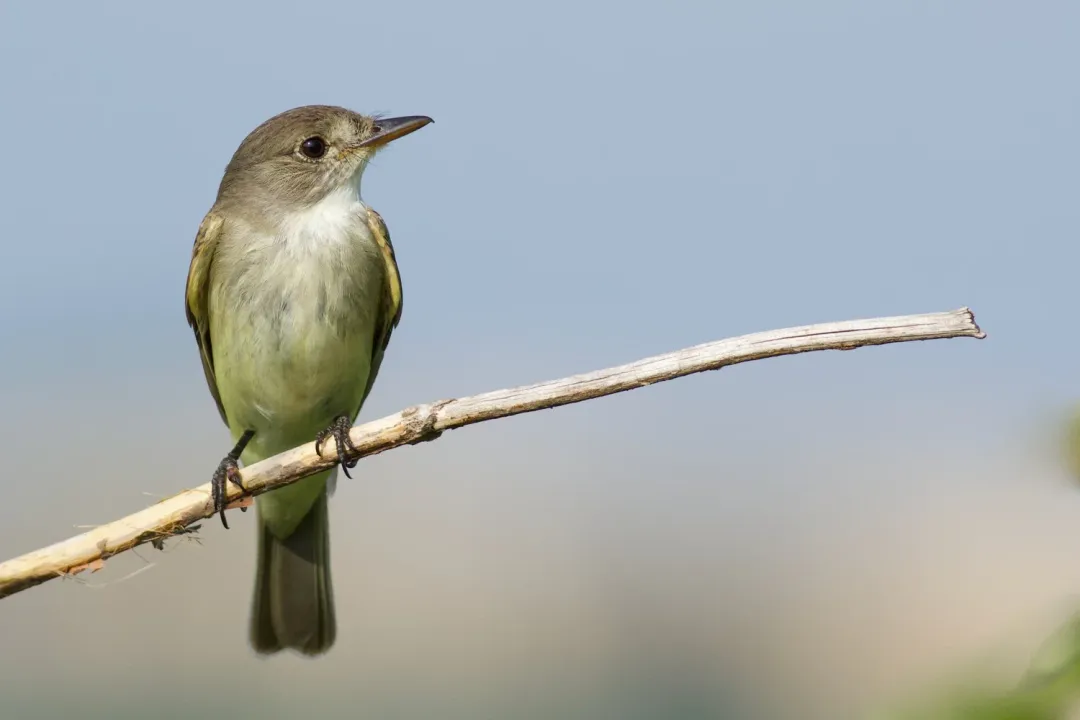
The Willow Flycatcher, Empidonax traillii, presents a visual study in subtlety, earning its reputation as one of the "infamous Empidonax flycatchers". These small, slender, insect-eating migrants are generally described as drab, brownish-olive birds whose presence is most reliably announced by their distinct, sneezy song, often rendered as fitz-bew. Because they look so similar to the Alder Flycatcher—so much so that they were once considered the same species, Traill's Flycatcher, until 1973—a deep dive into their specific physical markers is essential for observers who lack the benefit of a clear song recording.
# Size Metrics
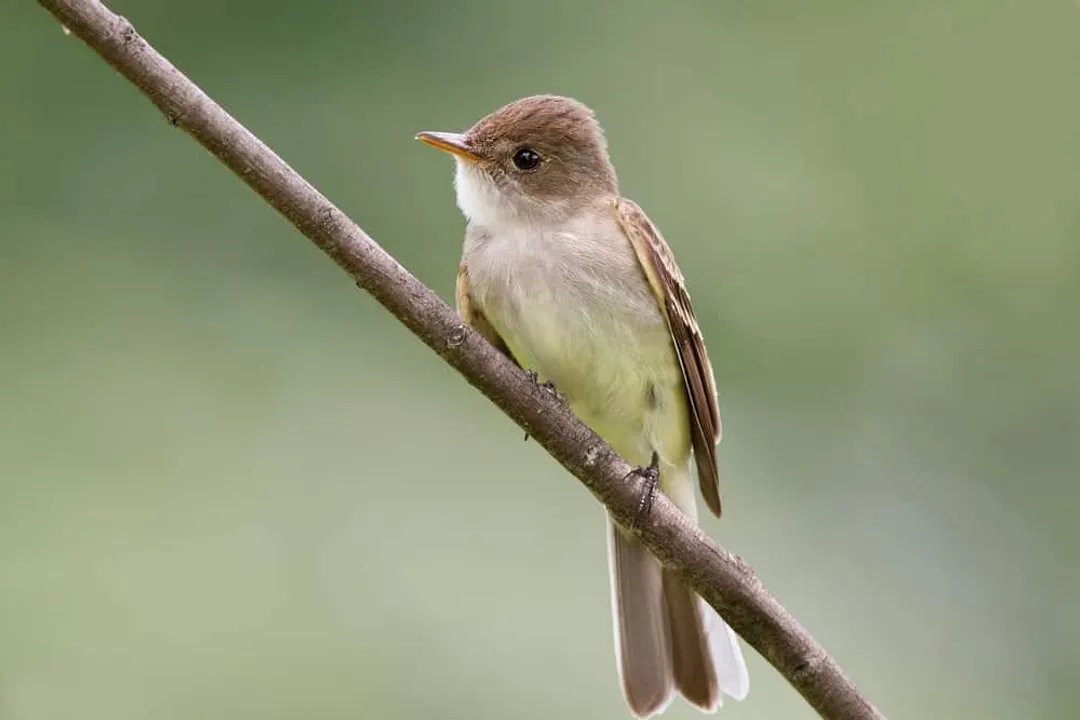
Despite their small stature, Willow Flycatchers rank among the larger members of the Empidonax genus. An adult bird typically measures between 13.3 and 17.0 cm in length, or about 5.2 to 6 inches, tail included. Their weight is slight, ranging from approximately 11.3 to 16.4 grams, or 0.40 to 0.58 ounces. The wings are fairly long, and they possess a tail that is described as long and thin.
For those with the rare opportunity to examine a specimen or bird in the hand, precise measurements offer the best chance of distinguishing this species from its closest look-alike, the Alder Flycatcher. As detailed in thorough ornithological accounts, there are slight, measurable differences between the sexes, though they are visually alike in the field. For instance, breeding males generally exhibit slightly longer wings and tails, along with longer and narrower bills than females. Taking data from a southern Michigan study, the average wing chord for males was around 70.55 mm, compared to 67.01 mm for females; tail lengths were 59.01 mm for males versus 52.27 mm for females. Even when utilizing such detailed measurements in combination with length ratios derived from complex formulae developed by researchers like Stein and Pyle, experts advise applying a buffer zone, acknowledging that a small percentage of individuals will defy definitive identification based on morphology alone. This inability to precisely separate the two species without auditory cues underscores why the song remains the primary field identifier for these Empidonax relatives.
# Plumage Tones
The overall impression of the Willow Flycatcher is one of muted, earthy tones, designed to blend into dense shrubbery. The upperparts, including the back and crown, are generally described as brownish-olive or gray-green. The crown often appears slightly darker due to dusky centers on the coronal feathers.
Moving to the underparts, the throat is distinctly white or whitish-gray. This contrasts with the breast, which is described as a diffuse, dull olive or olive-gray band. The lower belly often carries a slight yellowish wash. The wings and tail are darker than the back, featuring a pattern of dark feathers contrasted by light streakings. When the bird is freshly arrived in its breeding grounds, the wing-bars are more conspicuous, often showing slightly buffy tips, while older, worn plumage appears duller. For an observer used to spotting brighter species, the flycatcher’s appearance necessitates careful study of these faint contrasts.

# Key Features
Two characters, the wingbars and the eye-ring, are critical in the Empidonax identification puzzle, though in the Willow Flycatcher, they are often underwhelming. The species possesses two white wingbars across the upper wing coverts. These bars are formed where the pale tips of the median and greater wing-coverts meet the darker background feathers. They are considered conspicuous in fresh plumage.
Equally important, but often confusingly faint, is the eye-ring. While many similar Empidonax species show a prominent pale eye-ring, the Willow Flycatcher typically exhibits an indistinct, weak, or sometimes entirely lacking whitish eye-ring. This lack of a strong ring helps differentiate it from species like the Acadian Flycatcher, which possesses a pale yellowish eye-ring.
It is important to note that the visibility of these subtle features is highly dependent on the season. Field guides often describe the appearance of birds in fresh plumage—the condition birds possess shortly after molt—but many birders encounter them in the field after they have completed much of their breeding season wear. A field observation in late June or July will likely show duller wing-bars and an even less noticeable eye-ring than one described for a newly arrived spring migrant. Recognizing this seasonal variation—how quickly that fresh, bright appearance degrades—is a practical piece of experience that separates novices from more seasoned observers when trying to key out silent flycatchers.
# Bill Detail
The structure and coloration of the bill are key distinguishing traits that often override the confusing body plumage. The Willow Flycatcher has a bill that is wide and moderately long compared to other small Empidonax species.
Coloration is quite specific: the upper mandible (maxilla) is dark, dusky brown to blackish. In contrast, the lower mandible (mandible) is pale, ranging from yellowish-orange or pinkish to brownish-white. This combination of a dark top and a pale bottom is a significant field mark. The contrast between the dark upper bill and the pale lower bill is usually quite clear, provided the bird is perched in good light.
# Subspecies Shift
The general physical description covers the entire species, Empidonax traillii, which is split into several subspecies, with E. t. extimus being the federally endangered Southwestern Willow Flycatcher. While the song is the best tool for subspecific separation, plumage does show some geographic patterning.
In general, there is a trend where western subspecies tend to be paler with darker crowns and browner backs when compared to the eastern nominate subspecies, E. t. traillii. The endangered E. t. extimus, breeding in the arid Southwest, is noted as being particularly paler on the back and especially on the head compared to other western subspecies like E. t. adastus or E. t. brewsteri. Furthermore, the breast-band tends to be less distinct and paler gray in E. t. extimus than in its relatives. Conversely, the eastern forms often show brighter, whiter, or even lemon-yellow edging on the tertials and wing-feathers, contrasting sharply with the darker background.
# Molt Stages
Appearance is not static throughout the year, and distinguishing adults from immatures, particularly during migration, relies on understanding the molting cycle, which can differ between western and eastern populations.
Juvenile birds, in their Juvenal Plumage, look similar to adults but possess duller upperparts with a brownish wash. Their wingbars are distinctly buffy brownish, which helps distinguish them from adults wearing fresh Definitive Alternate Plumage. Adults in fresh breeding plumage have wing-bars that are pale olive or pale buffy grayish-brown. When a young bird is freshly fledged, these juvenile feather edgings appear somewhat duller and less contrasting than the brighter edgings on the flight feathers of an adult that has recently completed its prealternate molt.
The post-juvenal molt (Prebasic I) happens late, often during fall migration, meaning many young birds appear similar to their juvenile look through much of the fall travel before attaining their first Basic Plumage. This means a flycatcher seen in September migration might appear subtly different—perhaps browner and duller overall—than the bright, sharply marked bird seen in May on its breeding grounds.

# Bare Parts Coloration
Beyond the feathering, the bare parts provide distinct, albeit static, clues. The iris is consistently brown. The legs and feet are dark, described as dusky brown to blackish. As previously discussed, the bill shows the marked sexual dimorphism in coloration, with the upper bill dark and the lower bill pale. The inside of the mouth, or gape, is typically described as bright orangish or orange-yellow.
It is helpful to remember that for the Willow Flycatcher, identifying physical characteristics is a process of elimination, comparison, and recognizing subtle cues, which is why these birds are often best observed when they are actively singing—a physical behavior that, when paired with their visual traits, leads to a confident identification.
Related Questions
#Citations
Willow Flycatcher Overview, All About Birds, Cornell Lab of ...
Southwestern Willow Flycatcher (Empidonax traillii extimus)
Willow Flycatcher Bird Facts - Empidonax traillii - A-Z Animals
Empidonax traillii (willow flycatcher) - Animal Diversity Web
Willow flycatcher | Oregon Department of Fish & Wildlife
Southwestern Willow Flycatcher | Working Lands For Wildlife
Willow Flycatcher - Southern Wisconsin Bird Alliance
Willow flycatcher - Wikipedia
[PDF] INTRODUCTION - RiversEdge West