White-Eyed Vireo Scientific Classification

The placement of any organism within the Linnaean system offers a precise map of its evolutionary history and biological relationships, and the White-eyed Vireo (Vireo griseus) is no exception. Delving into its scientific classification reveals not just its formal name, but its deep connections to other songbirds, spanning from the broadest domain down to the specific characteristics that define its species. [7] The scientific name itself, Vireo griseus, is a clear identifier, with Vireo denoting the genus and griseus indicating the species epithet, which speaks to its grayish appearance. [4][5]
# Hierarchical Structure

The taxonomic path for the White-eyed Vireo establishes its position within the vast tree of life. It falls under the Kingdom Animalia, meaning it is a multicellular, eukaryotic organism that obtains sustenance by consuming other organisms. [9] Following this broad categorization, it belongs to the Phylum Chordata, characterized by having a notochord at some stage of development, and the Class Aves, the group encompassing all birds. [9] The journey continues through the Order Passeriformes, which represents the perching birds, the largest order of birds, containing more than half of all bird species globally. [1][2]
The family placement is crucial for understanding its immediate relatives. The White-eyed Vireo is classified within the family Vireonidae, the vireos. [2][7] This family is relatively small compared to some others in the Passeriformes order, distinguishing these birds by specific morphological and behavioral traits. [7]
A comparison across taxonomic databases shows essential agreement on the higher ranks. For instance, the Integrated Taxonomic Information System (ITIS) confirms its status with a unique Taxonomic Serial Number (TSN) of 178991. [8] Meanwhile, the Avibase registry confirms the classification through the order, family, and genus structure. [2]
Here is a summary of the generally accepted higher classification ranks:
| Rank | Classification |
|---|---|
| Kingdom | Animalia |
| Phylum | Chordata |
| Class | Aves |
| Order | Passeriformes |
| Family | Vireonidae |
| Genus | Vireo |
| Species | V. griseus |
# Genus Placement

The genus Vireo groups together over 40 species of New World insectivorous songbirds. [7] Birds belonging to Vireo are generally small to medium-sized, often exhibiting a stout bill and a slightly hooked tip, features typical of birds that glean insects from foliage. [1] They are known for their somewhat sluggish or deliberate movements compared to the quickness associated with warblers, a distinction that birders often notice when observing them in dense cover. [3]
When considering the White-eyed Vireo within Vireo, it shares the family's general characteristics, but its specific appearance sets it apart from others in the genus, particularly in North America. For instance, while many vireos possess distinct wing bars or spectacles (eye-rings), the Vireo griseus's defining characteristic, the bright white iris in adults, serves as a key field mark to differentiate it from congeners like the Yellow-throated Vireo (Vireo flavifrons) or the Blue-headed Vireo (Vireo solitarius). [1] This prominent white eye is a striking morphological trait that has cemented its common name and likely influenced the griseus species epithet, even though its overall plumage is predominantly olive-green and gray. [5]
An interesting point of classification insight is observing how frequently the common name references a single color or feature, even when the broader classification suggests a different dominant tone. While its species epithet griseus points to grayness, the common name highlights the eye. For a field observer, recognizing that many Vireo species share a generally greenish or grayish cast helps anchor the bird in the correct family, while the eye color becomes the final tool for species confirmation. [1][3]

# Species Designation
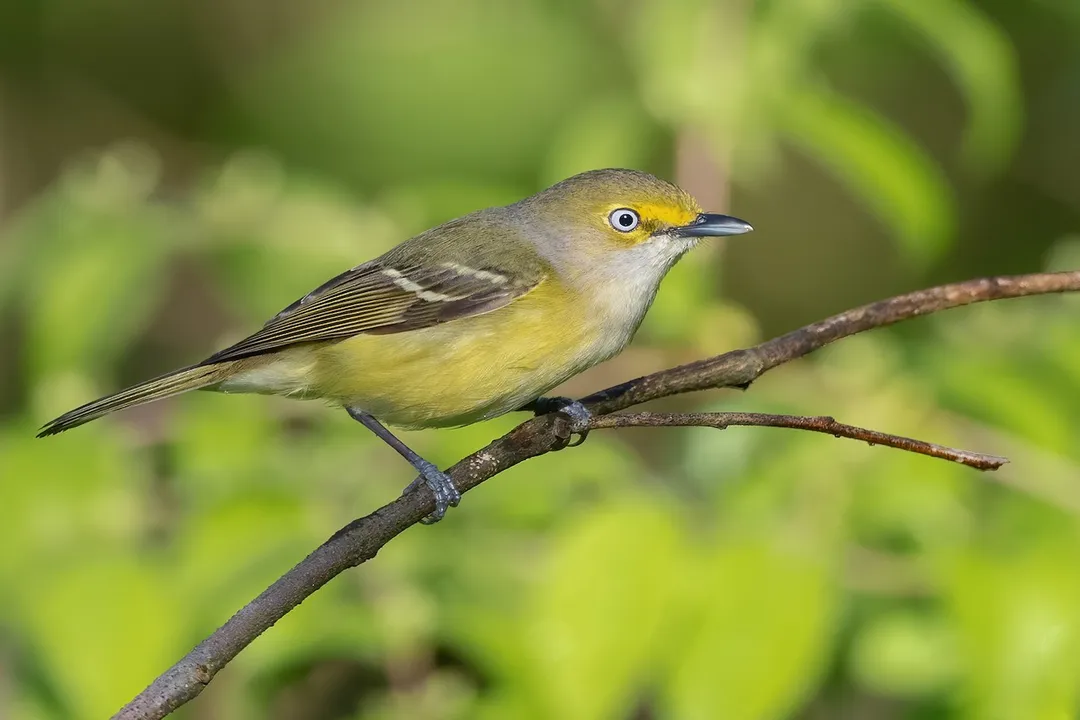
The full binomial nomenclature, Vireo griseus, locks in the identity of this particular bird. [8] Its current status is recognized as a distinct species, though scientists continue to examine the nuances of its population structure. Historical or ongoing taxonomic work, often detailed in comprehensive resources like Birds of the World, may address subspecies variations that reflect minor geographic differences across its range. [7]
The scientific literature notes that Vireo griseus populations are sometimes divided into subspecies based on characteristics such as size or the intensity of plumage coloration, which often correlates with latitude or specific geographic barriers. [7] For example, subtle variations in the extent of gray on the head or the depth of the olive wash on the back might lead to the recognition of different races across its breeding distribution, which stretches from the southeastern United States up through the Mid-Atlantic states and into Mexico. [1][6] These subspecies classifications represent fine-scale attempts to catalog the genetic drift and local adaptation within the species boundary.
The Avibase record, for instance, often lists recognized subspecies. While the general species is Vireo griseus, one might see designations like Vireo griseus griseus for the most common North American form, or other trinomials applying to Mexican or island populations if they are recognized by that authority. [2] This practice of using trinomial nomenclature highlights a secondary level of classification nested just under the species level.
# Systematic View
Systematics delves into the evolutionary history and relatedness, moving beyond the standard Linnaean ranks to investigate phylogeny. The evolutionary relationship of the White-eyed Vireo is explored by comparing its genetic makeup and derived physical traits against other vireos. [7] Researchers examining the phylogeny of the Vireonidae family seek to determine which species branched off earliest and which represent more recent speciation events.
The Birds of the World resource, which synthesizes current ornithological consensus on systematics, confirms that Vireo griseus is firmly situated within the Vireo genus. [7] A key aspect of understanding its systematic position involves its vocalizations, as song complexity and structure are often used in conjunction with molecular data to define species boundaries within closely related bird groups. The White-eyed Vireo is known for its varied and often rambling song, a trait shared, though expressed differently, across many members of the genus. [1]
An analytic takeaway for those interested in conservation and systematics is recognizing that subspecies status, when recognized, can influence management decisions. If a particular peripheral subspecies is genetically distinct and isolated—perhaps one found only on a specific island in the Gulf of Mexico—its classification as a separate evolutionary unit suggests it might require targeted conservation efforts distinct from the widespread mainland population. Understanding the formal classification, down to the subspecies level, is the first step in population management. [6][7]

# Data Consistency Examination
Scientific classification is a dynamic process, even when a species name has been established for a long time. Different authoritative bodies might maintain slightly different taxonomic treatments, especially regarding subspecies or synonymy (older, discarded names). For the White-eyed Vireo, this often means checking how various global repositories treat the names associated with Vireo griseus.
For instance, while ITIS provides the stable TSN for Vireo griseus, [8] Avibase might list synonyms or historical names that have been applied to the bird over time, such as Vireo noveboracensis or Vireo albicollis being historically used, though the consensus today strongly favors Vireo griseus for the North American form. [2] A review of the A-Z Animals account mentions the name Vireo griseus directly, reinforcing current usage. [5]
This slight variation in database emphasis underscores a subtle but important reality in ornithology: the "official" classification can depend on which international standard is being referenced at a given moment. Birders and researchers operating regionally might use a classification standard favored by a local bird society, while someone conducting international range mapping relies on an international standard like that used by ITIS or Avibase. [2][8] The most stable anchor point remains the specific binomial Vireo griseus, confirmed by multiple high-authority sources. [1][4][8]
# Identification Clues
Although classification is about relationship, the defining characteristics used to assign the bird to its classification group are essential. The White-eyed Vireo is readily identifiable by its distinct bright white iris in adults, which contrasts sharply with the typically brownish or reddish irises found in many other vireos. [1][4] The body plumage is generally an olive-green or olive-gray, providing camouflage within the dense, often thorny, thickets it prefers. [3][6]
Key physical markers that confirm its species status within the Vireo genus include:
- Spectacles: Yellowish spectacles (a ring around the eye, though less pronounced than in some relatives). [1]
- Wing Bars: Two prominent, yellowish-white wing bars. [5]
- Underside: The breast and flanks are pale gray or whitish, often washed with yellow near the sides. [1]
These features are the phenotype resulting from the genetic blueprint defined by its classification. An experienced observer can often place a bird into the Vireo genus simply by its behavior—its deliberate, methodical search pattern through dense shrubbery—before confirming the species via the iconic white eye. [3] This behavioral consistency across the genus is one of the unwritten rules that classification systems attempt to formalize.

# Range and Distribution Context
The geographic range of a species often provides context for its systematic placement, especially when considering subspecies divergence. The breeding range of Vireo griseus primarily covers the eastern and southeastern United States, extending south into northeastern Mexico. [1][6] This distribution is key because it separates it evolutionarily from many other Vireo species found exclusively in Central or South America, reinforcing its position as a distinct New World Vireo within its defined genus. [7] Its migration pattern, moving south to wintering grounds in the southeastern US, Central America, and the Caribbean, shows its adaptation to predictable seasonal resource availability across this broad area. [4]
The classification process acknowledges this distribution. The fact that the species maintains a relatively continuous distribution across the southeastern US but shows variation in the Caribbean or Mexican populations suggests where future taxonomic refinement might occur if geographic isolation proves strong enough to create genetically distinct populations worthy of subspecific recognition. [6][7]
Related Questions
#Citations
White-eyed Vireo Overview, All About Birds, Cornell Lab of Ornithology
Vireo griseus (White-eyed Vireo) - Avibase
white-eyed vireo - Illinois Department of Natural Resources
White-eyed vireo - National Zoo
White-Eyed Vireo Bird Facts - Vireo griseus - A-Z Animals
WHITE-EYED VIREO | The Texas Breeding Bird Atlas
Systematics - White-eyed Vireo - Vireo griseus - Birds of the World
ITIS - Report: Vireo griseus - Integrated Taxonomic Information System
Vireo griseus (white-eyed vireo) - Animal Diversity Web