White-Eyed Vireo Physical Characteristics
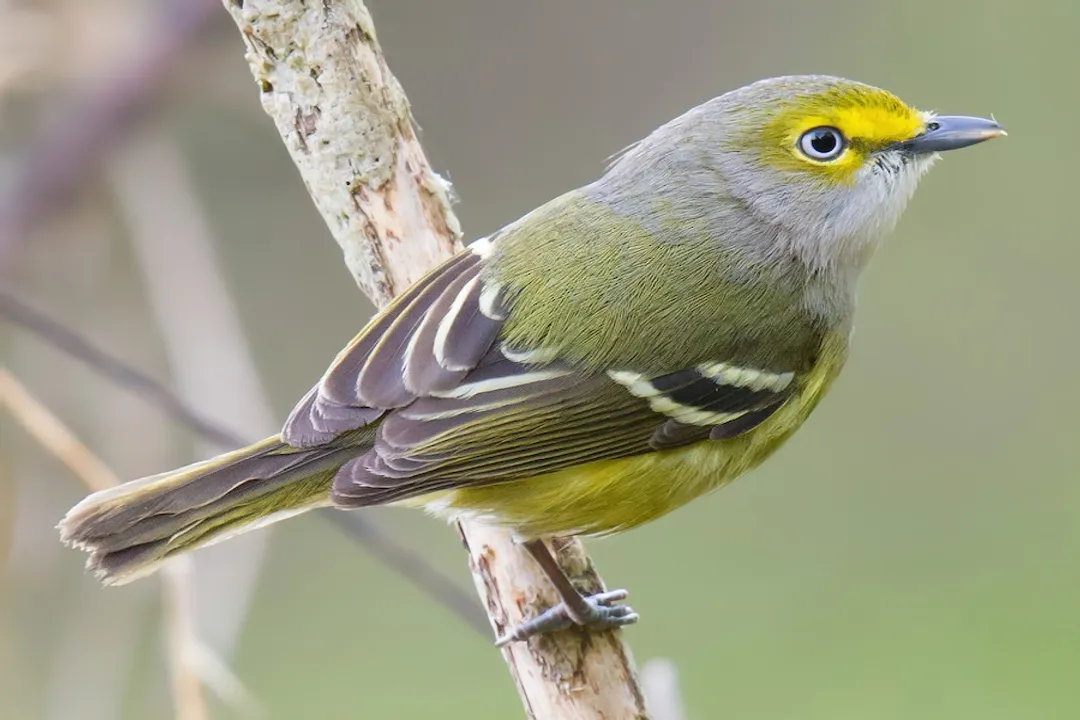
The White-eyed Vireo, a subtle yet strikingly marked songbird of eastern North America’s dense thickets, offers a fascinating study in avian identification, particularly due to the very feature that grants it its common name. While often overlooked due to its skulking nature and preference for dense understory, a careful look reveals a bird painted in contrasting shades of olive, yellow, and white, all centered around one unmistakable feature.
# The Eye
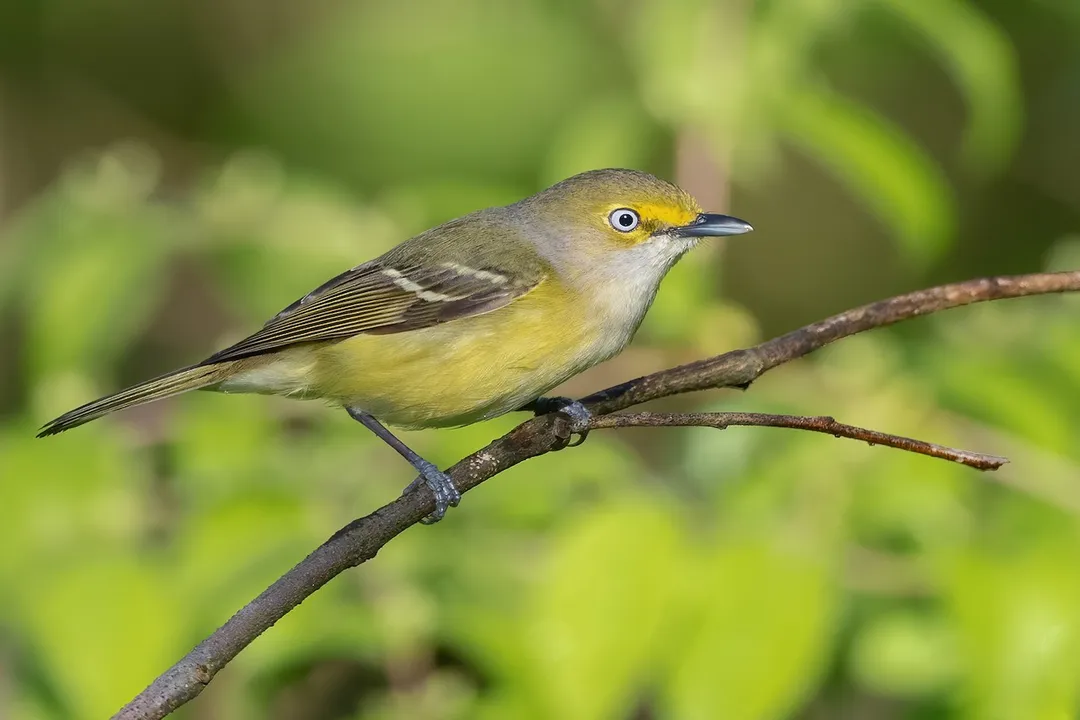
The adult White-eyed Vireo is instantly recognizable, provided one can catch a clear glimpse of its most defining characteristic: the iris. For mature individuals, this ring of tissue surrounding the pupil is a brilliant, stark white, creating an almost unnerving or ghost-like stare against the dark surrounding feathers. This feature contrasts sharply with many other vireos, which typically sport brown or gray irises, making the eye color a reliable field mark when observed closely.
However, this signature white eye is not present throughout the bird's life cycle. Distinguishing age is critical when spotting this species, as the eyes of younger birds tell a different story. Newly fledged and juvenile White-eyed Vireos possess dusky or grayish-brown eyes. As they transition into their first winter and subsequent breeding season, the iris gradually lightens, moving through various shades of grayish-brown or pale gray before fully attaining that pure, crystalline white seen in older adults. A birder spotting a bird with pale gray eyes in the spring or early summer might be looking at a first-year bird that hasn't quite completed its maturation of eye color.
# Head Details

Beyond the eye itself, the head pattern adds necessary context to this small bird's overall appearance. Encircling the bright white iris, or the dusky iris of a juvenile, is a prominent band of bright yellow feathers, often described as spectacles. This yellow spectacle is quite broad and helps frame the eye area, contrasting nicely with the darker feathers of the crown and the slightly darker line running from the bill through the eye, known as the lores.
The crown and nape generally present a dull, somewhat grayish-olive color. This slightly muted head tone helps keep the focus on the bright eye and the yellow spectacles. The bill itself is a typical vireo bill—stout, relatively short, and slightly hooked at the tip, ideal for picking insects from foliage. The bill color is usually dark or blackish on the upper mandible, with the lower mandible often appearing paler. The legs and feet are generally described as grayish or sometimes having a faint pinkish or pale horn tint.

# Body Plumage
The dorsal side of the White-eyed Vireo is dominated by an olive-green hue. This coloration provides excellent camouflage within the leafy canopy and shrubbery where the species prefers to forage. This olive tone extends across the back, rump, and upper tail coverts.
In contrast to the darker upperparts, the underside is significantly paler. The throat and chest are typically pale grayish-white or nearly white. This whiteness often transitions into a faint but noticeable yellowish wash or staining along the flanks and undertail coverts. It is this combination—olive back, white belly, and yellow sides—that solidifies the identification when the head features are obscured.
It is interesting to note the subtle sexual dimorphism, or rather, the lack thereof. In most plumage descriptions, adult males and females look virtually identical. This contrasts with many other bird species where clear color differences exist between sexes, meaning that physical characteristics alone rarely allow a birder in the field to determine gender.
# Wing and Tail Structure
The wings contribute two distinct markers to the bird's profile. They display two prominent white wing bars formed by the tips of the greater and median coverts. These bars stand out against the generally darker olive feathers of the wing surface. The primaries and secondaries show darker centers with paler, yellowish or whitish edges, especially visible in fresh plumage.
The tail is relatively short compared to some other warblers or vireos, and like the wings, the feathers are dark with pale edging. The overall impression is one of compactness; the bird is built for maneuvering through dense tangles rather than long, open flights.
For those tracking the subtle variances across its range, the intensity of the yellow wash on the flanks can sometimes be a point of comparison between subspecies, though this is often too subtle for general field identification. A careful observer might note that birds breeding further north, or those observed during migration outside the core breeding range, might exhibit slightly less intense coloring than the deeply colored residents of the deep south, where the yellow saturation seems highest. This geographic variation in intensity is a subtle physical trait tied to geography.
# Size and Stature
The White-eyed Vireo is a small passerine, occupying a size niche often comparable to kinglets or small New World warblers. Standard measurements place its length between about 4.5 to 5 inches from bill tip to tail tip. Its weight is similarly small, usually falling in the range of 10 to 14 grams.
This small stature contributes to its often-elusive behavior. When perched, the bird appears somewhat stocky or chunky for its size, often holding its head low as it peers into the foliage. When viewed head-on, the combination of the broad yellow spectacles and the piercing white eye creates a distinct, wide-eyed appearance that aids in separating it from similar-sized warblers that might lack such bold facial markings.
A comparative table can help place the White-eyed Vireo in context with a few other small songbirds it might be confused with, focusing on the key physical differentiators:
| Feature | White-eyed Vireo | Yellow-throated Vireo | Blue-headed Vireo | Ruby-crowned Kinglet |
|---|---|---|---|---|
| Iris Color (Adult) | White | Yellow | Dark Gray/Brown | Dark |
| Wing Bars | Two White | Two Yellow | Two White/Pale | Two Pale/White |
| Spectacles | Prominent Yellow | Strong Yellow | White/Pale Blue | Eye Ring (often broken) |
| Flank Color | Yellow Wash | Rich Yellow Breast | White/Gray | Grayish/Dull |
# Plumage Maturity
Understanding the progression of plumage through the first year is essential for accurate identification, especially during the spring migration when first-year birds are present alongside fully adult birds. The difference between a fresh juvenile and a seasoned adult is perhaps the most dramatic physical shift the species undergoes.
Juveniles in their first summer are characterized by duller overall coloration. The olive green on the back is less vibrant, and the yellow on the flanks is weaker or altogether absent. Crucially, as mentioned earlier, their eyes are dusky, and the spectacles are less distinct, blending more subtly with the surrounding feathers.
First-year birds, which survive their first fall and winter, will molt into a first basic plumage before spring. While these birds generally resemble adults, they might still retain some characteristics of immaturity. Their plumage might be slightly duller than a definitive adult's, and critically, the white in the iris may not be fully developed, appearing hazy or partially obscured by gray or dusky feathering at the edges. This transition period in the second calendar year is where subtle features matter most: look for the intensity of the olive, the richness of the yellow wash, and the purity of the white eye. If the eye is clearly white but the flanks seem pale, you are likely looking at a bird in its second summer that has achieved reproductive maturity but perhaps not the peak dullness-free plumage of an older individual.
This reliance on eye color for age determination emphasizes why light quality matters immensely when observing this species. A bird foraging deep in shadow, even if an adult, could easily be misidentified as a juvenile if the distinctive white iris is not caught in a direct beam of sunlight. Therefore, when trying to confirm an identification of a potentially rare vagrant or an early arrival, wait for the bird to move into a sunlit spot, even if it means waiting several minutes for the bird to position itself favorably. This patience regarding lighting can be the difference between a tentative sighting and a confident identification based on the bird's most reliable marker.
# Field Observation Tips
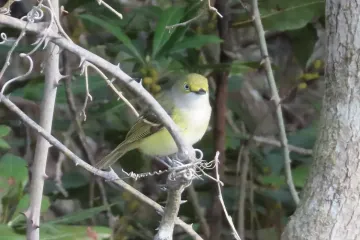
While the physical description is precise, the way the bird presents these features in the field is part of its physical characterization. The White-eyed Vireo is notoriously secretive, preferring low, dense shrubs, vine tangles, and thickets—often thorny ones—which naturally obscure clear views of its plumage. They frequently forage by hopping or creeping along branches and vines, often hanging upside down or leaning awkwardly to inspect leaves, similar to a titmouse or chickadee, which is somewhat atypical for a vireo known for more deliberate leaf-flipping. This energetic, often obscured movement means that identification often relies on catching a fleeting glimpse of the yellow spectacles or hearing its loud, complex song before the bird disappears back into the protective vegetation. The physical structure—compact, short-tailed, and marked by those high-contrast facial features—must be registered rapidly when the opportunity arises.
Related Questions
#Citations
White-eyed Vireo Identification - All About Birds
White-eyed Vireo | Audubon Field Guide
[PDF] White-eyed Vireo (Vireo griseus) - Texas Master Naturalist
White-eyed Vireo Vireo griseus - eBird
Vireo griseus (white-eyed vireo) - Animal Diversity Web
Plumages, Molts, and Structure - White-eyed Vireo - Birds of the World
White-eyed vireo vs red-eyed vireo side-by-side comparison
white-eyed vireo - Illinois Department of Natural Resources