White-Crowned Sparrow Scientific Classification
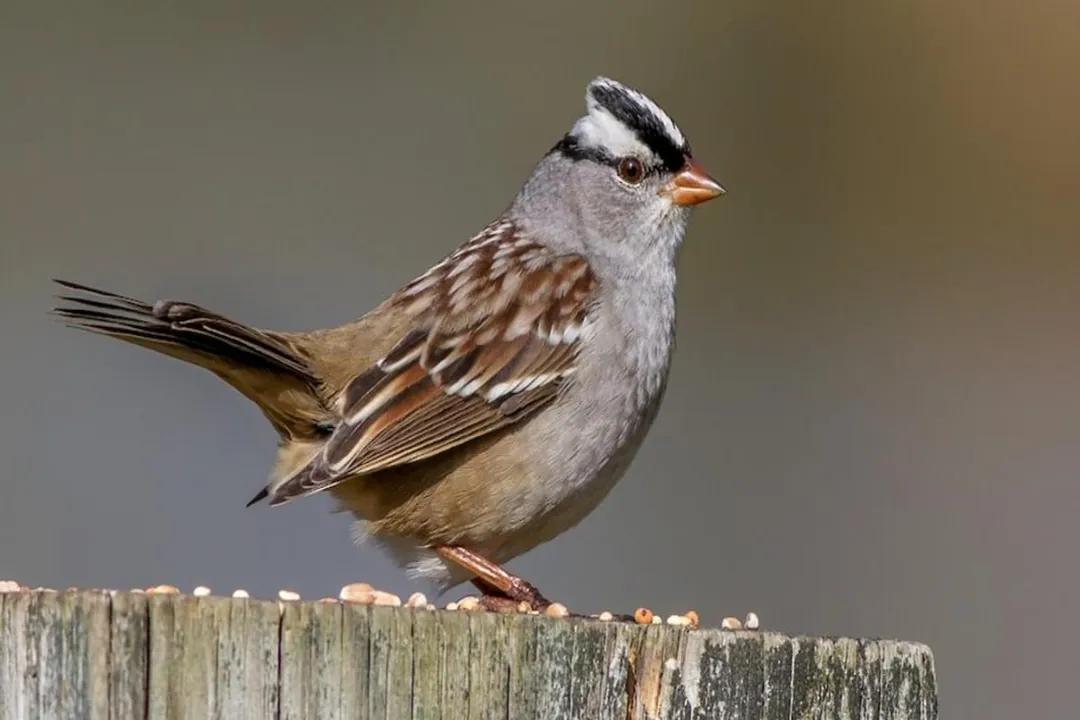
The White-crowned Sparrow, a familiar sight across much of North America, presents a classic example of how biologists organize the sprawling diversity of life into a logical structure. While we recognize it readily by the bold, contrasting stripes crowning its head—a feature that gives it its common name—its scientific classification reveals a precise placement within the massive avian family tree. [1][4][8] Understanding this hierarchy, from the broadest category down to the specific species, tells a much richer story than a simple field guide entry ever could.
# Kingdom Life
At the most general level, the White-crowned Sparrow belongs to the Kingdom Animalia. [2][3][7] This broad grouping simply confirms that the organism is a multicellular, eukaryotic organism that obtains its energy by consuming other organisms, placing it squarely in the realm of animals. [7] Within this kingdom, it belongs to the Phylum Chordata. [2][3][7] This phylum designation signifies the presence of a notochord at some point in its development, a characteristic shared with all vertebrates, including fish, reptiles, and mammals. [7]
# Class Aves
The next step down places the bird into the Class Aves. [2][3][7] This classification separates it from other chordates, such as amphibians or reptiles, by defining it as a warm-blooded vertebrate characterized by feathers, a beak with no teeth, the laying of hard-shelled eggs, and a highly efficient respiratory system—features essential for the demands of flight and high metabolism common to most birds. [7]

# Order Passerines
The Order Passeriformes is where we begin to see the bird defined by its specific ecological niche and physical structure. [2][7] Birds in this order are often referred to as perching birds or songbirds, representing the largest order of birds, containing more than half of all known avian species. [7] The defining characteristic for inclusion here is the unique arrangement of the foot: three toes point forward and one points backward, an adaptation perfectly suited for securely grasping branches, wires, or reeds. [7] This order includes everything from tiny warblers to large crows, indicating that while the White-crowned Sparrow shares the basic foot structure with a robin, it is still quite distinct in other ways. It is worth noting that within this massive order, the subsequent family placement truly narrows down its identity among the smaller songbirds.
# Family Sparrows
The classification within the family level has seen refinement over the years, reflecting deeper understanding gained through genetic research. Historically, many New World sparrows, including this species, were often grouped under the family Emberizidae, which also contains the Old World buntings. [4] However, modern taxonomy frequently places the North American sparrows into their own distinct family, Passerellidae. [9] This family is comprised solely of the New World sparrows and allies. [9] Placing the White-crowned Sparrow here confirms its close evolutionary relationship with species like Song Sparrows or Chipping Sparrows, differentiating it from true Old World sparrows (like the House Sparrow, which belongs to the family Passeridae). [9] If you observe a group of small, brown, streaky birds foraging on the ground in a North American winter field, you are likely looking at several members of the Passerellidae family sharing a similar foraging strategy, even if their songs and breeding patterns differ significantly.

# Genus Grouping
Moving into the Genus level, the White-crowned Sparrow falls into Zonotrichia. [2][3][5][6][7] This grouping is significant because it unites several closely related, relatively large sparrows known for their conspicuous head patterns, often featuring white crowns. [5] Members of Zonotrichia, sometimes called "crowned sparrows," are generally distinguished by this prominent head striping and often possess fairly complex songs. [5] This genus includes other familiar species such as the White-throated Sparrow (Zonotrichia albicollis). [5] The shared genus highlights a strong, recent common ancestor that established the template for this particular group of North American songbirds.
# Species Definition
The full binomial nomenclature is Zonotrichia leucophrys. [2][3][5][6][7] This scientific name serves as a universal identifier, preventing confusion that arises from regional common names that vary from state to state or country to country. Breaking down this name offers direct insight into the bird's appearance: Zonotrichia is derived from Greek roots meaning "striped bird," and leucophrys combines Greek words for "white" (leukos) and "eyebrow" (ophrys), though it more accurately describes the striking white crown stripes that are the bird's trademark. [1] It is interesting to note how the scientific name, rather than relying on a broad description like "sparrow," uses specific visual markers derived from careful field observation, making the name itself a precise diagnostic tool for those fluent in the nomenclature. [1]
# Subspecies Variation
The species Z. leucophrys is further divided into several recognized subspecies, typically five, which reflect geographic isolation and local adaptation across its wide range. [2] For instance, the subspecies breeding in the far north and wintering across the central and eastern United States (Z. l. gambelii), often called Gambel's White-crowned Sparrow, generally shows slightly different plumage characteristics or size compared to the populations found along the Pacific coast (Z. l. nuttalli), which tend to be non-migratory or short-distance migrants. [2] The existence of these subspecies within the single leucophrys species shows the raw material of evolution in action; populations adapting to local conditions—such as specific winter food availability or slightly different migratory navigation cues—can diverge subtly over time while remaining recognizable as the same species because they can still interbreed successfully if their ranges overlap. This subtle tension between local specialization (subspecies) and shared identity (species) is a key concept in understanding biological diversity that extends down to the smallest scale of classification.

# Conservation Status
While the scientific classification focuses on relationships, its global status speaks to its success as a species. The White-crowned Sparrow is considered globally secure, currently ranked as G5 by NatureServe, which indicates a species that is common, widespread, and not at immediate risk. [3] This robust status across its varied breeding habitats, which include shrubby areas, open woodlands, and suburban settings, underscores the effectiveness of its evolutionary blueprint as defined by its classification within the successful Passerellidae family and the adaptable Zonotrichia genus. It is a bird that has found a way to thrive across many different ecological challenges presented by the North American continent. [4][8]
Related Questions
#Citations
White-crowned Sparrow - Zonotrichia leucophrys - NatureWorks
White-crowned Sparrow - All About Birds
Zonotrichia leucophrys - NatureServe Explorer
White-crowned Sparrow - Montana Field Guide
Zonotrichia leucophrys (White-crowned Sparrow) | Idaho Fish and ...
Zonotrichia leucophrys (white-crowned sparrow) | INFORMATION
WHITE-CROWNED SPARROW - Birds of Nebraska – Online
white-crowned sparrow - Illinois Department of Natural Resources
Zonotrichia leucophrys (White-crowned Sparrow) - Avibase