What is the physical appearance of a pygmy marmoset?
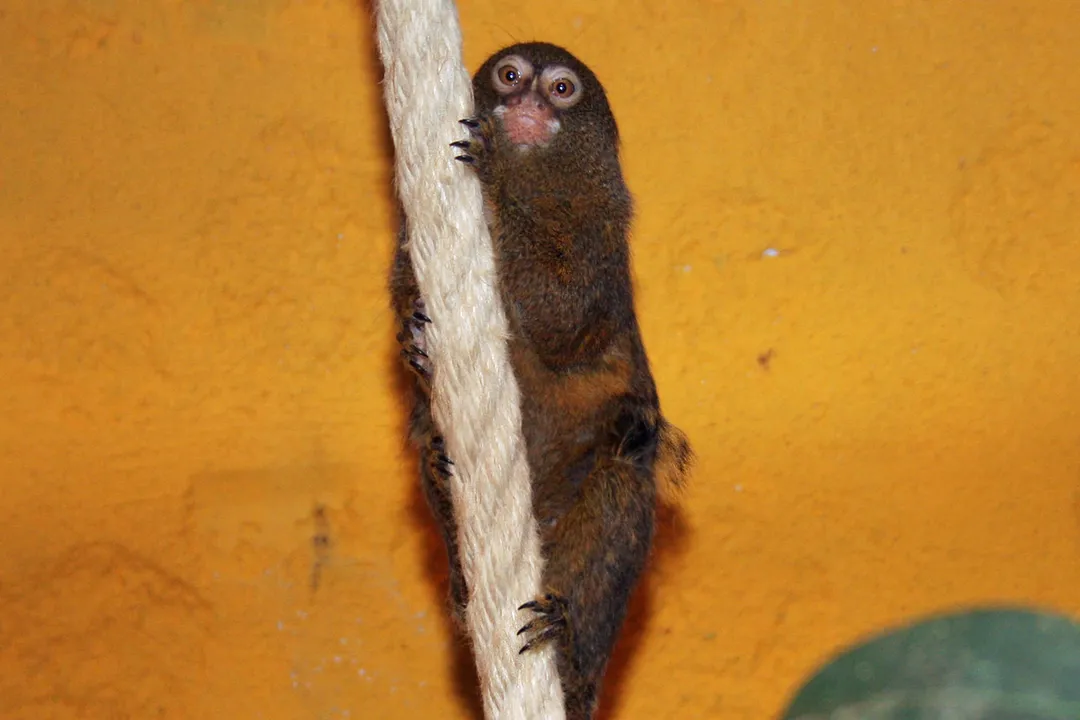
The description of the pygmy marmoset immediately brings to mind something incredibly small, and rightly so; this primate holds the title of the smallest monkey across the entire globe. To truly appreciate their diminutive stature, an adult individual of this species can fit right into the palm of an adult human hand. Their weight is often compared to that of a stick of butter, generally hovering around or just over 100 grams, which translates to about 3.5 ounces. Examining the measurements across different reports shows a consistent theme of tininess: head-and-body length typically ranges from about 117 to 152 millimeters, or between 4.6 and 6.0 inches. Some sources specify this as 12 to 15 centimeters, while others report a range of 4 to 6 inches (10 to 15 cm). It is worth noting that while they are the smallest monkey, they are not the absolute smallest primate; that distinction often falls to creatures like the mouse lemur.
# Tail Proportions
Despite being the smallest monkey, the pygmy marmoset possesses a tail that is surprisingly substantial relative to its frame. This tail is often described as squirrel-like and is notably longer than its body. In terms of length, documented measurements place the tail between 172 and 229 millimeters, or 6.8 to 9.0 inches. For the Eastern subspecies specifically, the tail can be up to 1.5 times the length of its head and body. This long appendage is not prehensile; it cannot be used for grabbing or grasping like the tails of some other primates. Instead, its primary function is to act as a crucial prop, providing balance as the monkey leaps and travels through the complex, three-dimensional architecture of the treetops. Visually, the tail is marked with distinct black rings or bands running down its length.
# Fur and Coloring
The overall fur coat provides excellent camouflage within their forested habitat. The general color scheme is a blend of brown, grey, and black across the back and head. Each individual hair is often striped with brown and black, a pattern known as agouti coloring. While both male and female pygmy marmosets share this basic coloration, they are generally described as orange-brown. The underparts, including the arms and legs, tend toward a lighter shade, often described as whiteish or orange/whitish.
There is an interesting distinction when comparing the two recognized species. While they share many features, the Eastern pygmy marmoset (Cebuella niveiventris) is noted for possessing a coat that is comparatively more white or pale.

# Head and Facial Features
One of the most distinguishing physical attributes, which grants them the nickname “lion monkey,” is the presence of longer hairs around the face and neck, forming what looks like a lion’s mane. The ears are often hidden within this mane. Further enhancing their expressive faces are specific white markings: flecks of white are present on the cheeks, and there is a distinct white vertical stripe running down the center of the nose, between the eyes. These facial markings, along with their ability to move facial features, aid in visual communication, allowing them to express emotions like contentment, fear, or surprise.
# Adaptations for Clinging and Movement
Their locomotion in the trees is characterized by incredible agility. They move around on all four limbs, capable of leaping up to 5 meters (about 16 feet) between branches. This movement requires specific physical architecture. Compared to their front limbs, their rear limbs are longer, which aids in their jumping prowess.
Perhaps the most peculiar physical adaptation, essential for their gummivorous lifestyle, relates to their digits. While most primates possess flat nails, or ungulae, the pygmy marmoset has claw-shaped nails called tegulae on most of their fingers and toes. These specialized claws allow them to grip tree trunks and branches vertically with exceptional strength, which is vital when clinging in place to feed. However, there is an exception: the big toenail on each foot remains flat. The ability to rotate their head nearly 180 degrees is another remarkable feature, serving as an effective way to scan their surroundings for potential predators without having to shift their body position.
The physical tools they use for feeding are just as specialized as their climbing aids. To access their preferred diet of tree sap, they possess sharp lower canine teeth, or large, forward-turned lower incisors. They use these teeth in an up-and-down sawing motion to pierce the tree bark and stimulate the flow of sap, which they then lap up with their tongues. Furthermore, their digestive system shows internal specialization for this unique diet, featuring a larger-than-usual cecum to allow the necessary extra time for breaking down the viscous plant exudates in the stomach. This combination—the specialized teeth for drilling, the claws for clinging, and the enlarged cecum for processing—paints a picture of an animal perfectly engineered for its niche as a gummivore.
It’s fascinating to consider how these physical traits interact in their environment. The reliance on claw-like digits for vertical clinging, paired with the ability to rotate the head so dramatically, suggests a highly developed sense of spatial awareness and balance control, essential for a creature that spends its life navigating the vertical and horizontal planes of the mid-canopy and understory without the benefit of a prehensile tail. This contrasts with tree-climbing habits seen in other species; while they resemble squirrels in some behaviors like freezing, their physical mechanism for clinging is far more radical due to the claw-nails.
# Size Variation and Dimorphism
While the title of "smallest monkey" is generally applied, there's slight variation in documented weights and lengths, which might reflect subspecies differences or measurement methods. Birth weights are minuscule, often cited as 13 to 15 grams, or between 0.4 to 0.5 ounces (3 to 15 grams). Newborns are sometimes compared to the size of a human thumb.
Regarding sexual dimorphism—the physical differences between males and females—the general consensus for the species leans towards no significant difference. However, sources detailing the Eastern subspecies suggest a subtle variation in weight, where females are slightly heavier than males. For C. niveiventris, males might weigh between 107–125 grams, while females weigh 126–141 grams.
To summarize the key physical dimensions for easier reference:
| Feature | Measurement Range | Notes |
|---|---|---|
| Adult Weight | 85 to 140 grams (3 to 5 oz) | ~100g (3.5 oz) is often cited as the average |
| Head-Body Length | 11.7 to 15.2 cm (4.6 to 6.0 in) | The smallest monkey |
| Tail Length | 17.2 to 22.9 cm (6.8 to 9.0 in) | Longer than the body; features black rings |
| Gestation Period | 125 to 142 days (approx. 4.5 months) | Birth interval of 5-7 months common |
# Babies vs. Adults
The physical changes from infant to adult are relatively rapid considering their small size. After birth, the babies initially present with gray heads and fur covered with black markings. Within their first month, they begin to develop the characteristic adult patterning. While they are very tiny at birth, often weighing less than 15 grams, they grow quickly enough to be weaned by about three months of age. It takes them approximately two years to reach their full adult size.
The appearance of the pygmy marmoset is intrinsically linked to its behavior and diet. Its entire physical structure—from the specialized gouging teeth and large cecum designed for sap extraction, to the claw-like nails and rotating neck for arboreal survival—demonstrates an extreme physical commitment to a specialized life in the Western Amazon Basin's river-edge and evergreen forests. This level of physical adaptation toward a singular food source in the primate world is quite remarkable, suggesting that mastering the exudate niche provided a significant evolutionary advantage over generalist diets in their specific habitat.
Related Questions
#Citations
Pygmy marmoset - Wikipedia
Pygmy Marmoset | San Diego Zoo Animals & Plants
Pygmy marmoset - The Dallas World Aquarium
Eastern Pygmy Marmoset, Cebuella niveiventris
Pygmy marmoset - Zoo Barcelona
Pygmy Marmoset - Facts, Diet, Habitat & Pictures on Animalia.bio
Meet the Pygmy Marmoset | Clermont Animal Hospital