What is the largest dragonfish in the world?
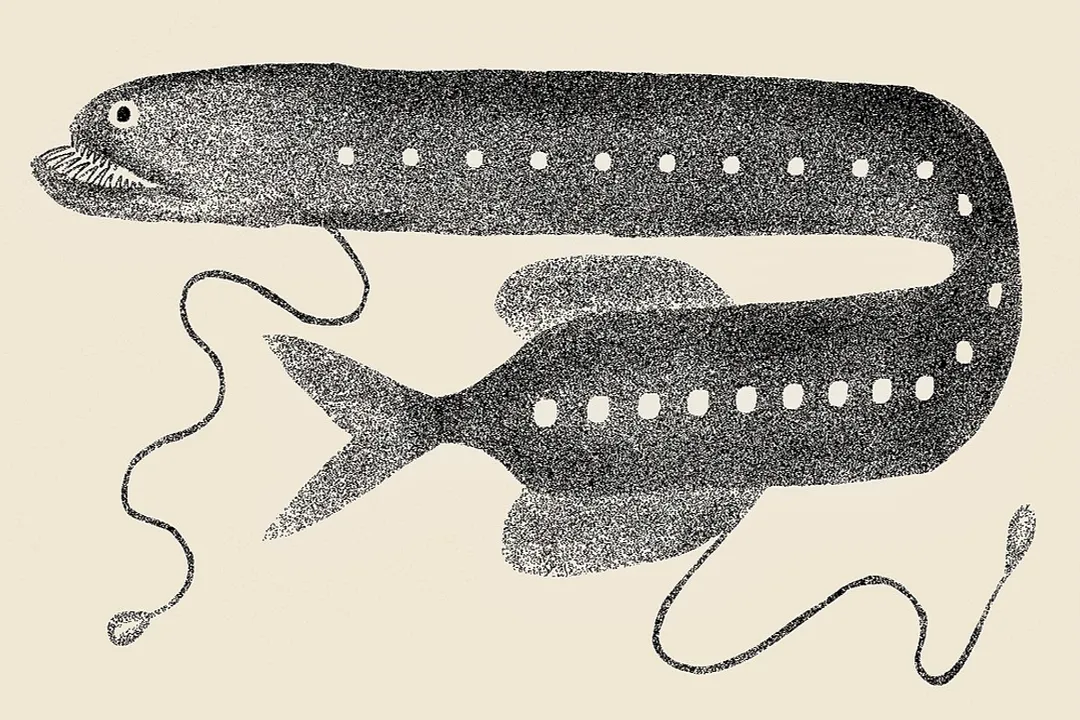
The inquiry into the world’s largest dragonfish often leads down a rabbit hole where established ichthyology blurs with the exciting, yet unverified, world of cryptozoology. The term "dragonfish" itself is fluid; scientifically, it frequently refers to members of the deep-sea family Stomiidae, known for their ferocious appearance, elongated bodies, and bioluminescent lures. [10] However, within the archives of unexplained creatures, a specific, much larger entity holds the title of the largest known dragonfish by reputation: the Giant Dragonfish, sometimes referenced by its proposed scientific moniker, Bathysphaera intacta. [3][6]
# The Giant Claim

The primary source for the largest claimed dragonfish comes from a single, highly referenced historical account. This creature, the Bathysphaera intacta or Giant Dragonfish, was allegedly observed in 1932 at a staggering depth of 2,100 feet, or approximately 640 meters beneath the ocean surface. [4][7] This sighting is noteworthy not just for the creature's reported size, but for the context: it was seen during an expedition that utilized a bathysphere. [3][4] The genus name Bathysphaera itself hints at this deep-sea origin. [1]
What makes the Bathysphaera intacta unique among deep-sea mysteries is the near-total lack of subsequent confirmation. It was reportedly only ever seen on that one documented occasion. [3] Unlike massive cryptids whose sightings are scattered across decades and continents, the Giant Dragonfish’s existence hinges almost entirely on this single observation from the early 20th century, placing it firmly in the realm of deep-sea legend, albeit one rooted in an actual manned submersible dive. [5][7]
# True Dragonfish
To contextualize the "giant" claim, it is helpful to look at what marine biologists classify as dragonfish. Scientifically recognized dragonfish belong primarily to the family Stomiidae, which includes several genera such as Stomias. [10] These are not the whale-sized behemoths sometimes imagined; they are generally formidable, but small, predators of the bathypelagic zone. [10]
Typical deep-sea dragonfish usually measure in the range of a few inches to perhaps a foot or slightly more in length. [10] They are characterized by their elongated, dark bodies, disproportionately large mouths filled with long, fang-like teeth, and photophores (light-producing organs) that run along their flanks. [10] Many species also possess a light-producing barbel hanging from their chin, acting as a lure in the eternal darkness of the deep. [10] The established world record size for a known species within this family would likely be measured in inches or just over a foot, making the Bathysphaera intacta's reputed size an order of magnitude greater. [10]

# Scale Comparison
The discussion of the "largest" becomes complicated when juxtaposed against anecdotal reports that conflate known deep-sea biology with cryptozoology. In addition to the 1932 Bathysphaera sighting, some cryptozoology sources present other claimants to the title, such as a creature reported to weigh around 75 kilograms (roughly 165 pounds). [9] This 75kg specimen is sometimes referred to as a "Giant Dragon Fish". [9]
It is critical to observe the difference in evidence type here. The 1932 account is a visual sighting at a specific extreme depth, [3][4] while the 75kg report is tied to a specific trapping event involving geoduck bait. [9] The lack of confirmation on whether this 75kg specimen was preserved, fully described, or genetically tested leaves its taxonomic placement ambiguous; it could be an abnormally large member of the Stomiidae, a related but undescribed deep-sea fish, or something else entirely. [9] A 75kg fish of any deep-sea type would represent a massive, almost unheard-of specimen, given that most known dragonfish are mere fractions of that mass. [10]
When considering the reported 2,100-foot depth of the Bathysphaera, [4] we must remember that many deep-sea fish are built to withstand immense pressure. This often results in gelatinous, less dense bodies when brought to the surface. If the 75kg specimen was caught at shallower depths or even near the surface, its structure might differ significantly from the highly pressurized Bathysphaera observed at depth. Conversely, if the 75kg fish was a true deep-dweller, its sheer biomass suggests a predator capable of handling an energy-rich diet unavailable to smaller, more widely distributed deep-sea species. [9][10]
# Abyssal Hunter
The deep ocean is not short on large predators, but the niche occupied by the dragonfish family often favors ambush hunting over sheer size. Their extreme jaws and needle-like teeth are adaptations for seizing prey instantly in an environment where meals are infrequent. [10] If a true Bathysphaera intacta or a fish matching the 75kg description exists, it implies a successful ecological strategy that allows for massive growth, suggesting a higher availability of prey or a significantly longer lifespan than its smaller cousins.
For a fish to reach 75 kilograms, it requires substantial caloric intake. In the aphotic zone, this usually means either feeding on frequent, falling organic matter (marine snow) or successfully preying upon larger, actively swimming bathypelagic fauna, such as lanternfish, small squid, or even other mid-water fish that migrate vertically. [10] The evolutionary pressure that would lead to such gigantism in a family known for miniaturization is a fascinating point of ecological speculation, suggesting a unique localized deep-sea food web capable of supporting such an apex predator within that specific depth range. [1]
# Sighting Reliability
Documenting fauna in the bathypelagic and abyssal zones presents inherent challenges, which explains why creatures like the Giant Dragonfish can persist as tantalizing mysteries. Submersible technology in 1932, while revolutionary for its time, was limited in its ability to capture, measure, or precisely identify fauna over sustained periods. [3][4] A brief, perhaps obscured, view through a thick porthole at a large, dark shape is often the limit of evidence available.
For general deep-sea fish, scientists rely heavily on net trawls, which often damage specimens, or remotely operated vehicles (ROVs) with sophisticated lighting and sampling tools. [10] Cryptozoological claims, however, rely on personal testimony or sparse visual records. [3][5] The difficulty in obtaining a physical specimen of the Bathysphaera means that even if the 1932 sighting was accurate regarding size, the creature's classification remains hypothetical. [3] The very few encounters with large, unidentifiable deep-sea organisms often stem from expeditions specifically designed to investigate the limits of marine life, whether for pure science or for the thrill of discovery. [7]
# Depth Dynamics
Examining the recorded depth offers another layer of analysis concerning the Bathysphaera. The 640-meter mark sits near the boundary between the mesopelagic (twilight) zone and the bathypelagic (midnight) zone. [4] While the bathypelagic zone is entirely dark, the lower reaches of the mesopelagic still receive some residual, downwelling light, which influences vision and bioluminescence strategies. [10]
If the creature was observed at this depth, it might utilize a form of counter-illumination, though its reputed size suggests it may also rely on sheer bulk and the element of surprise, perhaps feeding on less agile prey passing through its territory. [1] The fact that this potential giant was sighted where many fish still exhibit some degree of light sensitivity contrasts sharply with creatures found deeper, which are purely adapted to absolute darkness. This habitat places the Bathysphaera in a transitional, and perhaps highly competitive, ecological band. [1][10]
In summary, while the established world of ichthyology has not formally cataloged a dragonfish rivaling the proportions suggested by cryptozoological reports, the Bathysphaera intacta remains the most cited candidate for the largest, based on the historical 1932 observation. [3][4] The existence of an even heavier, 75kg analogue adds significant intrigue, forcing observers to weigh the historical visual record against modern, though still unverified, capture claims. [9] The true largest dragonfish likely resides in the vast, uncatalogued regions of the deep, waiting for technology capable of bringing back more than just a fleeting glimpse or a confusingly large catch. [10]
Related Questions
#Citations
Bathysphaera
Giant dragonfish | Encyclopaedia of Cryptozoology - Fandom
while normal dragon fish grow up to 2 feet long. Beebe ...
In 1932, 2100 feet (640 meters) beneath the ocean's ...
The Giant Dragonfish- – @cryptidsundays on Tumblr
Giant Dragonfish - Cryptid Wiki - Fandom
Cryptid Profile: Giant Dragonfish
more
Deep Sea Dragonfish