What is the largest species of Smilosuchus?
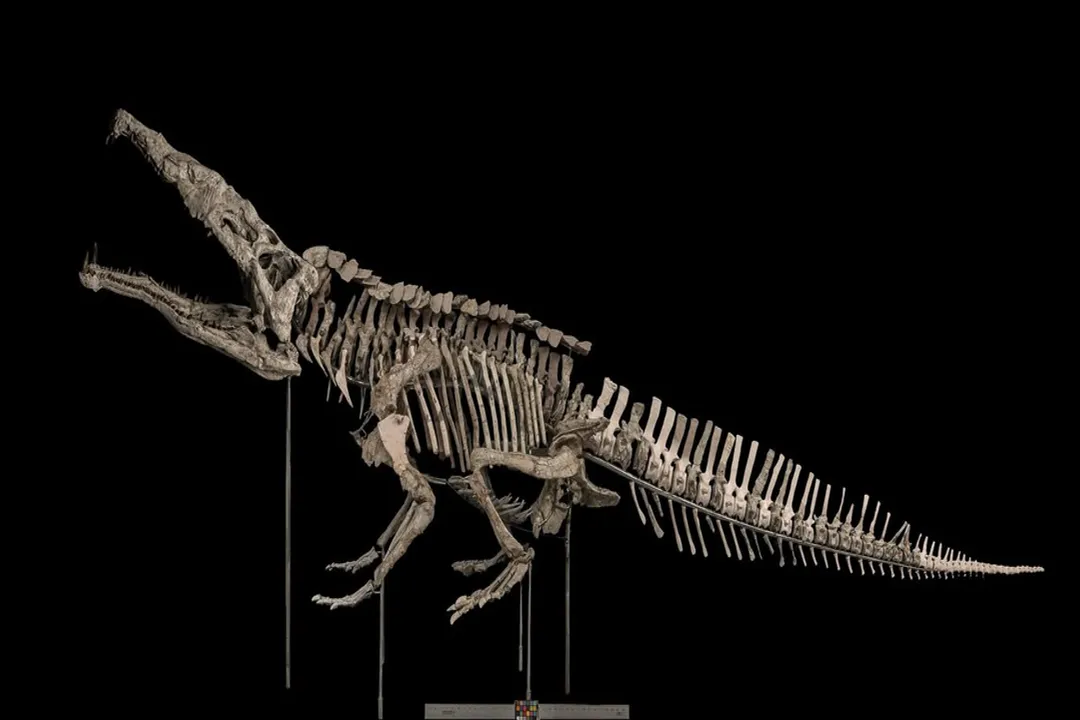
The term Smilosuchus immediately brings to mind images of fearsome, enormous aquatic predators from deep prehistory, often mistaken for giant crocodiles. However, this animal, which dominated certain river systems during the Late Triassic period, belongs to a distinct, though superficially similar, lineage of reptiles known as phytosaurs. [1][3] The question of size within this genus is central to understanding its ecological role, yet paleontology often relies on incomplete skeletons, making definitive measurements an exercise in careful estimation based on recovered fragments. [5]
# Reptile Classification
To appreciate the scale of Smilosuchus, one must first understand its family tree. Phytosaurs were archosaurs, placing them near the evolutionary base that would later give rise to crocodilians, birds, and dinosaurs. [3][4] Despite the superficial resemblance to modern crocodiles—a clear example of convergent evolution driven by similar semi-aquatic lifestyles—phytosaurs possessed key anatomical differences. [3] One of the most recognizable distinctions lies in the placement of the nostrils. In phytosaurs like Smilosuchus, the external nostrils were situated high up on the snout, close to the eyes, rather than at the tip of the jaw like in a true crocodile. [3] This suggests that when they submerged their massive bodies, they could breathe with only the very top of their head breaking the surface, much like a modern crocodilian, but the cranial architecture achieving this was fundamentally different. [3] Fossil evidence, including skulls and post-cranial remains, places Smilosuchus firmly within the Phytosauridae family during the Norian to Rhaetian stages of the Late Triassic, roughly 227 to 201 million years ago. [1][4]
# Species Defined
The genus Smilosuchus currently encompasses several named species, though paleontological consensus can shift as new finds are analyzed. [1] The best-known and most frequently studied species is Smilosuchus gregorii. [4] In studies comparing phytosaur anatomy and size, it is often S. gregorii that serves as the benchmark for the genus's potential maximum dimensions. [1][5] While other species have been assigned to the genus over time, such as S. tenuis, the fossil record, often pieced together from fragmentary remains, frequently points back to the characteristics seen in S. gregorii as representing the apex of the group’s size potential. [1] Therefore, when asking what the largest species of Smilosuchus is, the answer, based on the most substantial and consistently referenced material, centers on the characteristics attributed to Smilosuchus gregorii. [1][4]
# Massive Scale
Estimates for the total length of a mature, fully grown Smilosuchus gregorii place it among the largest terrestrial carnivores of its time, though strictly aquatic or semi-aquatic. [4] Recovered fossil material, including large portions of the skull and vertebrae, suggests that individuals could reach lengths of up to 7 to 10 meters (about 23 to 33 feet). [1][4] To visualize this, imagine a massive reptile, bulkier and perhaps even longer than many of the largest modern saltwater crocodiles, existing in an environment dominated by newly evolving dinosaurs. [1]
Consider the skull alone. Phytosaur skulls are typically long and relatively narrow, built for a powerful, snapping bite needed to secure slippery prey in the water. [5] The size of the skull elements belonging to Smilosuchus indicates a head that could easily measure over a meter in length. [5] Furthermore, the robustness of the recovered limb and torso bones suggests a creature built for significant mass, likely weighing several tons. [5] This sheer bulk was necessary for an apex predator navigating the sluggish, broad river systems characteristic of the Late Triassic. [4]
While direct comparison between all recognized species of Smilosuchus for a single, definitive "largest" title can be challenging due to specimen bias, the recorded dimensions associated with S. gregorii set the upper boundary for the genus. If other species existed, their published descriptions do not currently override the imposing scale suggested by the S. gregorii holotype and associated finds. [1]
# Triassic Setting
The world Smilosuchus inhabited was vastly different from today. This creature thrived when the supercontinent Pangea was still largely intact, leading to continental climates that often featured vast, seasonally fluctuating river networks, especially in the regions that would become North America. [4]
The environment dictated the predator's success. These rivers and associated floodplains were teeming with life, including early dinosaurs, large amphibians, and various other reptiles. [4] Smilosuchus was an apex predator of this aquatic realm. Its elongated snout, lined with numerous sharp teeth, was perfectly adapted for grabbing fish and smaller terrestrial creatures that ventured too close to the water's edge. [5]
The evidence suggests Smilosuchus and its relatives were perhaps the dominant, large-bodied predators in these wetland environments for much of the Late Triassic, occupying a niche that would later be filled by giant crocodilians in the Cenozoic, or by massive aquatic dinosaurs in other eras. [3] The fossil record shows its presence across various formations dating to this period, underscoring its widespread, if specialized, success. [1][4]
# Size Context
When assessing the "largest" title, it is useful to contextualize Smilosuchus not just against modern reptiles, but against its contemporaries on land. [5] While a 10-meter Smilosuchus would dominate any river it occupied, it existed concurrently with some of the first truly gigantic terrestrial animals: the early dinosaurs. For instance, during the same general period, large early dinosaurs like Plateosaurus (a basal sauropodomorph) were growing quite large, sometimes exceeding 7 meters, but Smilosuchus retained the size advantage in its specific domain. [4] The ecological separation was clear: Smilosuchus owned the water, while the land was increasingly ceded to the dinosaurs. [3] However, if we were to place a fully grown S. gregorii next to an average adult Postosuchus—a large, terrestrial rauisuchian predator that often competed for the apex role on land—the phytosaur's sheer mass and length would likely make it the physically larger animal overall, emphasizing its ecological dominance in the water. [5] This partitioning of the apex predator role between terrestrial and aquatic specialists is a fascinating feature of Late Triassic ecosystems. [3]
# Nostril Placement
The unusual placement of the nostrils high on the skull is more than just an interesting anatomical trivia point; it is a direct result of evolutionary pressure favoring massive size in a heavily preyed-upon niche. [5] A predator achieving 10 meters in length cannot afford to expose its entire head above the water to breathe, as doing so would make it an easy target for terrestrial threats or reveal its position too obviously to wary prey. [3] The high nostrils, supported by the structure of the nasal bones which appear to have formed a distinct structure where the nostrils were located, allowed the animal to effectively become an invisible hunting platform. [5] The skull could remain almost entirely submerged while the animal maintained a steady supply of oxygen, a crucial advantage for ambush hunting. This adaptation is a hallmark of the phytosaur success story, enabling them to evolve to such immense sizes without sacrificing aquatic efficiency. [3]
# Fossil Interpretation
Interpreting the size of Smilosuchus requires acknowledging the reality of fossil discovery. Most large, extinct animals are known from scattered elements—a femur here, a piece of jaw there. [5] The length estimates for Smilosuchus are often derived by scaling up known, well-preserved fossils against the dimensions of a more complete, though perhaps slightly smaller, relative. [5] This methodology, while standard in paleontology, inherently carries a margin of error. [5] The sheer consistency of the resulting size estimates across multiple studies, however, lends significant authority to the conclusion that Smilosuchus gregorii was indeed one of the largest semi-aquatic reptiles to ever exist outside of the later crocodilian giants. [1] Researchers must continuously weigh the evidence from isolated massive scales or osteoderms against the known morphology of the type species to understand the upper limits of the genus. [5] This ongoing process of comparison and scaling ensures that the picture of Smilosuchus remains as accurate as the physical evidence allows. [1]
#Videos
Smilosuchus: One Of The Largest Amphibious Predators Before The ...
Related Questions
#Citations
Smilosuchus - Wikipedia
Smilosuchus - SciiFii Wiki - Fandom
Smilosuchus looks like an enormous Triassic crocodile, but it was ...
Smilosuchus gregorii, an pytotosaur from North America, Late ...
Smilosuchus - Prehistoric Wildlife
[PDF] A large, pathological skeleton of Smilosuchus gregorii
Smilosuchus gregorii - BiodiversityPMC
Smilosuchus | Facts app
Smilosuchus: One Of The Largest Amphibious Predators Before The ...