Wels Catfish Physical Characteristics
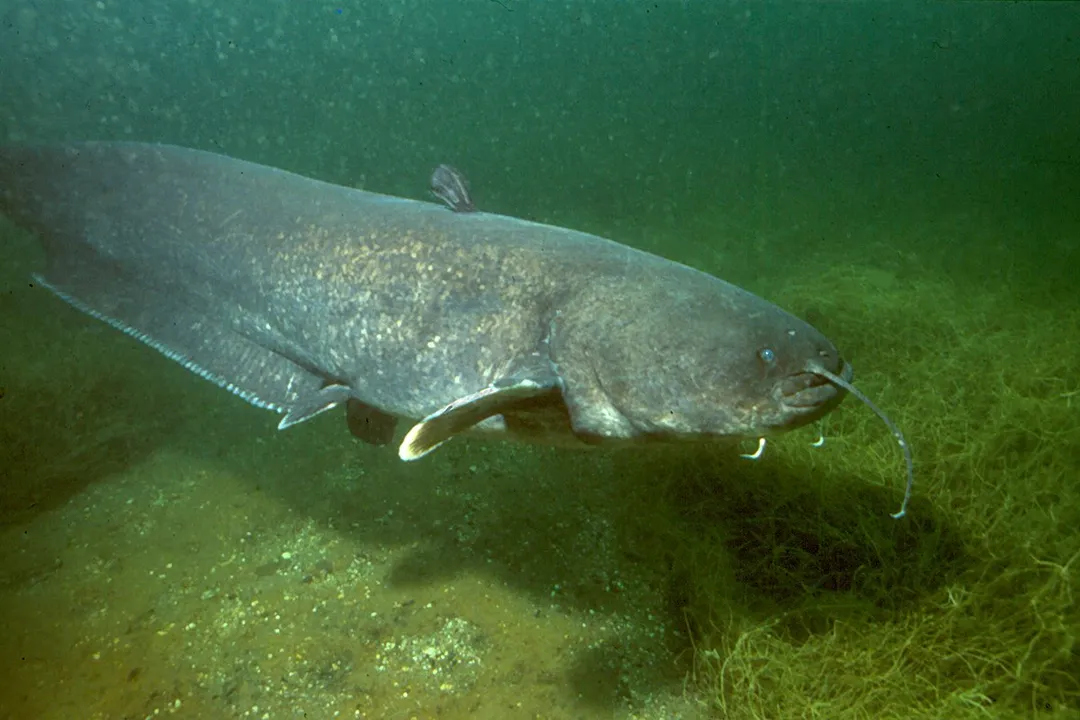
The Wels Catfish, Silurus glanis, presents an imposing figure in the freshwater realm, easily recognized by its sheer scale and distinctive head shape. It holds the distinction of being one of the largest freshwater fish in Europe, a predator whose physical attributes speak directly to its status as an apex bottom-dweller in many native and introduced systems. [5][7] Its appearance is often described as somewhat primitive or ancient, characterized by a heavy, elongated body that tapers toward the tail. [1]
# Form and Coloring
The overall coloration of the Wels Catfish is generally dark, ranging from olive-green to dark grey or even black along the back and sides. [1][3] This darker pigmentation provides effective camouflage against the murky bottoms where it prefers to reside. [7] As one moves down the body toward the belly, the coloration lightens significantly, often appearing white or pale grey. [1][3] While large, adult Wels are typically uniform in color, younger specimens may exhibit dark spots or blotches on their flanks, though these markings tend to fade as they mature. [7]
A critical physical characteristic differentiating the Wels from many other catfish species is its skin. It completely lacks scales. [1][3][7] Instead, the body is covered in thick, slimy skin, which is believed to aid in protection and potentially sensory perception in low-visibility environments. [1][7] The skin texture is smooth beneath the layer of mucus. [3]
# Immense Dimensions
The size potential of the Wels Catfish is perhaps its most famous trait. These fish can grow to considerable lengths, with documented individuals exceeding two meters in total length. [1][7] While exact maximum weights vary depending on geography and environmental conditions, they are routinely cited as exceeding 100 kilograms, or over 220 pounds. [7] These massive sizes are not merely historical anomalies; sustained growth over many years allows them to become the dominant piscivore in their established habitats. [1] The IGFA world record, for instance, stands testament to these giants, highlighting the maximum size attainable under optimal conditions. [4] Considering that these fish are native to the large river systems and lakes of Central and Eastern Europe, their physical capacity to attain such bulk is supported by the abundance of prey in those environments. [1][7]
# Head Morphology
The head of the Wels Catfish is notably broad and distinctly flattened, contributing to its generally broad-shouldered appearance. [1][3] This broad, low profile is an excellent adaptation for a fish that spends most of its time resting or foraging directly along the substrate. [1] The mouth itself is large, capable of engulfing substantial prey items relative to its body size. [1][3]
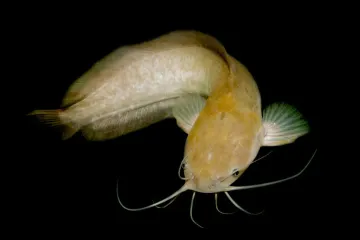
The sensory apparatus around the mouth is perhaps the most identifiable feature when viewing the fish head-on. The Wels possesses eight barbels emanating from its head region. [1][3][7] These fleshy, whisker-like structures are crucial for sensing the environment in dark or turbid water. [3] Specifically, there are two very long barbels positioned on the upper jaw (maxillary barbels) that can extend far back along the side of the head. [1][7] Complementing these are four shorter barbels situated on the lower jaw. [1] The arrangement and relative length of these eight sensory organs create a highly specialized, almost panoramic detection field for locating food near the river or lake bed. [1][7] In contrast to the long upper pair, the lower barbels are significantly shorter. [1] The eyes are relatively small in proportion to the overall size of the head, further emphasizing reliance on tactile and chemosensory input over sight. [3]
# Fin Structure
The finnage of the Wels Catfish is streamlined and optimized for steady movement and propulsion rather than rapid bursts, fitting its generalist predatory lifestyle. [1] It notably lacks the sharp spines found in the fins of many other bony fish. [3]
The dorsal fin is a striking feature; it originates relatively far back on the body and is quite long, extending across a significant portion of the back. [1][7] Immediately contrasting this is the anal fin, which is also exceptionally long. [1] This extended anal fin runs almost the entire length of the posterior underside and often merges with the caudal (tail) fin. [1][7] The large surface area provided by these two extensive fins, combined with a rounded caudal fin, allows for powerful, slow maneuvering through water, which is ideal for maintaining position in currents or executing slow, deliberate predatory advances. [1][7] Pectoral fins are present and notably large, providing necessary stabilization during bottom-dwelling activities. [3]

# Comparative Morphology and Ecological Adaptation
When considering the physical description, it becomes clear how structure dictates function for the Wels Catfish. The combination of a scaleless, muscular body, flattened head, and prominent barbels forms the blueprint of an obligate bottom feeder and scavenger. [1][3] Unlike fish that rely on speed in open water, the Wels is built for strength and stealth close to the substrate.
Interestingly, while native to the established river systems of Europe, its physical hardiness—thick skin and generalist morphology—allows it to successfully colonize new environments, such as the canals and ponds in areas like the UK, where it is non-native and requires careful management. [5][6]
For the angler or biologist studying this species, understanding the sensory array is key to understanding its behavior. The four short barbels on the lower jaw, combined with the two long ones above, likely function at different sensory ranges. The shorter ones might offer fine-tuned, immediate contact sensing near the mouth for inspecting potential food items, while the long upper barbels could serve as longer-range chemical antennae sweeping the water column above the fish, alerting it to passing prey or disturbances. [1][7] This sophisticated sensory input negates the need for large eyes, which is a typical trade-off in organisms inhabiting dimly lit waters. [3] While some European catfish populations thrive in cool waters, the Wels seems particularly adept at handling warmer, slower flows, suggesting its physical structure is highly adaptable across a range of lotic and lentic systems. [5] Observing specimens from different regions—say, a slow-moving lowland river versus a deep, cold alpine lake—would likely reveal subtle differences in their relative girth or head size, reflecting localized feeding pressures, though the core morphological blueprint remains consistent across its documented range. [1][7] This consistency in shape, even across varied habitats, underscores the evolutionary success of this basic physical design for maximizing survival as a large, demersal predator. [1][3]
#Videos
Wels Catfish Facts: a GIANT Catfish | Animal Fact Files - YouTube
Related Questions
#Citations
Wels catfish - Wikipedia
Wels catfish : Silurus glanis
Wels Catfish - Ontario's Invading Species Awareness Program |
Silurus glanis - IGFA Member Services
Invasive Species: Wels Catfish - State of Michigan
Facts About Catfish (Wels) | Canal & River Trust
Silurus glanis, Wels catfish - FishBase
Wels Catfish Facts For Kids | AstroSafe Search - DIY.ORG
Wels Catfish Facts: a GIANT Catfish | Animal Fact Files - YouTube