What is the physical description of a flathead catfish?
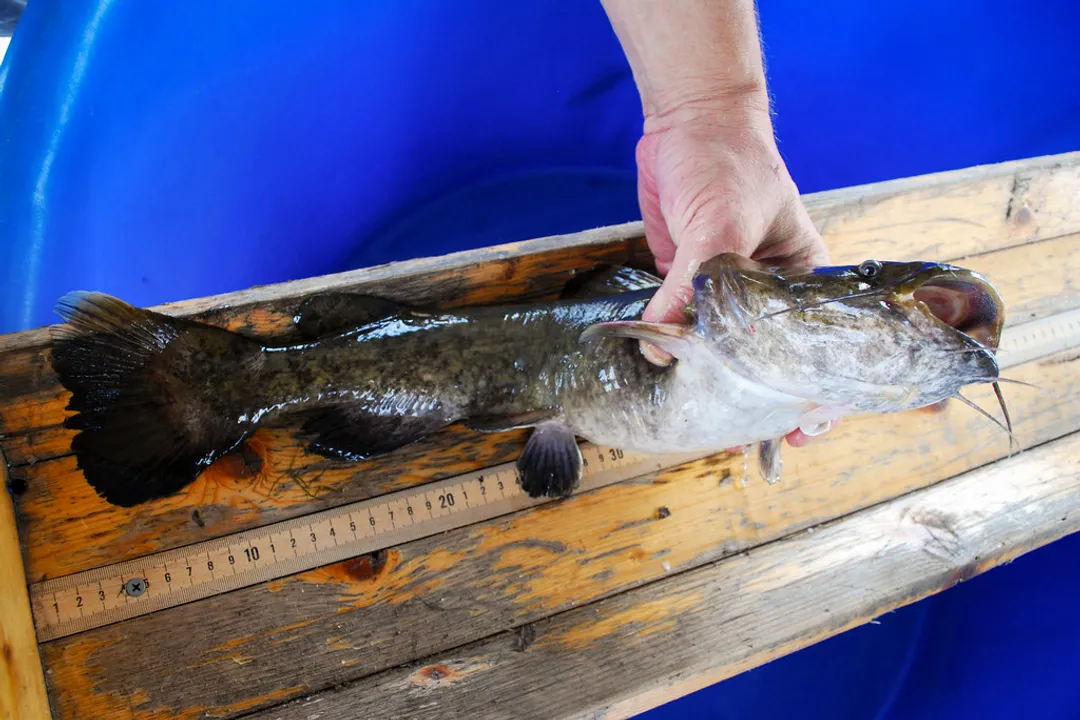
The flathead catfish presents a truly unmistakable profile in North American freshwaters, immediately setting itself apart from its whiskered cousins like the channel or blue catfish. [1][6] When you first encounter one, the sheer mass and the unique shape of its head are the dominant characteristics that catch your eye. [1][6] This species, scientifically known as Pylodictis olivaris, earns its common name from that very feature: a broad, flattened head that is noticeably wider than it is deep, giving it a shovel-like appearance when viewed from above. [1][6][4]
# Head Shape

The head structure is key to identification. Unlike the channel catfish, which has a more rounded head, the flathead possesses a decidedly flattened cranium. [6] This broadness extends to the mouth, which is large and distinctly inferior or underslung. [1][6] This means the lower jaw protrudes slightly past the upper jaw, a configuration perfectly suited for scooping prey from the bottom substrate. [6] The eyes are relatively small and situated high on the sides of the head, adding to its somewhat prehistoric look. [1]
# Body Structure
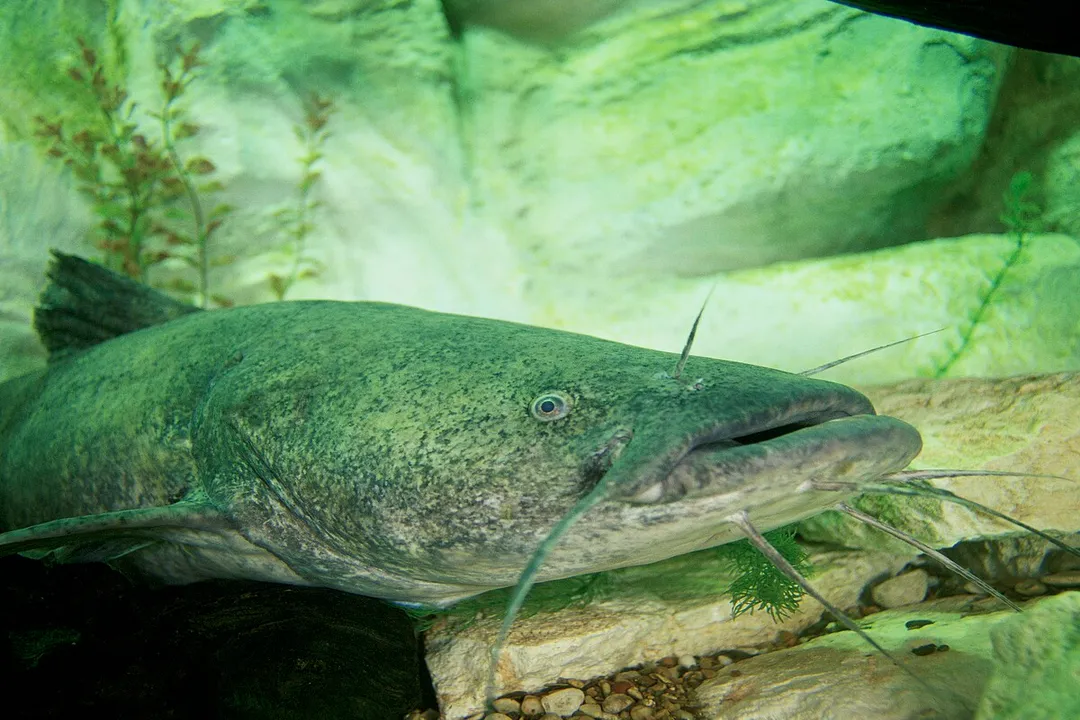
Moving down the body, the flathead catfish is built for power and size. [5] They are heavy-bodied fish, often described as robust, especially the larger adults. [6] While they share the lack of scales common to all true catfish, their skin is thick and tough. [1][4] The dorsal profile starts low and generally rises to a moderate hump over the shoulders before tapering toward the tail. [6] It is important to note the dorsal fin structure, which is crucial for differentiation against other large catfish species. The flathead has a short, stout dorsal fin that contains a single, strong, sharp spine at the front, followed by several soft rays. [1][6]
If you are looking for a specific feature to quickly rule out a blue catfish, observe the tail fin. The blue catfish has a noticeably forked tail, whereas the flathead catfish possesses a tail that is broad, slightly rounded, or only minimally notched; sometimes referred to as truncate or only slightly emarginate, especially in older specimens. [1][6][3] This broad tail provides immense thrust for short bursts when pursuing prey or escaping danger.
# Coloration Patterns
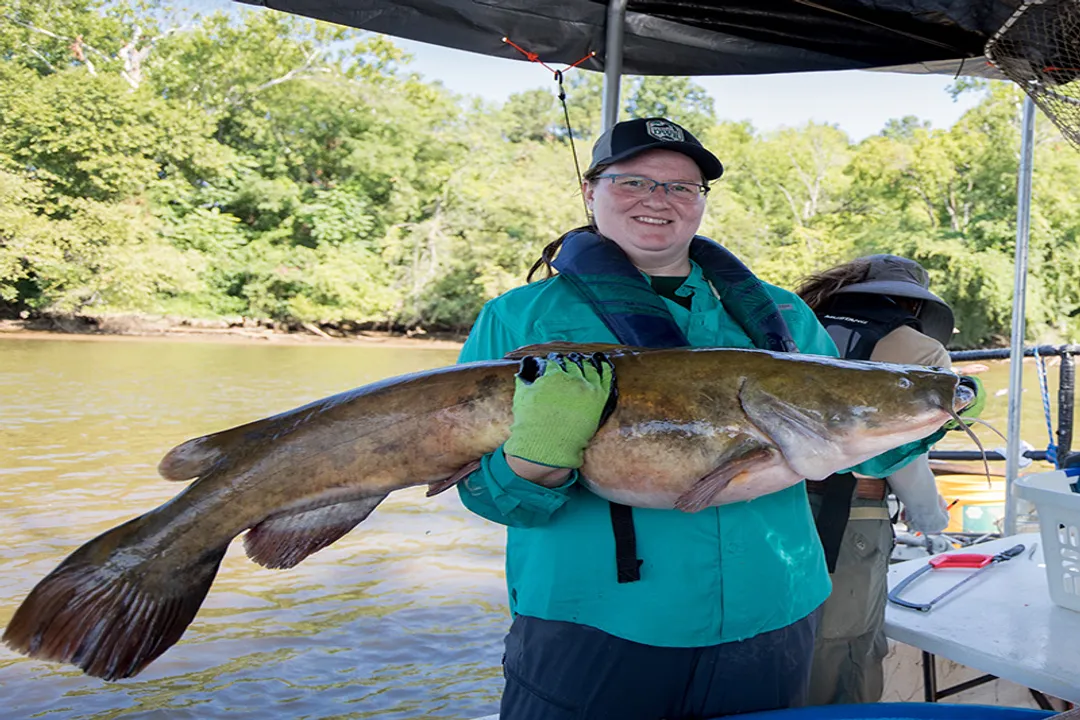
Coloration in the flathead catfish is famously variable, which often complicates field identification when size or location isn't a factor. [3] The dorsal surface—the back and upper sides—typically ranges from a yellowish-brown to a dark olive, brown, or almost black tone. [6][4] This dark coloration helps them blend into the muddy or rocky bottoms they inhabit. [3] In contrast, the belly, or ventral surface, is usually much paler, often appearing white, cream, or light yellow. [1][4]
A key characteristic that anglers often rely on for positive identification, especially when dealing with younger or smaller fish, is the presence or absence of markings. Healthy, adult flatheads usually lack distinct patterns. [3] They do not possess the numerous dark spots characteristic of the channel catfish, nor do they exhibit the uniform dark slate-gray or bluish-black coloration often seen in large blue catfish. [1][6] The young flatheads, however, might display a mottled or somewhat spotted pattern, which fades as they mature, sometimes leaving behind dusky bars or blotches. [4][6] If you catch a large catfish in the upper Midwest region that is yellowish-brown with a plain, pale underside and a rounded tail, you are almost certainly looking at a flathead. [6]
# Fins and Appendages
Beyond the dorsal fin, the other fins contribute to the fish's overall robust appearance. The pectoral fins, located just behind the gills, are large and contain a formidable spine. [1] This pectoral spine can be quite sharp and is often the source of minor cuts if the fish is handled carelessly. [1] The pelvic fins are situated relatively far back on the body. The anal fin is long, running along much of the underside toward the tail, containing many soft rays but no spines. [1][6]
The barbels, or "whiskers," are another critical sensory feature. Like all members of the catfish order, the flathead has these sensory organs around its mouth, but the color of these barbels can sometimes be a useful field marker. The barbels on the upper jaw are typically dark, matching the coloration of the upper body, while the lower jaw barbels are usually lighter or whitish. [4]
| Feature | Flathead Catfish | Channel Catfish (Contrast) | Blue Catfish (Contrast) |
|---|---|---|---|
| Head | Broad, flattened, shovel-like [1][6] | Rounded, narrower [6] | Large, but less distinctly flattened [6] |
| Tail | Rounded or only slightly notched [1][6] | Deeply forked [1][6] | Clearly forked [1][6] |
| Color | Yellowish-brown to olive; pale belly [1][4] | Bluish-brown; often has dark spots [1][6] | Uniform dark slate-gray/blue; no spots [1][6] |
| Jaw | Inferior (underslung) [1] | Even or slightly superior | Inferior (underslung) [1] |
# Size and Scale
Flathead catfish are renowned for their potential size, easily classifying them among the largest freshwater game fish in the systems they inhabit. [5] While they can be caught at modest sizes—sometimes under 10 pounds—they are built to grow exceptionally large and heavy. [5][1] In many parts of their range, they are known to exceed 40 or 50 pounds, with documented specimens approaching or exceeding 100 pounds. [5] This immense size is supported by their heavy bone structure and powerful musculature.
The growth rate, like their coloration, is heavily influenced by habitat and food availability. In warmer, productive southern river systems, they can achieve massive sizes relatively quickly compared to cooler northern waters. [5] For instance, a fish measuring 25 inches might only weigh 8-10 pounds in a slower-growing environment, but an equivalent-sized fish in a nutrient-rich delta environment could easily push 15 pounds, demonstrating the plasticity of their physical development based on local conditions. [5]
One insight worth noting for anglers trying to differentiate between a very large blue catfish and a flathead is the texture of their body when landed. While both are slippery, the muscular girth and the lack of the blue's sleek, streamlined look often betray the flathead. A mature flathead appears thicker in cross-section relative to its length compared to the blue catfish, suggesting immense bottom-dwelling power rather than pelagic speed. [6]
# Distinguishing Juveniles
Distinguishing young flatheads from young channel cats is a common challenge, as the stark adult differences are less pronounced. [4] At smaller sizes (under 12 inches), the young flathead often retains more of a mottled or blotchy pattern compared to the channel catfish's crisp, defined spots. [4][6] The most reliable non-size-dependent feature remains the head shape: even a small flathead’s head will appear noticeably broader and flatter than a channel catfish of the same length. [6] Furthermore, while the tail may not be fully rounded on a very young flathead, it will almost never show the deeply cut "V" shape seen in a young channel catfish. [1] If you are in an area where blue catfish are also present, remember the blue catfish juvenile will usually have a darker, more uniform gray body color than the yellowish-brown flathead juvenile. [6]
Another subtle but helpful field observation relates to the lateral line system, though this requires a closer look or feeling the fish. The lateral line canals on the flathead are often less prominent than those on the channel catfish, which can sometimes present a more distinct, dotted appearance along the flank when the fish is stressed or newly caught. [1]

# Habitat Influence on Appearance
It is fascinating to observe how the physical description adapts slightly based on where the fish lives. A flathead harvested from a deep, turbid reservoir with a dark, silty bottom might be nearly black or dark gray across its entire back and sides, minimizing lighter belly contrast. [3] Conversely, a specimen taken from a shallow, sandy-bottomed river system or a clear, tannic-stained lake might exhibit a much brighter, more pronounced golden or straw-yellow hue. [3][4] This environmental camouflage is highly effective and demonstrates the species' adaptability across diverse freshwater environments, from large rivers like the Mississippi and Missouri systems to major reservoirs across the southern and eastern United States. [1][2][6] Their general body configuration, however—the flat head, the short dorsal, and the rounded tail—remains constant, confirming their identity regardless of the local environmental tint they adopt. [1]
Related Questions
#Citations
Flathead catfish - Wikipedia
Flathead Catfish (Pylodictis olivaris) - Texas Parks and Wildlife
Flathead Catfish - Chesapeake Bay Program
Flathead Catfish | FWC
Flathead Catfish - Fish Species by Location - California Fish Website
Flathead Catfish - Missouri Department of Conservation
Flathead Catfish - Virginia Department of Wildlife Resources
[PDF] Flathead Catfish Pylodictis olivaris 90 - Pennsylvania Envirothon
Fish - Species - Flathead Catfish - SCDNR