Water Beetle Evolution
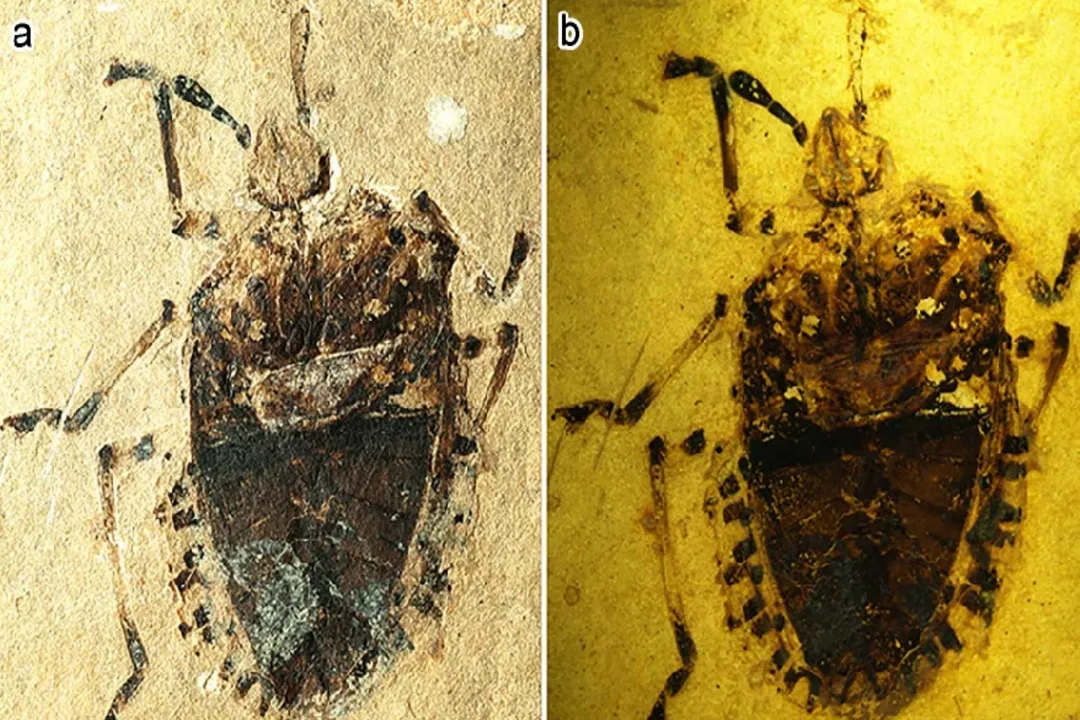
The story of water beetles is a sprawling narrative etched across hundreds of millions of years, detailing the remarkable conquest of aquatic habitats by one of the most successful insect orders on Earth. Tracing the exact pathway of these insects from dry land into diverse freshwater niches presents a significant challenge, as the fossil record for soft-bodied aquatic creatures is often incomplete. However, modern molecular tools, combined with key paleontological discoveries, are slowly revealing the ancient, divergent evolution that sculpted these specialized creatures. [1][2] The sheer variety within aquatic beetles—from the surface-skimming to the deep-diving predators—points to a history rich with evolutionary experimentation and adaptation. [2]
# Ancient Fossils
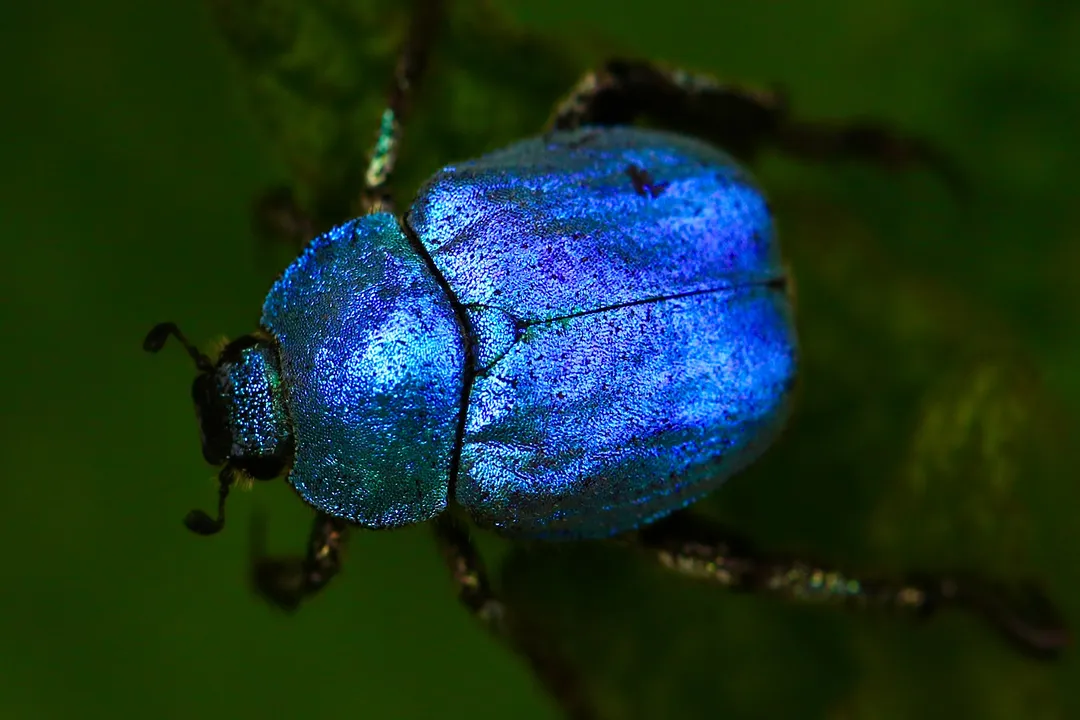
The antiquity of water beetles is far greater than previously estimated, a fact cemented by the identification of a fossilized specimen named Zekuforma maculata. [5] This remarkably preserved insect dates back to the Middle Triassic period, placing its existence around 230 million years ago. [5] This finding fundamentally rewrites the timeline, suggesting that key steps in water beetle evolution, or at least the deep ancestral lineages leading to them, were established well before the rise of the dinosaurs reached its peak. [5] The existence of such an ancient specimen provides a critical anchor point, even if Z. maculata itself is not a modern water beetle, as it establishes a minimum age for the early diversification within the broader group from which aquatic forms would later emerge. [5][4]
This deep antiquity contrasts interestingly with the timelines derived purely from molecular studies of extant species. While molecular clocks estimate the timing of splits between major modern groups, the 230-million-year-old fossil pushes the potential for aquatic lineage separation much further back into the Mesozoic era. [1][5] Understanding the precise point at which these lineages committed to an aquatic existence requires synthesizing the hard evidence of fossils with the statistical models of genetic change. [2][7]
# Molecular Dating
Contemporary evolutionary biology relies heavily on sequencing the DNA of living beetles to reconstruct their family tree, a method that often utilizes molecular clock estimates to assign dates to evolutionary branching points. [6][7] These phylogenetic analyses are essential for understanding the relationships among the various aquatic families, revealing which groups diverged earliest and which are more recently related. [1][7] Such studies have confirmed that the aquatic lifestyle has evolved multiple times independently across the beetle phylogeny, meaning that convergent evolution—where unrelated species evolve similar traits because they face similar environmental pressures—is a major theme in water beetle history. [2] The molecular data helps untangle these repeated evolutionary invasions into the water. [1]
Molecular studies looking at deep evolutionary splits provide essential context for the morphological diversity we observe today. [2] For instance, tracing the divergence between major lineages using molecular data can show whether the transition to water happened once in a common ancestor, or repeatedly in separate terrestrial groups. [1][6] The current consensus leans toward multiple, independent acquisitions of aquatic traits, underscoring the environmental pressures of freshwater habitats. [2]
A comparative analysis of respiratory modifications across various aquatic beetle families reveals a fascinating spectrum of solutions to the fundamental problem of underwater oxygen acquisition. Some lineages, like the Diving Beetles (Dytiscidae), carry a physical air bubble—a plastron—held beneath their wing covers, acting as a physical gill that relies on diffusion from the water. [2] In stark contrast, other groups, such as the Whirligigs, spend nearly all their time at the surface, using specialized structures to breathe atmospheric air directly, often diving only briefly. This diversification in respiratory strategy—from carrying stored air to actively harvesting surface air—suggests that the ecological niches available within aquatic habitats were partitioned early on, favoring different mechanical solutions for surviving submerged or semi-submerged. [2]
# Specialized Forms
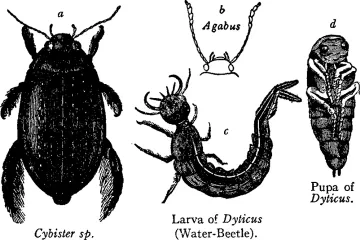
Perhaps no water beetle better exemplifies extreme aquatic specialization than the Whirligig beetle (Gyrinidae). [3] These insects are instantly recognizable by their tendency to patrol the water surface in dizzying, erratic patterns, giving them their common name. [3] Their entire morphology is tuned to this specific ecological role. For respiration, they trap a layer of air beneath their hardened forewings, which acts as a physical gill, allowing them to stay submerged for extended periods while retaining access to atmospheric oxygen. [3]
The visual apparatus of the Gyrinids is legendary. They possess distinctive, highly divided eyes, essentially separated into upper and lower portions. [3] The dorsal, upper part of the eye is adapted for viewing objects in the air above the water surface, while the ventral, lower part is modified for seeing underwater prey or threats. [3] This split vision allows the beetle to maintain constant awareness of both its aerial and aquatic surroundings simultaneously while navigating the air-water interface. Furthermore, their legs are adapted for rapid rowing on the surface film, showcasing a complete evolutionary dedication to the boundary layer between air and water. [3]
# Divergence Timings
When we compare the divergence times suggested by fossil evidence and molecular evidence, we sometimes find discrepancies, which is common in evolutionary studies. [4] However, the consistency across dating methods allows researchers to build a more complete picture of when major clades established themselves. [1] The evolutionary history of beetles in general is marked by massive radiations, and the aquatic forms represent specialized branches of this success story. [4]
Understanding the timing of these splits is critical because it connects evolution to Earth's history. For instance, if a major lineage of water beetles appears to have speciated rapidly around a specific geological boundary, it suggests that environmental turnover—a shift in water chemistry, temperature, or habitat availability—may have acted as a strong selective filter. [8] The deep evolutionary splits observed in some aquatic groups suggest a long, continuous period of refinement within freshwater systems, indicating that the initial move into water was not a single, swift event, but rather a prolonged process involving many separate colonization events across different groups of beetles. [2][4]
Given the sensitivity of aquatic environments to temperature and precipitation changes, a sharp spike in speciation rates following a known ancient climatic upheaval—such as the warming periods associated with the Mesozoic—would strongly suggest a role for environmental pressure in driving rapid trait fixation in these lineages. The stability of the deep lineage splits, however, also implies that once certain ancestral aquatic forms became established, they were able to persist through significant environmental fluctuations, indicating a certain degree of evolutionary conservatism in their fundamental adaptations. [1][8]
# Climate Influence
The timing of diversification events in many insect groups, including water beetles, is often linked to significant shifts in global climate across geological time. [8] Climate change, both ancient and modern, shapes habitats, altering the availability of standing water, river flow, and water chemistry, which directly impacts the fitness landscape for aquatic insects. [8] Molecular phylogenies that map out the diversification history of water beetle families can be superimposed on paleoclimatic records to test hypotheses about environmental forcing. [1][8]
For example, periods of increased global warmth and humidity in Earth's past may have led to the expansion of slow-moving, warm-water habitats, potentially favoring the rapid diversification of certain beetle types adapted to those specific conditions. [8] Conversely, arid periods could lead to habitat fragmentation, isolating populations and potentially driving speciation through allopatry, or in failure scenarios, leading to local extinctions of less adaptable forms. [2] The overall success of water beetles suggests that they, as a collective, were generally well-positioned to capitalize on the recurring availability of aquatic refugia throughout various climatic regimes. [4] The ability of some groups, like the Gyrinids, to utilize the atmospheric interface provides a buffer against poor underwater water quality, a trait that might have been strongly selected for during periods of environmental stress in their history. [3]
# Phylogenetic Placement
Pinpointing the exact evolutionary relationships between the major families of aquatic beetles—such as the Predaceous Diving Beetles, Water Scavengers, and Whirligigs—remains an active area of study, often requiring sophisticated phylogenetic methods that integrate data from various sources. [6][7] While morphological similarities can sometimes be misleading due to convergence (e.g., streamlined bodies in different diving groups), molecular markers offer a more independent measure of relatedness. [2]
The resolution provided by modern sequencing techniques helps clarify which specific traits evolved before the aquatic split and which arose after the beetle was already committed to life in the water. [1] For example, identifying the precise sister group to all extant water beetles—the closest terrestrial relatives—is crucial for understanding the nature of the initial habitat transition. [7] The sheer breadth of the order Coleoptera means that many lineages have explored aquatic life, leading to complex evolutionary trees where a single, unifying "water beetle" ancestry is less likely than several independent evolutionary ventures. [2][4] The ongoing refinement of these phylogenetic trees, often involving analysis of hundreds of genes, provides a detailed road map of evolutionary change, moving us away from simple morphological classifications toward a more accurate understanding of descent. [6]
Related Questions
#Citations
Ancient divergent evolution of specialized swimming modes in ...
Water Beetles as Models in Ecology and Evolution
Whirligig beetle
Evolutionary transition from surface to subterranean living in ...
Fossil found in Tibet rewrites 230 million years of insect ...
Water Beetles as Models in Ecology and Evolution
Evolution and biogeography of acidocerine water ...
What the evolution of beetles can tell us about the effects ...