Water Beetle Locations
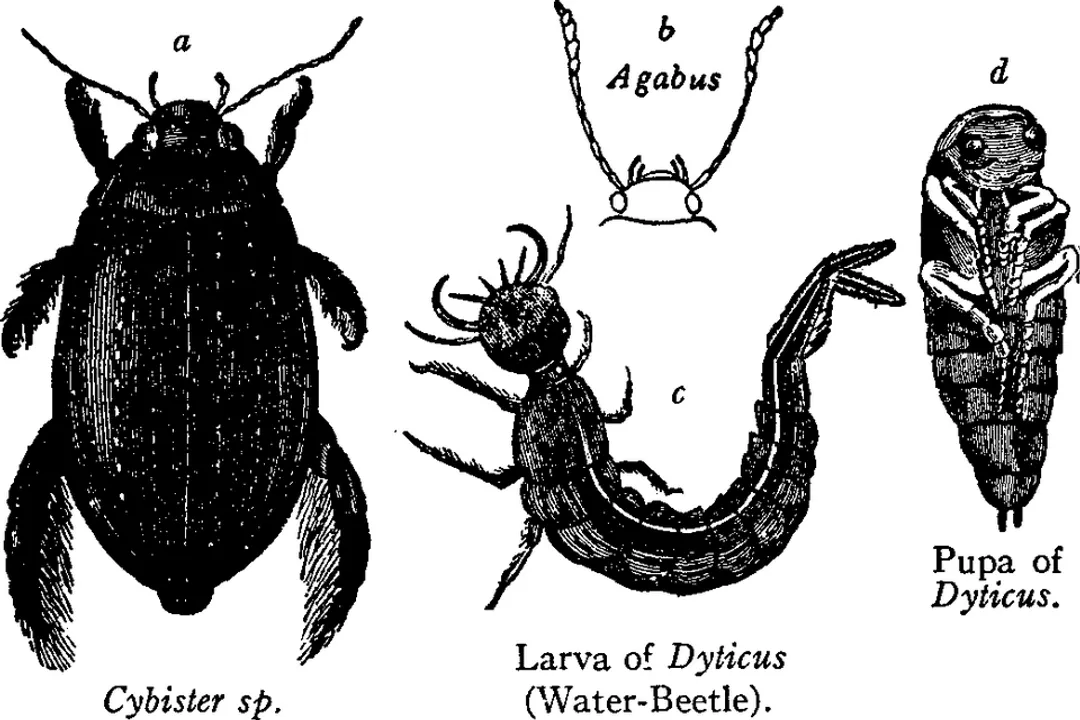
Water beetles are far more diverse than a single image might suggest, inhabiting almost every conceivable type of freshwater environment across the globe. [1] Pinpointing their exact locations requires looking beyond just "water" and considering specifics like current speed, substrate, and water depth, as different families have evolved to specialize in distinct micro-habitats. [4]
# Habitat Types
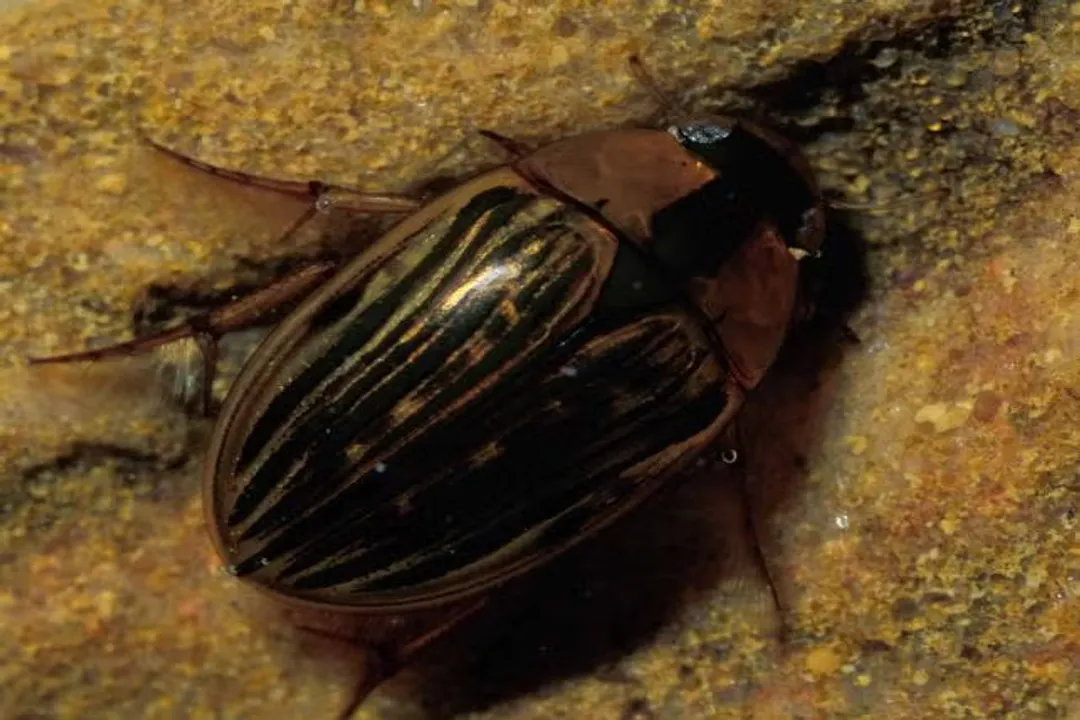
The vast majority of water beetles are found within aquatic settings, but the nuances of these settings dictate which species you might encounter. Generally, they occupy lentic systems—still or slow-moving waters like ponds, marshes, ditches, and the sheltered edges of lakes—or lotic systems, which are flowing waters such as streams and rivers. [1][4]
For instance, beetles that require still water often thrive in areas rich with aquatic vegetation, using the plants both for cover and as a food source, either directly or for the biofilm that grows on them. [4] In contrast, those adapted to rivers and streams must contend with current. If you are looking for Brychius hungerfordi, the Hurd's Crawling Water Beetle, for example, the location is incredibly specific: it requires the flowing riffle zones of rivers, often associated with clean, coarse substrates. [2][3] This preference for moving water and specific bottom composition sets it apart from many common pond dwellers. [2]
When examining a body of water, the substrate—the material making up the bottom—is a key determinant of location. Some species prefer soft bottoms composed of mud or silt, often burrowing within it, while others are consistently found clinging to or moving over hard surfaces like gravel, sand, or rocks. [4][8] For general field identification, looking along the littoral zone—the shallow area near the shore where sunlight penetrates to the bottom—is often rewarding, as this area supports high biodiversity. [4] Even in larger water bodies, beetles often favor the margins where terrestrial and aquatic environments meet. [7]
# Distribution Depth
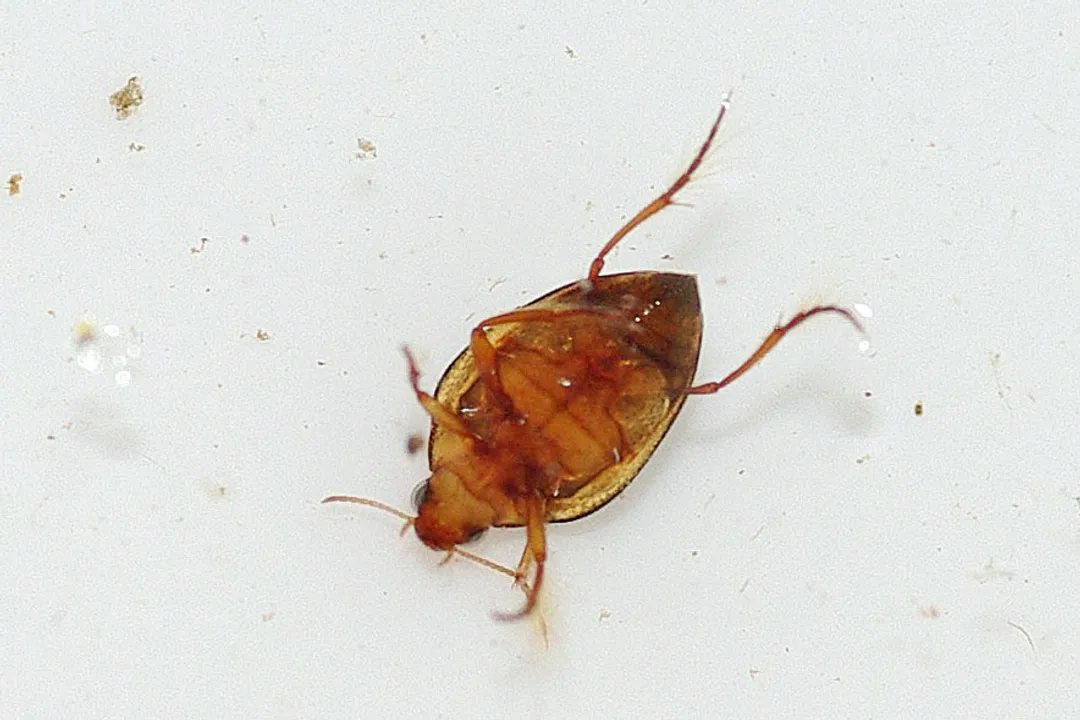
Water beetle distribution within the water column varies significantly. Some species spend most of their time clinging to submerged debris or the bottoms of water bodies, while others, particularly certain predaceous diving beetles, are strong swimmers and move throughout the water column, though they still require the surface for respiration. [1][4]
Many aquatic insects, including beetles, utilize the interface between the water surface and the air. These surface-dwelling species are adapted for that specific location, often using surface tension to move about. [1] Conversely, the larvae of many species, even those whose adults fly or swim actively, might be located deeper down, buried in the sediment or hidden within dense mats of submerged weeds. [4] For instance, while an adult water scavenger beetle (Hydrophilidae) might be spotted near the surface of a Missouri pond, its larvae may be found in the muck below. [6] This suggests that a thorough search for a complete water beetle community requires sampling across all strata, from the bottom sediment to the water surface. [4]
A good strategy when surveying a site is to divide the habitat conceptually based on depth and flow: shallow edges with vegetation, open areas of still water, and, if present, the faster-flowing areas over coarser bottoms. The habitat of Brychius hungerfordi perfectly illustrates this: it is specifically found in river riffles with sand and gravel substrate, not in slow, silty backwaters. [2][3] This differentiation highlights that a location description is only meaningful when tied to the species' physiological needs regarding oxygenation (related to flow) and substrate type.
# Endangered Focus
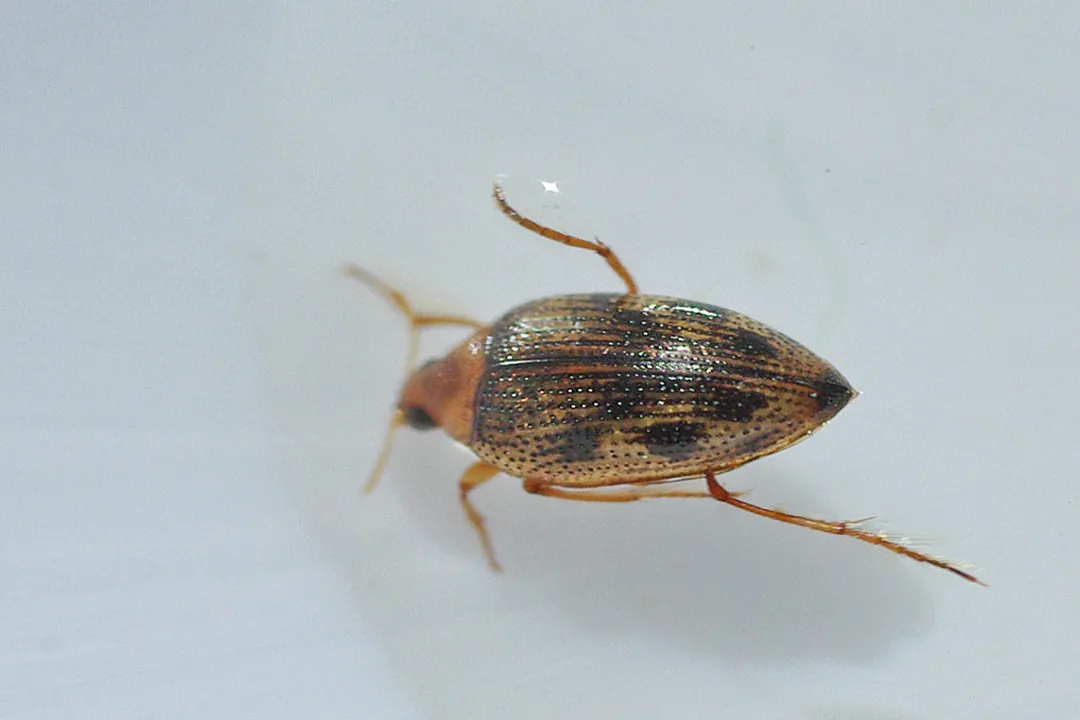
For certain species, the location data is critically important because it defines their conservation status. The Hurd's Crawling Water Beetle, Brychius hungerfordi, serves as a prime example of extreme habitat specificity defining its location profile. [2] This species is federally listed as threatened. [2]
The known locations for B. hungerfordi are restricted to specific river systems, primarily within the Great Lakes region of North America. [2][3] In Michigan, for example, the beetle has been documented in streams within the southern part of the Lower Peninsula, with specific records noted in the Huron River system and the Grand River basin. [3] Its presence requires areas of fast-flowing water, specifically riffles that maintain a consistent current. [2][3] The necessary substrate appears to be a mix of sand and gravel, which needs to be relatively clean and free from excessive siltation. [3] If a river has the right flow but is choked with fine sediment, this species is unlikely to be present, even if it is geographically nearby. [2]
When comparing the location requirements of this specialized beetle with generalist families, the difference is striking. While a common diving beetle family might have members in nearly any pond in the state, [1] B. hungerfordi's location is defined by a few kilometers of perfect lotic conditions. [3] This serves as an important lesson: for common beetles, location means general habitat type; for rare beetles, location means precise hydrologic and geologic conditions within that habitat type. [2][3]
# Regional Specifics
Examining regional field guides provides even more granular location information. For instance, when looking at Water Scavenger Beetles (Hydrophilidae) in Missouri, their presence is tied to the availability of stagnant or slow-moving water bodies. [6] These areas might include permanent or temporary ponds, ditches, and the edges of lakes. [6] They are particularly common where decaying organic matter is present, as many species feed on detritus or decaying plant material. [6] This contrasts with the need for clean gravel substrate seen in the specialized B. hungerfordi. [3]
In the Australian context, aquatic bug guides often point observers toward still water bodies or the sheltered, slow-moving margins of creeks. [7] This reinforces the idea that regardless of continent, there is an ecological niche for beetles that prefer low-energy environments, typically utilizing emergent aquatic plants or floating debris as anchors. [4][7]
If an observer is using water quality testing as a proxy for macroinvertebrate habitat assessment—a common practice in environmental monitoring—the presence of certain beetle families can act as an indicator. [8] Beetles requiring clean, cool, flowing water (like the Crawling Water Beetle group) suggest high water quality, whereas a dominance of species found in still, potentially warm, and slow-moving waters might suggest a different ecosystem profile. [8] Therefore, the location isn't just a point on a map; it's an entire set of physical and chemical parameters acting as a filter for which beetles can establish a population there. [8]
# Actionable Observation
When attempting to locate water beetles in an unknown water body, focusing your search energy where different habitats meet often yields the best results. Since many families prefer the edges and the transition zones, spending time examining the dense vegetation that grows right at the water line—where roots transition into submerged stems—is often more productive than sampling the open, deep water. [4][7] This approach captures species that hide among the plant structure as well as those that crawl along the substrate immediately beneath it. Furthermore, understanding the respiration method is key to location prediction: if you see bubbles rising from the substrate or an air bubble trapped under a beetle's wing covers, you know that individual is utilizing the water-air interface, meaning the surface is a mandatory habitat component, even if the beetle spends most of its time below. [1] A simple sweep net technique, used carefully to target this plant-water boundary, can effectively sample the diverse residents across various flow regimes, provided the substrate preference of highly specialized species is kept in mind. [8]
The sheer variety of aquatic environments, from the silted bottom of a temporary vernal pool to the sun-dappled gravel of a perennial stream riffle, explains why water beetles have achieved such widespread distribution. [1][4] A location survey must account for flow, substrate, vegetation, and depth to capture the full spectrum of these fascinating insects. [4][8]
Related Questions
#Citations
Water beetle - Wikipedia
Hungerford's Crawling Water Beetle (Brychius hungerfordi)
Brychius hungerfordi (Hungerford's crawling water beetle)
Water beetles (order Coleoptera) - LIFE IN FRESHWATER
Water Beetle Insect Facts - Coleoptera hydrophilidae - A-Z Animals
Water Scavenger Beetles | Missouri Department of Conservation
[PDF] Water bug detective guide
Bug o'the Week – Wetlands Month I – Crawling Water Beetle
Water Beetles and Bugs | USU