How do you identify a Blackburnian Warbler?
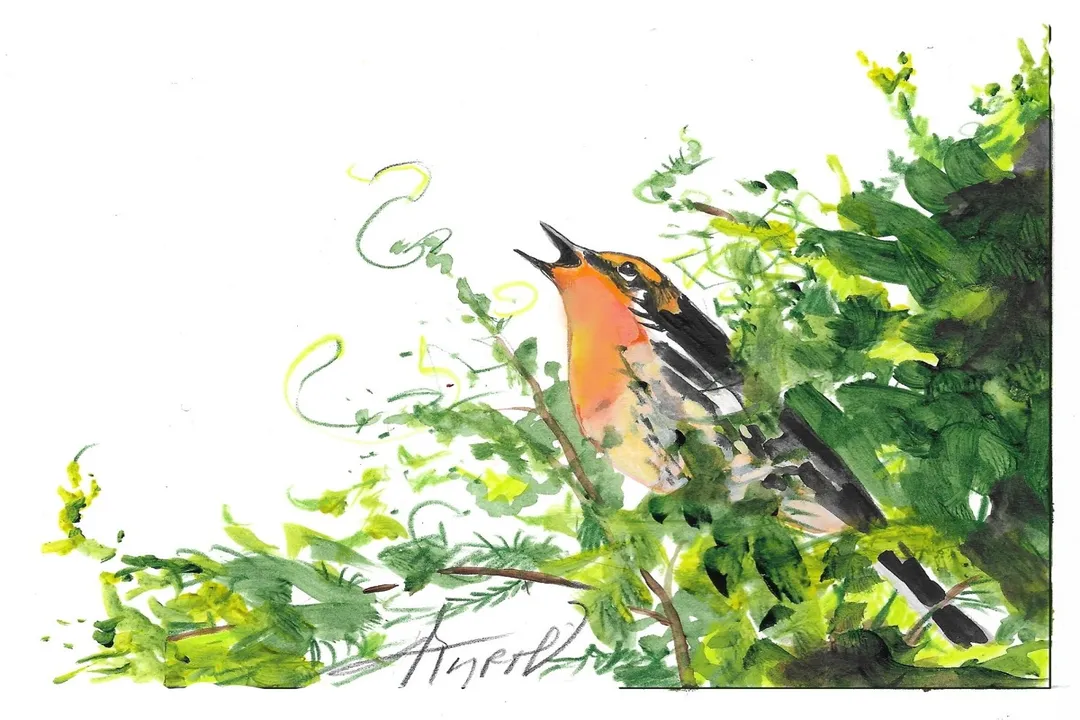
Identifying the Blackburnian Warbler in the field requires a keen eye for color, especially when encountering the brightly adorned male during the breeding season, or careful listening when faced with its less conspicuous female counterparts during migration. These small songbirds, measuring about five inches in length, present a distinct challenge and reward for birders across their range. [1][6] Understanding their specific visual cues and vocalizations is key to confirming their presence, whether they are flitting through a summer spruce stand or pausing briefly on their long migratory passage. [9]
# Male Coloration
The breeding male Blackburnian Warbler is instantly recognizable, primarily due to a spectacular wash of flame-orange across its face and throat. [1][2] This vibrant coloration is perhaps the single most striking field mark. The intensity of this orange can vary, but its presence on the face and upper breast is diagnostic for the adult male. [5]
To complement the fiery face, the male exhibits striking black markings. Its back and flanks are streaked heavily with black against a yellowish-green background. [1][6] Furthermore, there are prominent black markings on the crown. [2] Look closely at the wings; you should observe two distinct white wing bars set against darker feathers. [1] While the upper parts feature this strong black streaking, the underparts are generally pale or whitish, though the flanks often show dark streaks contrasting with the bright orange or yellow wash extending from the breast. [5] A small but helpful detail noted by many observers is the presence of a yellowish eye-ring, which sets off the intense facial pattern. [2]
If you are observing a male in dense coniferous foliage, focus on the strong contrast: the brilliant orange against the dark streaking and the bright white wing patches when the wings are briefly opened or flicked. This combination of flame orange, streaked black, and white wing bars separates it definitively from other yellow-green warblers encountered in similar habitats. [1][6]
# Female Appearance
Identifying the female Blackburnian Warbler demands a different approach, as she lacks the male's intense orange blaze. Females are significantly duller, generally appearing more yellowish-green overall. [2] The distinct black streaking found on the male's back and flanks is present but much less bold and conspicuous in the female. [2]
While the deep orange is absent, females often retain hints of yellow or pale orange on the throat and breast, though these areas will be significantly washed out compared to the male. [5] The wing bars are usually visible, though perhaps less clearly defined than in the fully plumaged male. [1] For the birder, the key is recognizing that the overall pattern—the general structure, the pale eye-ring, and the hint of warmth in the underparts, even if muted—suggests the species, rather than relying on the shocking color display of the male. [2]
When encountering a drab warbler in the canopy during migration, particularly one showing a yellowish cast, it's worthwhile to check for the subtle streaking and wing pattern. It's easy to overlook these more subdued birds, confusing them with plain-looking Yellow Warblers or other Dendroica species, but the combination of features points toward the Blackburnian. [5][9]
# Vocalizations and Sound Identification
Often, the sound is what gives the Blackburnian Warbler away long before the visual confirmation is made, especially since both sexes and the male's bright colors can be obscured by foliage. [1]
The male's song is characteristically high-pitched and thin, often described as insect-like. [1][6] The melody typically consists of a series of thin notes that ascend in pitch, concluding with a sharp, short flourish, often transcribed as a tsee or tsee-tsip. [1][6] The whole sequence is delivered quickly.
When listening for this call during a walk in the woods, an effective way to approach identification is to try and isolate the ascending quality of the notes, focusing less on the loudness and more on the pitch trajectory. [6] If you hear a very thin, almost reedy set of notes climbing upward and ending abruptly, you are likely on the right track.
In addition to the full song, the species has a sharp, plain call note. This call is a simple, emphatic chip. [2] This contact or alarm call is heard from both sexes year-round when the birds are active, making it a useful identifier even outside the singing season. When a group of warblers is moving through, listening for that distinct, sharp chip among the general chatter can help single out the Blackburnian from other species in the mixed-species flock. [3]
# Habitat and Range Specifics
The breeding range of the Blackburnian Warbler is concentrated in eastern North America, extending generally across the northern tier of the continent. [1][4] During the summer months, these birds strongly prefer high-elevation coniferous or mixed-wood forests. [1][6] Specific tree associations include spruce and fir stands. [9] They generally forage high in the canopy of these tall trees. [1]
This preference for dense, often cooler, coniferous nesting environments means that during the breeding season, location is a major component of identification. If you are birding in a lowland deciduous patch in southern regions during June, the odds of finding a breeding Blackburnian are low, though they might be present as late migrants. [9]
During migration, the habitat use broadens considerably. They move through deciduous or mixed woodlands, often utilizing the upper and middle canopy layers. [1][9] This widespread movement means that spring and fall birding in almost any substantial woodland area within their migratory corridor can yield sightings. [3]
Here is a brief summary of typical habitat use:
| Season | Primary Habitat Type | Key Tree Association | Foraging Height |
|---|---|---|---|
| Breeding | Coniferous/Mixed-wood Forest | Spruce, Fir | High Canopy [1][6] |
| Migration | Deciduous or Mixed Woodland | Varied | Mid to Upper Canopy [1][9] |

# Foraging Behavior
To spot a Blackburnian Warbler, you need to watch where it moves in the foliage. They are active foragers, seldom sitting still for long periods. [1][6] Their movement style often involves darting and brief hovering as they snatch insects from the undersides of leaves or needles. [1]
One useful piece of field experience to keep in mind is that because they favor the high canopy even when migrating through mixed woods, observers often have better luck spotting them by tilting their binoculars upward to scan the tops of the trees rather than scanning horizontally through the middle branches. When a flock passes overhead, the bright, often sunlit orange flash of a male is sometimes momentarily visible against the bright sky, even if the bird is too distant for close inspection. This overhead visibility often contrasts sharply with the difficulty of picking out the drabber females deep within the leafy mid-story. [9]
# Distinguishing Similar Species
The identification challenge often comes down to separating the Blackburnian from other small, yellow-green warblers, especially migrants lacking the male’s brilliant throat color. For instance, species like the Wilson's Warbler (lacking strong streaking and having a distinct black cap on the male) or certain Dendroica relatives require careful pattern matching. [2]
Consider the differences in the face pattern. While many warblers have eye-rings or eye-lines, the combination of the intense orange on the throat/face and the prominent white wing bars on a streaked yellowish-green body is the signature of the Blackburnian male. [1][6] If the bird is completely green or yellow without streaking or bright orange patches, it is likely another species.
For birders in the central part of their range during migration, differentiating between a female Blackburnian and a female Bay-breasted or Blackpoll Warbler can be tricky. In such situations, the relative lack of heavy black streaking on the flanks (compared to a female Bay-breasted) and the presence of some warmer color (orange/yellow wash) hints at the Blackburnian, whereas a Blackpoll female often looks paler or grayer overall, lacking the rich yellow tones of the Blackburnian. [5] Relying on a very high, thin, ascending song is often the quickest way to settle the identification when visual cues are ambiguous. [1]
# Migration and Timing
Blackburnian Warblers are long-distance migrants, spending their non-breeding season in Central and northern South America. [1] This extensive travel schedule means that their arrival and departure times significantly impact when and where you are likely to find them in North America.
In the spring, birders in the eastern United States and Canada await their arrival, often starting in late April through May, depending on latitude. [4] The timing of migration can be slightly staggered based on weather systems, with large waves moving north following favorable conditions. Similarly, their southward passage occurs in late summer and early fall, often peaking in September. [9]
A practical tip for maximizing sightings during migration is to track local rarity reports or "fallouts." When a cold front stalls migrating songbirds, hundreds can descend into a small, localized area of good cover (like a park or coastal thicket), temporarily creating concentrated viewing opportunities that defy normal habitat patterns. During these "fallout" events, you might see Blackburnians foraging lower than usual as they rest and refuel, providing better chances to confirm field marks on both sexes. [3] This behavior, where normally high-canopy birds are forced lower by weather, is a classic migratory phenomenon that birders should anticipate.
Overall, successfully identifying a Blackburnian Warbler is a process that combines appreciating the male's breathtaking orange breeding plumage with mastering the subtle cues of the female and paying close attention to the thin, ascending song that carries through the high canopy of eastern woodlands. [1][6]
#Videos
Fall Blackburnian Warbler Identification - YouTube
Related Questions
#Citations
Blackburnian Warbler | Audubon Field Guide
Blackburnian Warbler (Setophaga fusca) identification - Birda
Blackburnian warbler Identification tips
Spotting a blackburnian warbler in its vibrant orange plumage
Bird of the Week- Blackburnian Warbler - St. Louis Audubon Society
Blackburnian Warbler - BirdWeb
Fall Blackburnian Warbler Identification - YouTube
Blackburnian warbler - Conserve Wildlife Foundation of NJ
Treetop Gem: The Brilliant Blackburnian Warbler | The Outside Story