How can I identify an emerald tree boa?

The striking appearance of the Emerald Tree Boa (Corallus caninus) often makes it instantly recognizable, yet confusing it with other vibrant green arboreal snakes is surprisingly common. Identifying this particular South American resident requires paying close attention to several minute, yet definitive, physical characteristics that separate it from its look-alikes. The first thing that captures attention is the intense, almost neon green coloration that covers most of the body. [4][7][8] This vibrant base coat serves as excellent camouflage within the dense canopy it calls home. [4]
# Color and Markings
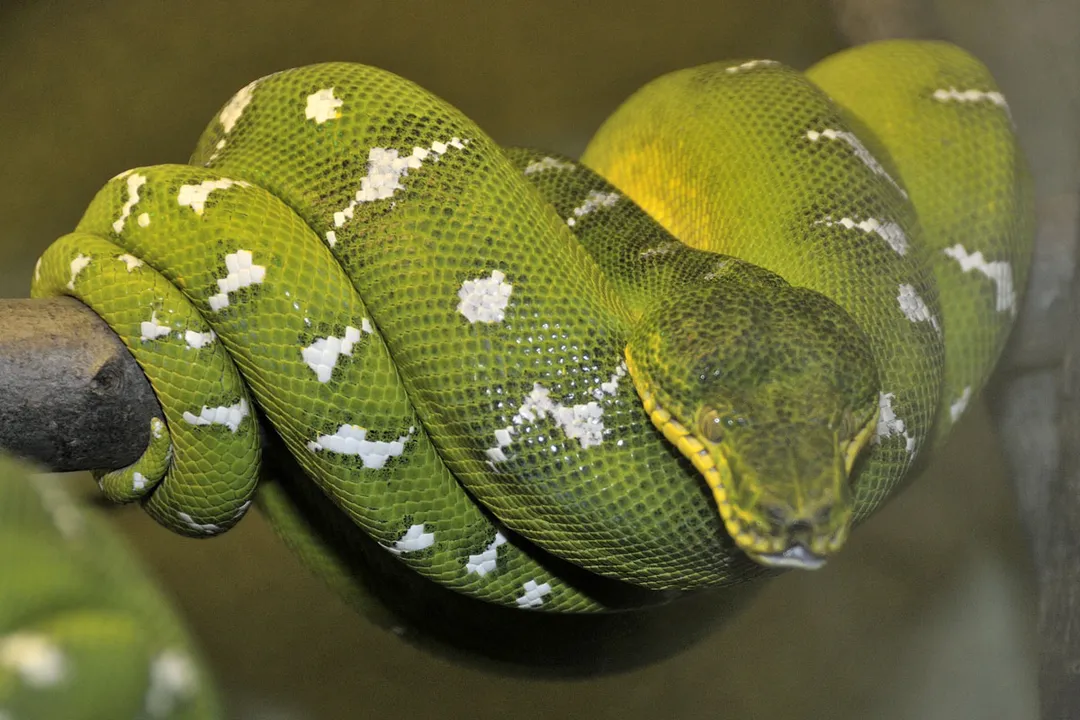
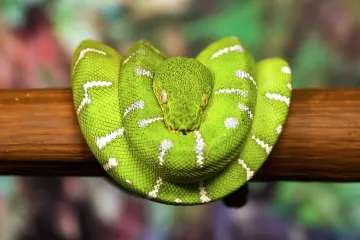
Beyond the dominant green, the presence and style of the secondary markings are critical clues. Emerald Tree Boas typically display striking white or yellowish markings that run down the length of their back. [4][7] These markings are often described as being more like isolated blotches or disconnected spots rather than continuous stripes, though variation exists. [2][6] If you see a snake whose white markings form sharp, distinct triangles pointing down towards the belly, you might actually be looking at a Green Tree Python, which exhibits a much more geometrically precise pattern. [6] The difference in how those dorsal markings are arranged—whether they are scattered, irregular blotches or neat, sharp diamonds—can be a quick indicator. [2][6]
# Key Physical Traits
Several non-color features cement the identification of Corallus caninus. The head shape is one of the most unusual aspects; it appears disproportionately large when compared to the slender neck. [2] Furthermore, the eyes themselves are often described as being bright red or orange, which stands out dramatically against the green scales. [4][7]
Another vital characteristic involves the texture of the scales. Emerald Tree Boas possess scales that are distinctly keeled—meaning they have a ridge running down the center of each scale—though this may not always be obvious from a distance. [2][6]
A more unusual, though often hidden, trait is the presence of extremely long maxillary teeth, particularly noticeable in juveniles. [2][4] While you generally won't see these unless the snake gapes its mouth, it is a known feature of the species, which uses these teeth to secure fast-moving prey in the dark. [2] Finally, their highly arboreal lifestyle is supported by a prehensile tail, which they wrap tightly around branches while resting in their characteristic coiled sleeping posture. [2][4][7]

# Comparing Look-Alikes
The primary challenge in identification comes from differentiating the Emerald Tree Boa from two other common green snakes: the Green Tree Python (Morelia viridis) and the Green Tree Snake (various species, often Dendrelaphis). Recognizing the differences between these three species requires a focused checklist of contrasts. [1][6]
| Feature | Emerald Tree Boa (C. caninus) | Green Tree Python (M. viridis) | Green Tree Snake (Dendrelaphis) |
|---|---|---|---|
| Scale Texture | Keeled [2][6] | Smooth [6] | Keeled [1] |
| Body Build | Very robust, heavy-bodied [6] | More slender, athletic [6] | Very slender, thin [1] |
| Dorsal Markings | Irregular white/yellow blotches [2][6] | Sharp, defined white/yellow triangles [6] | Usually uniform green, less distinct markings |
| Head Shape | Very large, distinct from neck [2] | More tapered head [6] | Less pronounced head size difference |
| Pupil Shape | Elliptical or round [6] | Vertical (elliptical) [6] | Elliptical [1] |
When examining pupil shape, remember that the Boa's pupil may appear rounder in certain light conditions compared to the consistently vertical slit seen in the Python. [6] If you are in a situation where you can feel the snake, the difference between the keeled scales of the boa and the smooth scales of the python is definitive. [6] For the slender Green Tree Snake, the sheer lack of body mass compared to the stout build of the boa usually provides the first clue. [1]
# Habitat Context
While identification relies heavily on physical appearance, knowing where you are looking can sometimes provide a supporting context. The Emerald Tree Boa is native to the rainforests of northern South America, inhabiting areas like the Amazon basin. [2][4] Knowing the snake’s geographical origin can rule out species that are strictly endemic to other continents or regions, such as Australia (where the Green Tree Python originates). [5][6] Although the species' distribution is broad, recognizing that the boas inhabit the upper canopy layers further reinforces their identification as an exclusively arboreal species. [4]
If you encounter a snake exhibiting a unique pattern—perhaps one with more pronounced white striping along the sides rather than just dorsal blotches—it’s worth considering the subtle regional variations within the species. While published guides often focus on the "classic" look, field observations sometimes reveal local populations possessing bolder, more connected white markings that blur the line between what might be described as a blotch or a stripe. [2][6] Experienced keepers sometimes note that boas collected from slightly different river basins display shifts in the intensity and connectivity of their white patterns, which is a fascinating, though non-diagnostic, point of interest. [2]
# Practical Observation Checklist
For someone trying to confirm an identification quickly, running through a mental checklist focusing on the most obvious features is the most effective approach. If you are looking at a green, tree-dwelling snake, ask yourself these three questions in order:
- Body Mass: Is the snake heavy-bodied, thick, and robust for its length, or is it noticeably slender? If robust, lean toward the boa or python. [6]
- Scale Feel/Look: Are the scales clearly ridged (keeled), or do they appear perfectly smooth under good light? Keeled suggests Boa or Green Tree Snake; smooth suggests Green Tree Python. [1][6]
- Eye Color: Are the eyes strikingly red or orange? This strongly favors the Emerald Tree Boa over most other green tree snakes in the region. [4][7]
If the snake is robust, keeled, and has bright red eyes, you can confidently identify it as an Emerald Tree Boa. Conversely, if it is robust, smooth-scaled, and has vertical pupils, you are almost certainly looking at a Green Tree Python. [6] If it is extremely thin, keeled, and has elliptical pupils, it is likely a Green Tree Snake. [1] This systematic elimination based on morphology is the most reliable path to identification. [6]
Related Questions
#Citations
Easy Guide To Identifying Green Tree Snake vs Emerald ...
Corallus caninus (Emerald Tree Boa) | INFORMATION
What is an Emerald Tree Boa?
Emerald tree boa - Animals
The Emerald Tree Boa and Paleogeography
Emerald tree boa - San Francisco Zoo & Gardens