What are some interesting facts about the Blackburnian Warbler?

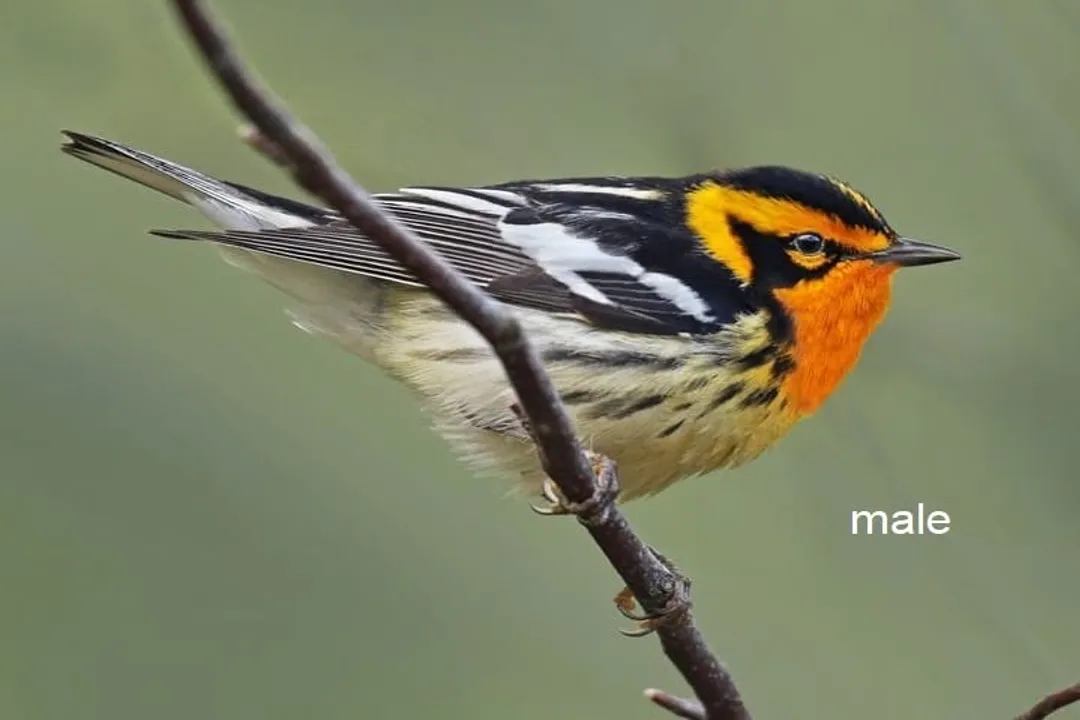
The Blackburnian Warbler, Setophaga fusca, presents a striking visual contrast between the sexes, making its identification a particular delight for birdwatchers who manage to spot the brilliant male during the breeding season. [1][7] This small songbird is renowned for the male’s intense, fiery orange or deep yellow throat and breast, which can appear almost reddish or flame-colored when backlit by the sun. [1] This vivid plumage is set against a black and white patterned back and flanks that feature black streaks. [1] The male also sports white wing bars and distinct black streaks on its sides. [6] In sharp contrast, the female exhibits a much more subdued appearance; her throat and breast are a pale yellow, lacking the male's dramatic intensity. [1] Both sexes possess dark eyes and fine, pointed bills suited for insect foraging. [3] Identifying features common to both include the white wing patches and the somewhat indistinct eye-ring, though the male's pattern is far more defined with prominent black stripes bordering the orange throat patch. [6][1] Young birds generally resemble the female, though their colors may be slightly duller. [6]
# Range and Habitat
The geographic range of the Blackburnian Warbler dramatically splits between its summer breeding grounds and its winter havens, reflecting diverse ecological needs across the year. [5][2] During the nesting season, these birds are distinctly northern residents, preferring mature, often high-elevation coniferous or mixed-wood forests across the boreal regions of North America. [9][8] Specifically, their breeding territory stretches across the northern tier of the continent, covering areas from the Great Lakes region northeastward through southeastern Canada, including the Maritime provinces. [5][8] In the United States, while they breed sparsely in some areas, the core populations are concentrated in the Appalachian Mountains and the northern New England states. [5] The preference within these forested areas leans toward cool, moist environments dominated by spruce, fir, and hemlock trees, though they will use deciduous trees as well, provided the canopy structure suits them. [9][1] Observers in places like the higher elevations of the Appalachians, such as in Tennessee, frequently associate them with these dense stands of conifers. [8]
Once the breeding season concludes, the picture shifts entirely as they embark south for the winter. [2] Their non-breeding habitat is characterized by a completely different set of environmental conditions, generally found in the humid, broadleaf evergreen and deciduous forests of Central and northern South America. [6][7] They are commonly found from southern Mexico down through Colombia, Ecuador, and Venezuela. [6] This massive shift in geography means that a bird born in a cool, needle-scented spruce forest in Maine spends its winter amidst the humid, tropical foliage of the Andes foothills, a testament to their adaptive capabilities. [2]
This extreme geographic separation in residency highlights a key ecological feature of this species. Consider the stark difference in necessary resource availability between the two life stages:
| Feature | Breeding Habitat (Summer) | Wintering Habitat (Winter) |
|---|---|---|
| Primary Vegetation | Coniferous/Mixed Forest (Spruce, Fir, Hemlock) [9] | Broadleaf Evergreen/Deciduous Forest [6] |
| Elevation/Climate | Often higher elevation, cooler, moist climate [8] | Typically lower elevation, tropical/subtropical [6] |
| Key Resource Focus | Abundant summer insects for nesting young | High density of arthropods for refueling [6] |
| Geographic Center | Boreal North America [5] | Central/Northern South America [6] |
The reliance on distinct forest types across their annual cycle underscores the importance of maintaining healthy, continuous habitat corridors across their entire migratory pathway, not just the breeding grounds. [9][2]
# A Bird’s Voice

The vocalizations of the Blackburnian Warbler are an essential part of identifying them when their bright plumage is hidden by dense foliage. [6] The male has a distinctive, high-pitched song that is often described as a rapid, buzzy cascade of notes that ends with a very high, thin final note. [1] It can sometimes sound like a drawn-out tseet-tseet-tsee-tsee-tsee-tseeeeee. [6] When singing loudly, the melody is quite noticeable, especially in the deep woods where they reside. [9]
In addition to the full song, the warbler possesses several distinct calls used for communication, alarm, or contact. [1] One common call is a sharp, relatively high-pitched chip sound, often used when agitated or near the nest. [6] Another is a quieter sip note. [1] Learning the precise quality of the song—that distinctive, soaring, yet insect-like quality—is often more reliable for field identification than relying solely on sight, particularly for birds moving quickly through the canopy. [6]
# Feeding Habits

Like nearly all warblers, the Blackburnian Warbler subsists almost entirely on insects and other small arthropods, especially during the breeding season when they need to provision fast-growing nestlings. [7][6] Their diet typically includes caterpillars, spiders, aphids, beetles, and small wasps. [3] They are primarily insectivores, though they may occasionally consume small berries or nectar when insects are scarce, particularly outside the breeding season. [7]
Their foraging style is characterized by quick, energetic movements within the forest canopy. [9] They are known to actively glean insects from the undersides of leaves and bark crevices, moving methodically through the upper and middle levels of the trees. [9] While they prefer coniferous habitats for breeding, they are capable foragers across different tree structures, moving among the needles and twigs of spruces and firs just as adeptly as they might work through the leaves of a mixed woodland. [8] This energetic approach to finding food ensures they maximize nutrient intake in environments that might have fluctuating insect availability. [3]
# Nesting Cycle
The nesting process of the Blackburnian Warbler is a meticulous affair, usually taking place high up in the trees they inhabit during the summer months. [6] The nest itself is a compact, neat cup, often constructed using fine materials such as pine needles, twigs, moss, and spider silk, which helps bind the structure together and anchor it securely to a branch fork. [6][7] They typically place their nests on a horizontal limb, often quite high off the ground, sometimes as much as 20 to 60 feet up, usually utilizing the cover of the outer branches of conifers like hemlocks or spruces. [6][9]
The female is solely responsible for building the nest. [6] Once the structure is complete, she lays a clutch typically consisting of four or five eggs. [7][6] These eggs are usually whitish or pale buff, marked with light brown or grayish spots. [6] The incubation period lasts around 10 to 12 days, with the female doing nearly all of the sitting. [6] Once the nestlings hatch, both parents share the demanding task of feeding them a steady diet of insects until they fledge, which occurs about 9 to 12 days after hatching. [6] Due to the relatively short breeding season in the north, efficiency in nesting is paramount.
One element often overlooked by casual observers is the necessity of identifying the female or juvenile birds during a sighting. While the male's brilliance draws the eye, a true test of field identification skill lies in correctly picking out the drabber female amidst the canopy shadows. [1] If you are relying solely on identifying the screaming-bright male, you might be missing half the picture of the local breeding pair. The female’s paler yellow wash and subdued streaking require a much closer look and better light conditions than the male's flashy attire. [1] Focusing on that subtle chest wash under the conifers can significantly increase your confirmed sightings during the summer months.
# The Migratory Challenge
The journey undertaken by the Blackburnian Warbler is one of the most arduous parts of its life cycle, involving thousands of miles between its northern breeding range and its tropical wintering grounds. [2] Their migration south generally begins in late summer, with most birds departing their breeding areas by September. [2]
The key to a successful passage lies in refueling efficiently, especially during the southbound leg. [2] Areas like the coastlines or major forested corridors along the Appalachian spine become vital stopover sites, sometimes referred to as "warbler waves" when large numbers of birds pass through simultaneously. [2] These stopovers provide critical, high-calorie insect resources needed to sustain them for the next leg of the flight. For instance, bird-friendly habitats maintained in places like New York State act as temporary sanctuaries where these travelers can recharge before tackling open water crossings or continuing deep into the continent. [2]
Compared to some short-distance migrants, the Blackburnian Warbler undertakes a long-distance commitment, crossing the Gulf of Mexico or navigating the complex terrain of Central America to reach its winter home. [6][7] This multi-stage process—breed, depart, refuel, survive winter, return, breed again—is energetically costly, making survival rates during migration a major factor in population dynamics. [2] The timing of their departure is crucial; departing too early might mean encountering fewer insects on the way south, while departing too late risks running into adverse weather conditions or arriving on the wintering grounds after the best foraging spots have already been claimed. [6]
The spring return journey is equally significant. They follow a similar general route north, often arriving back on their breeding territories in late April or May, ready to find a mate and begin nest construction once the insect hatches begin in earnest. [6] Their success depends on the timely availability of specific canopy types—spruce and fir—which must be insect-rich enough to support the high demands of egg production and chick-rearing. [9]
# Conservation Context
While the Blackburnian Warbler is not currently listed as endangered globally, monitoring its population trends is important due to habitat specialization. [8] The reliance on mature, specific forest types for breeding means that deforestation or changes in forest composition due to climate change or disease (like hemlock woolly adelgid affecting hemlocks, a favored nesting tree) can severely impact local breeding success. [9][8] Furthermore, disturbances on their long migratory routes, such as widespread habitat loss in Central American wintering grounds, place added pressure on the species overall. [2][6] For instance, in regions like Tennessee, their presence is often tied closely to high-elevation forests, making them an important indicator species for the health of those specific ecosystems. [8] Protecting large, contiguous tracts of mature conifer and mixed forest in the northern latitudes is the most direct way to support this species' breeding success. [9]
Related Questions
#Citations
Blackburnian Warbler | Audubon Field Guide
From Jaguars to Waterfalls: One Warbler's Northbound Odyssey
Blackburnian Warbler Bird Facts - Setophaga fusca - A-Z Animals
Blackburnian Warbler breeding habits and characteristics - Facebook
Blackburnian Warbler Dendroica fusca - Find a Bird - BBA1
Blackburnian Warbler Life History - All About Birds
Dendroica fusca (Blackburnian warbler) - Animal Diversity Web
Blackburnian Warbler | State of Tennessee, Wildlife Resources ...
Treetop Gem: The Brilliant Blackburnian Warbler | The Outside Story