How do you identify a mourning warbler?
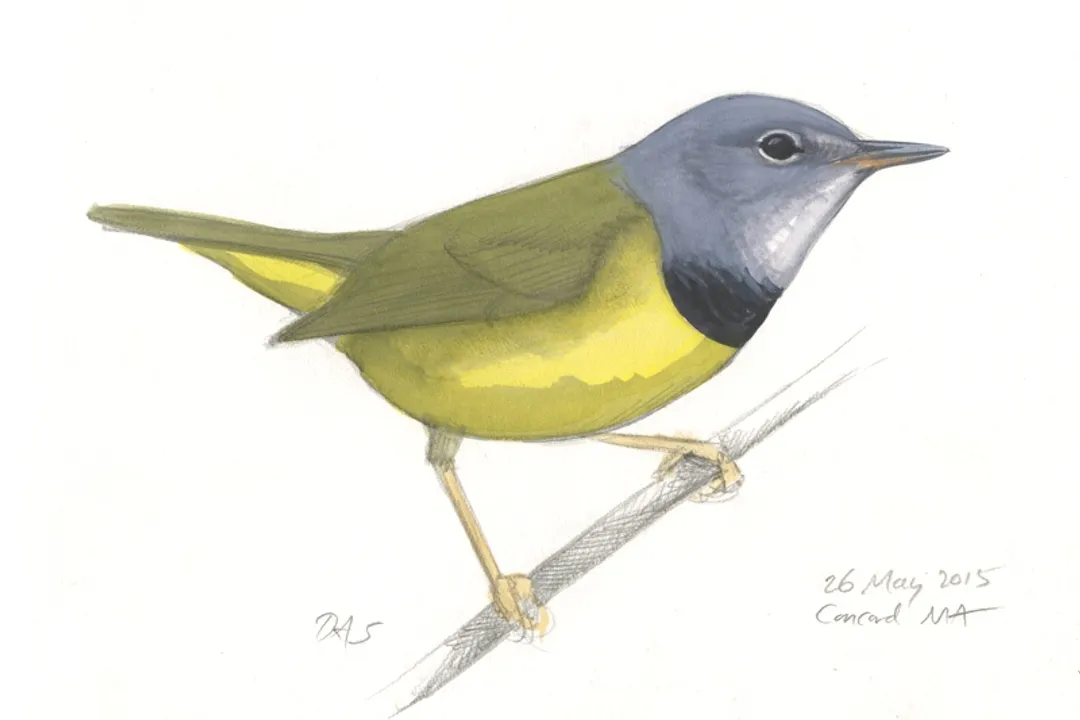
The Mourning Warbler presents one of the more satisfying identification challenges among the New World warblers, precisely because it earns its reputation as a skulker of the dense understory. Finding one often requires patience, a sharp ear, and an appreciation for the subtle, often hidden, plumage cues that separate it from its close relatives. This bird stays low, foraging in brush and low thickets year-round, and even during migration, it rarely joins mixed flocks, preferring solitude in the thickest cover available.
# Core Plumage
The visual key to identifying the Mourning Warbler hinges on understanding the distinct differences between the sexes, particularly in breeding plumage. Overall, the bird is small—about the size of a Sparrow—with olive upperparts and bright yellow underparts. Its bill is thin and pointed, and its legs are pinkish.
# Adult Male Look
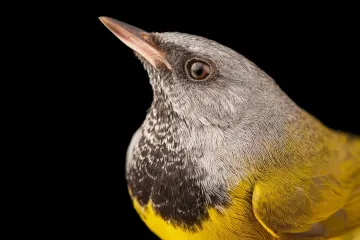
The adult breeding male is the most striking, which is how the bird earned its evocative name. He is characterized by an olive-green back, contrasting sharply with bright yellow flanks and belly. The head features a distinct gray hood that encompasses the head and throat area. Crucially, the male displays a complete black patch covering the throat and breast. This extensive black area, suggesting mourning attire to early observers, is the definitive field mark for an adult male in the breeding season. Even in the fall, the breast patch remains, though it may appear less distinct against slightly duller colors.
# Female Immature
Females and first-year birds lack this dramatic presentation, making their identification more dependent on context and subtle head patterns. Adult females and immature males are significantly paler overall than their counterparts. They do not possess the solid black chest patch. Instead, the head wash is a more muted gray-brown, and the throat might show a yellowish wash, or the breast may carry a brownish-olive cast. Immature females, in particular, show less contrast between their heads and backs.
When looking for ocular details, both sexes generally lack an eyering, which is a vital separation tool from the similar Connecticut Warbler. However, an adult male might exhibit thin white eye arcs, a feature that can cause momentary confusion with the MacGillivray’s Warbler, which has bolder markings.
# Shape Structure
In terms of structure, the Mourning Warbler is described as a small but sturdy songbird with a relatively full body and a thick neck. They possess moderately long tails and strong legs, helping them navigate dense shrubbery. Measurement-wise, they run about inches (14 cm) in length, with a wingspan around 7.1 inches (18 cm). A consistent field mark, important across all plumages, is the absence of wingbars.
# Auditory Clues
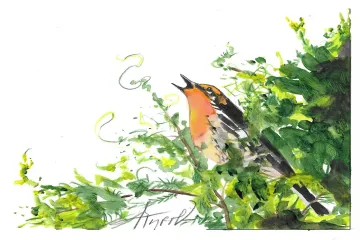
Since these birds often hide in dense tangles, sound identification becomes paramount, especially during migration when they might be quiet, or on the breeding grounds when only the male sings to defend territory. The typical song is described as loud, ringing, and musical. The pattern is often transcribed as teedle-teedle, turtle-turtle, with the last pair of notes noticeably lower in pitch. On the breeding grounds, the song can be short and somewhat burry. If you hear a warbler singing a somewhat halting or variable tune, especially in early morning or toward evening when they sometimes perform rapid, skylarking song flights, you should focus your search in the nearby brush. Their typical alarm call is described as a falling, flat chip or chirp.
# Habitat Behavior
Identifying a Mourning Warbler often means knowing where not to look for typical warblers. While many warblers move through the mid-story or canopy, the Mourning Warbler nearly always forages low to the ground, walking along branches or hopping right on the ground to glean insects, caterpillars, and spiders. Their preferred habitat in the north consists of brushy, second-growth areas, often in clearings created by fires, storms, or logging operations, especially where dense shrubbery or berry-bearing tangles like raspberry and blackberry thrive. They will also use bog edges. This preference for temporary, regenerating habitats is so strong that the species is sometimes referred to as "fugitive," as they must relocate when their favored thickets mature past a certain point, roughly 7 to 10 years post-disturbance. When migrating or overwintering in the tropics, they maintain this preference for low, dense thickets and overgrown fields.
If you suspect you have one nearby but can’t see it, pishing sounds might coax a bird into view, though they usually remain concealed even while singing. Because this species tends to be solitary, you should stop looking for a flock of warblers and focus your attention narrowly on a single, dense patch of shrubs.
For birders accustomed to mixed-species foraging flocks, observing a Mourning Warbler requires a change in mindset. If you are scanning deciduous trees for Yellow-rumped or Black-throated Green Warblers and find nothing, shift your focus to the dense underbrush at the edge of the woods or a nearby clearing; this specialized habitat use is as good an identification clue as any plumage feature. Furthermore, note that they migrate relatively late in spring, sometimes arriving on breeding grounds as late as early June, meaning you might be searching for them long after other warblers have settled in.
# Similar Species Comparison
The key to positive identification often lies in ruling out three main look-alikes: the Connecticut Warbler, MacGillivray's Warbler, and the Common Yellowthroat.
# Connecticut Warbler
The Connecticut Warbler is the closest relative in structure and behavior but has two unmistakable differences when seen well. First, the Connecticut Warbler possesses a complete, distinct eye-ring. Second, it is generally larger than the Mourning Warbler. While both may inhabit similar brushy areas, the presence of that full ring immediately rules out a Mourning Warbler.
# MacGillivray's Warbler
The MacGillivray's Warbler is essentially the western counterpart to the Mourning Warbler, and fortunately, their breeding ranges do not typically overlap, simplifying identification geographically. For males, the MacGillivray's usually shows broken eye-rings, contrasting with the Mourning's lack thereof (though this can be obscured by the male’s dark hood). Separating females and immatures is notoriously difficult, and identification in these plumages is often strictly based on whether the bird is within the expected range for that species.
# Common Yellowthroat
Female and immature Mourning Warblers can sometimes be confused with the Common Yellowthroat. The primary distinctions here involve the extent of gray/olive coloration and the belly color. Yellowthroats typically lack the noticeable gray or brownish wash across the breast that a female Mourning Warbler may exhibit. More decisively, the Common Yellowthroat has a white belly, whereas the Mourning Warbler is yellow below. If a bird looks generally yellow underneath but lacks the strong black throat of a male, check the lower belly—yellow rules for Mourning, white suggests Yellowthroat.
# Puzzling Variations
Birders should be prepared for variations that defy easy categorization, as the Mourning Warbler is known for showing anomalies, sometimes even hybridizing with the MacGillivray's Warbler where their zones meet. David Sibley described an unusual sighting of a bird that looked like a Mourning Warbler but featured a pale gray face, conspicuous thin whitish eye-arcs, a clean white throat, and a striking black breast patch. This observation highlights a scenario where the black breast patch, normally blending with a dark gray throat in males, stood out dramatically against the white throat, suggesting a potential first-spring male failing to molt correctly, or a hybrid. When you encounter a bird that seems to mix features—for example, possessing strong eye arcs and a heavy black breast patch, or having an unusually clean white throat against that patch—it warrants extra scrutiny. If the bird is singing, songs in hybridization zones can be intermediate between the two species.
The takeaway for the field is to rely on a hierarchical approach when encountering ambiguity: If the bird has a clear, solid black throat and a gray hood, it is an adult male. If it is yellow below but lacks that black throat, check for a white belly (Yellowthroat) or a full eye-ring (Connecticut). If neither of those fit, the bird is likely a female or immature Mourning Warbler, best identified by the subtle olive-yellow underparts and the overall lack of a strong pattern, remembering that they should not show distinct wingbars.
For those wanting to confirm their identification in North America, checking real-time sightings on community science platforms like eBird can provide essential regional context, confirming if a specific unusual sighting type (like the white-throated variant mentioned above) has been documented recently in your state or province. This cross-referencing with community data builds confidence when you are faced with a truly unusual individual. Considering the bird's known tendency to be solitary, if you find one unusual bird, you should resist the urge to immediately search for a mate or companion in the same dense thicket; you are more likely to find the same bird still skulking nearby than a second one.
Related Questions
#Citations
Mourning Warbler Identification - All About Birds
Mourning Warbler | Audubon Field Guide
Mourning Warbler
An interesting warbler - Sibley Guides