What is the mobility trade-off associated with the Wattled Jacana's giant feet?
Answer
It is somewhat awkward and slow when forced to walk on dry land or firm banks
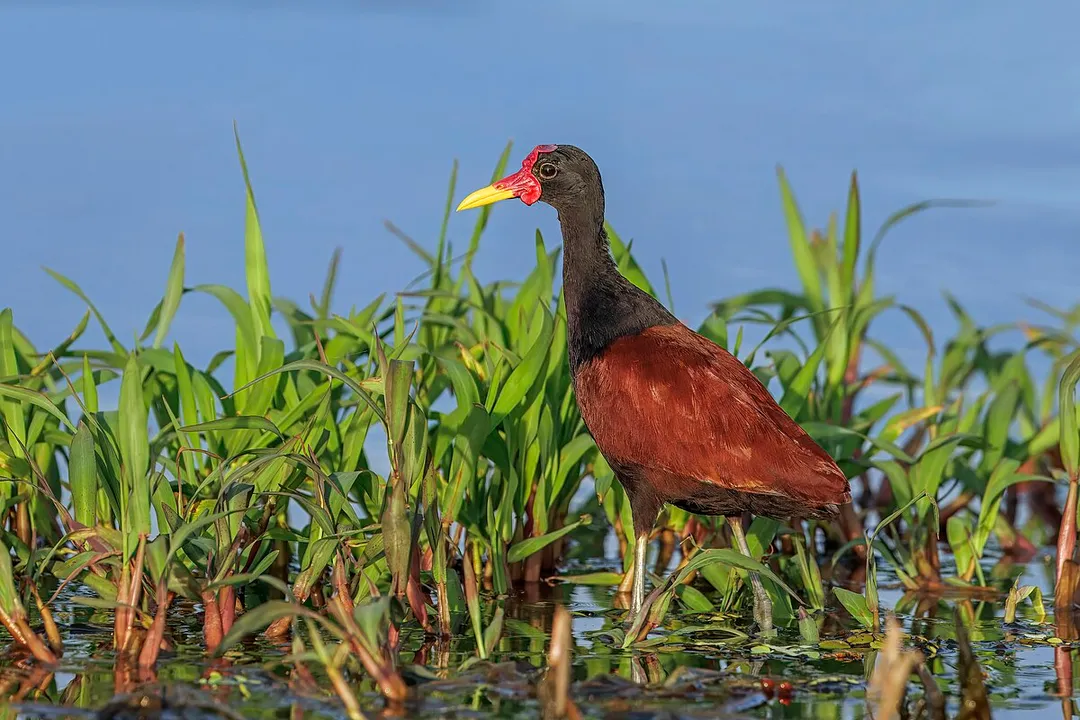
The extreme specialization of the Wattled Jacana's feet for distributing weight on floating plants results in a clear disadvantage when the bird is forced onto solid ground. While perfectly suited for traversing unstable aquatic mats, the large appendages designed for surface tension support are not optimized for terrestrial propulsion. Consequently, when walking on dry land or firm banks, the bird appears slow and awkward, relying on these large structures primarily for balance rather than efficient forward movement.
Related Questions
What is the prominent fleshy yellow structure adorning the Wattled Jacana's head?What structural adaptation grants the Wattled Jacana its nickname, the "Jesus Bird"?What is the mobility trade-off associated with the Wattled Jacana's giant feet?What geographical region encompasses the wide distribution of the Wattled Jacana?What type of food source primarily constitutes the diet of the Wattled Jacana?What is the mating system characteristic of the Wattled Jacana's breeding behavior?Following egg laying in the polygynous system, which parent assumes responsibility for incubation?What is the male Wattled Jacana's unique defense mechanism when facing terrestrial or avian predators?What environmental stability factor is critical for determining suitable foraging territory for the jacana?What is the current global conservation status assigned to the Wattled Jacana?What is the typical length measurement range for an adult Wattled Jacana?