How does the Zebra Mussel's flattened underside differ from the Quagga Mussel's rounded underside during a stability test?
Answer
It remains stable when placed on a flat surface
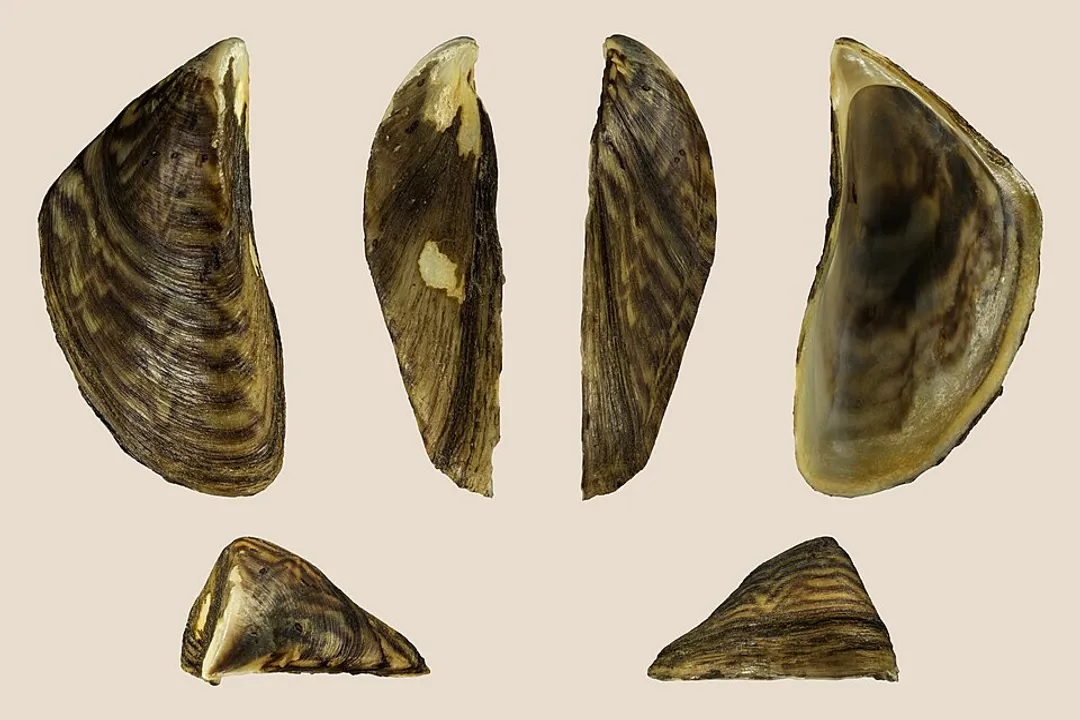
When differentiating between the closely related Zebra Mussel (*D. polymorpha*) and the Quagga Mussel (*D. bugensis*), a simple physical assessment known as the 'sit test' is highly effective. The Zebra Mussel possesses a distinctly flattened ventral (bottom) side, which allows it to lie flat and remain stable when placed on a level surface. Conversely, the Quagga Mussel has a rounded underside, causing it to fall over onto its side when subjected to the same test. This morphological difference in the base shape is the primary characteristic used for quick field identification.
Related Questions
What shape is the hard, calcified shell of the Zebra Mussel (Dreissena polymorpha)?What is the typical adult size range for a Zebra Mussel in inches and centimeters?What physical characteristic gives the Zebra Mussel its common name?What specialized fibers allow the Zebra Mussel to anchor securely to virtually any firm underwater substrate?What term describes the dense clusters formed by aggregating adult Zebra Mussels?How does the Zebra Mussel's flattened underside differ from the Quagga Mussel's rounded underside during a stability test?What are the free-swimming, microscopic larvae of Dreissena polymorpha called, and what is their typical size?What features interrupt the generally smooth surface texture of the Zebra Mussel shell upon closer inspection?What is the reported color variation for the nacre layer found on the interior of the Zebra Mussel shell?What is the typical lifespan range cited for an adult Zebra Mussel?