Zebra Pleco Physical Characteristics
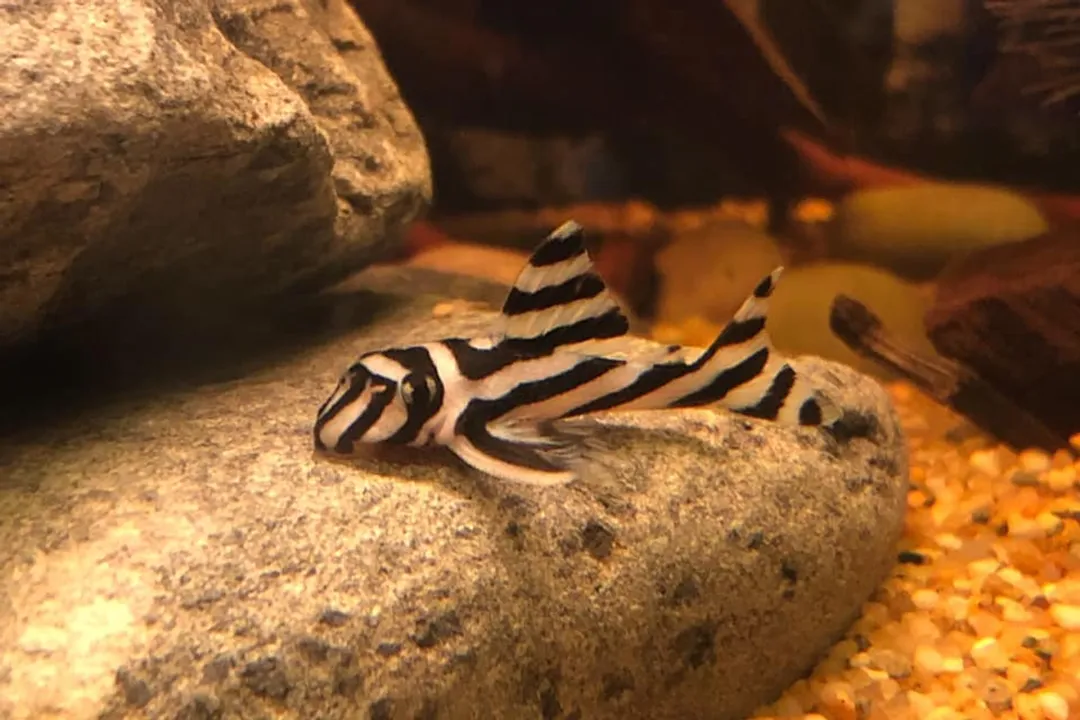
The defining feature of the Zebra Pleco, or any fish bearing that coveted moniker, is its stunning, high-contrast livery. These small catfish are instantly recognizable by the bold, alternating bands of black and white that wrap around their entire bodies. [2] This dramatic patterning is precisely what earns them the "Zebra" designation. The intensity of this pattern is often a key indicator of the fish's condition; a healthy specimen will display sharply defined bands, not blurred or faded ones. [5]
# Number Codes
The L-number system, used to classify Loricariidae catfish before formal scientific description, is particularly relevant here, as it helps distinguish between closely related or visually similar species that share the 'Zebra' name. [2] The original and arguably most sought-after fish is scientifically Hypancistrus zebra, often referred to by the L-numbers L046 and sometimes L098. A variation associated with the L098 number specifically involves wavy or broken lines instead of the perfectly straight stripes found on the more common L046 form. [2]
However, the trade also includes the L129 or Colombian Zebra Pleco, scientifically classified as Hypancistrus debilittera. [1] While visually similar, understanding these codes is crucial, especially given the conservation status of the true H. zebra. [2] A dedicated aquarist needs to be aware that the common term "Zebra Pleco" can refer to at least two distinct, albeit similarly marked, fish. [1]
# Adult Dimensions
Compared to many of their larger, more common Loricariid cousins—some of which balloon to 18 inches or more—the fish referred to as Zebra Plecos are remarkably petite. [1] This manageable size is one of their main appeals for aquarists not equipped for massive tanks. [1]
The true Hypancistrus zebra (L046/L098) is consistently reported to reach a maximum length of around 2.5 inches up to 4 inches (approximately 6.4 cm to 10 cm) in an aquarium setting. [2] Some reports cite a maximum of just 2.5 inches standard length (SL).
The L129 Colombian Zebra Pleco, H. debilittera, is often noted as being slightly smaller, with maximum adult sizes generally listed between 2.5 to 2.8 inches, or about 6.4 cm to 7.1 cm. [1] Given that the species are related, it's understandable why they are sometimes grouped together, but this small size difference highlights the need for precise identification for those documenting lineage or aiming for exact biotope replication. [1][6]
# Body Structure
Like all members of the Loricariidae family, Zebra Plecos possess armored plates covering their bodies, distinguishing them from soft-bodied catfish. [2] They are bottom dwellers, and their physique reflects this lifestyle. They feature a notably flattened underside and a body shape adapted for resting on or near the substrate in fast-flowing water. [2][6]
When observing a healthy adult from above, the body structure should appear robust. Specifically, the area just behind the pectoral fins should be as wide as, or wider than, the head. [5] A significant physical deviation from this is underdeveloped growth, where the body remains much narrower than the head, a sign of sub-optimal conditions during juvenile development. [5] Furthermore, a healthy fish will exhibit a round and full tummy, a direct physical indicator that the fish has been feeding well and is not suffering from internal ailments or long-term malnutrition. [5] Conversely, a sunken belly suggests severe undernourishment, which can sometimes lead to permanent internal damage. [5]
# Fin Features
The fins contribute significantly to the overall appearance and species identification. The dorsal fin is generally well-developed. [5] A key trait, particularly for discerning healthy specimens during purchase, is the shape of the caudal fin, or tail fin. A healthy Zebra Pleco should display a pronounced V-shape in its tail. [5] Underdeveloped specimens, however, might exhibit a permanently round tail fin. [5] Pectoral fins should also be fully formed; underdevelopment can manifest as very short pectoral fins. [5]
In terms of sexual characteristics, mature males often present physical differences noticeable upon close inspection or from a dorsal view. Males typically develop a wider head compared to females. [2][6] Furthermore, mature males possess longer interopercular spines—the bristle-like structures located on their cheek or operculum area—than their female counterparts. [5][6] Females, on the other hand, tend to present a shorter and plumper shape when viewed from above, a characteristic that becomes more pronounced as they prepare to spawn. [2][6]
# Cranial and Ocular Traits
While the pattern dominates the visual impression, specific details of the head and eyes are important for assessing health and confirming identity, especially when purchasing high-value specimens. [5] A healthy Zebra Pleco is described as having a relatively long nose. [5] The eyes are another subtle characteristic; a healthy fish may exhibit a bluish tint in its eyes, although this can be challenging to observe clearly in photographs. [5] Even the fins can show this coloration, with the caudal and tail fins sometimes showing a bluish tint when the fish is healthy. [5] Any sign of lesions or red spots on the skin or fins is a serious red flag, indicating potential injury, poor water quality, or infection. [5]
If you are examining a fish where the striping pattern seems slightly inconsistent, such as having wavy or broken lines rather than stark, straight ones, remember that this might simply indicate you are looking at an L098 variant rather than a compromised L046. [2] While the L129 is identified by its species name, it's important to realize that for the purist collector, differentiating between the L046 and L098 variations relies entirely on these minute, pattern-based physical characteristics, making detailed observation paramount before acquisition. [2] Moreover, the physical condition related to feeding is immediately observable; if the fish's muscle tone does not clearly indicate it has been well-fed, avoid purchasing, as a sunken belly can sometimes signal permanent internal damage that no amount of future care can fully repair. [5]
Related Questions
#Citations
Health - ZebraPleco.com • The complete Hypancistrus zebra resource
Zebra Pleco | Endless Ocean Wiki - Fandom
How to Build a Zebra Pleco Habitat | TFH Magazine
Zebra pleco - Hypancistrus zebra - Aqua-Fish.Net
Zebra pleco - Wikipedia
L129 Colombian Zebra Pleco (Hypancistrus debilittera) - Aquatic Arts