How are the maxillary teeth of *Xiongguanlong* described compared to later tyrannosaurs?
Answer
They are labiolingually narrow and more blade-like.
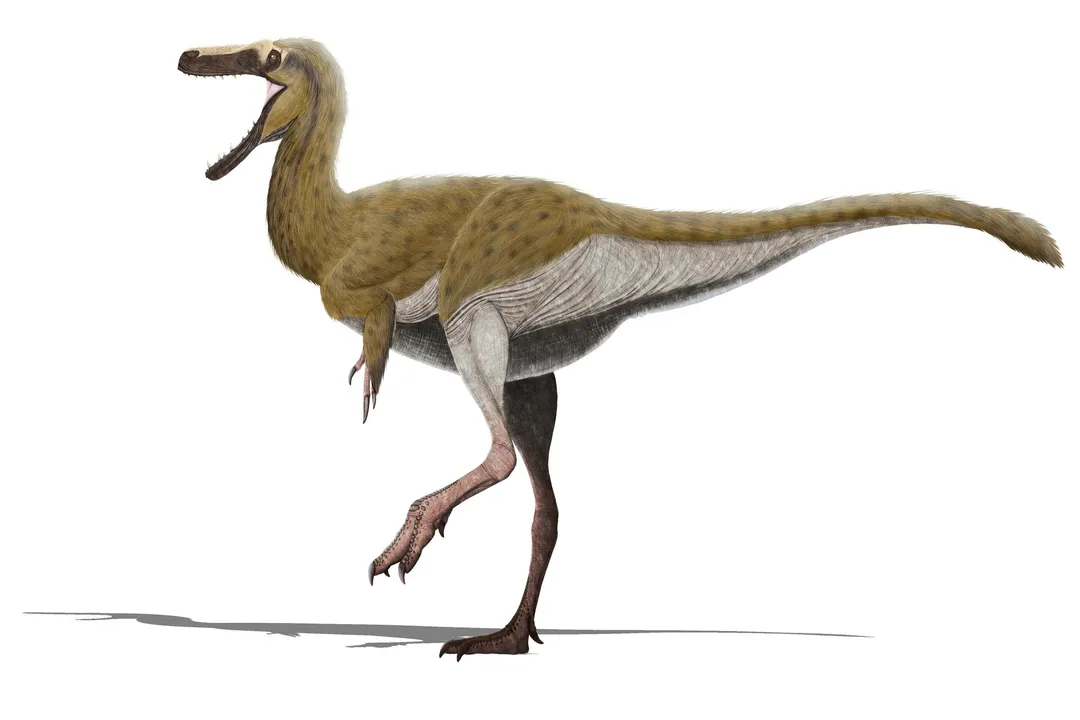
The maxillary teeth, located further back in the upper jaw of *Xiongguanlong*, exhibit a form optimized for cutting flesh rather than crushing bone. They are characterized as being labiolingually narrow, giving them a more blade-like profile, which contrasts with the typically more conical crowns seen in later tyrannosaurs like *Tyrannosaurus*. Although they do possess serrations on both edges (carinae), these serrations are small and block-shaped, supporting the interpretation that *Xiongguanlong* was adapted for precision tearing and slicing prey rather than pure bone-crushing power.
Related Questions
Where was the fossil specimen *Xiongguanlong baimoensis* unearthed from the geological record?How did *Xiongguanlong*'s estimated mass compare to the *T. rex* specimen SUE?What morphological descriptor is applied to *Xiongguanlong* due to its skull shape?What proportion of the total skull length did the preorbital region account for in *Xiongguanlong*?Which trait is absent in *Xiongguanlong* nasals but present in *Dilong* and *Eotyrannus*?What characteristic is noted for the serrations on the premaxillary teeth of *Xiongguanlong*?How are the maxillary teeth of *Xiongguanlong* described compared to later tyrannosaurs?How many pairs of pneumatic foramina do *Xiongguanlong*'s cervical centra possess compared to *Tyrannosaurus*?What characteristic of the axial neural spine is shared with more derived tyrannosaurids?Which other longirostrine tyrannosauroid do *Xiongguanlong*'s body proportions resemble?