Besides the head and body, where else was Xiaotingia clearly covered in feathers?
Answer
Forelimbs and hind limbs
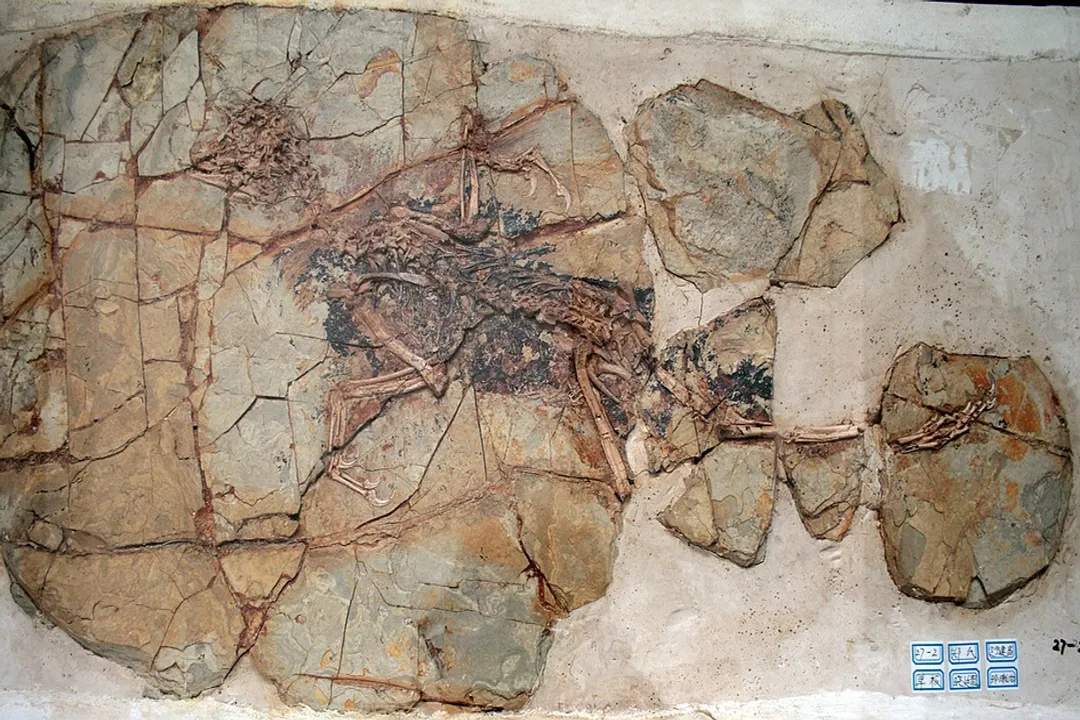
The fossil evidence demonstrates that *Xiaotingia* possessed extensive plumage, contributing significantly to its placement near the avian origins debate. The creature was clearly covered in feathers across its main torso and head, but significantly, feathers were also present across both its forelimbs and its hind limbs. The presence of substantial feathers on the legs, including lengths reaching 55 mm on the femur and long, vane-like feathers on the tibia and metatarsus, leads to speculation about potential auxiliary functions in locomotion or short flights.
Related Questions
Roughly when did Xiaotingia zhengi exist based on Bathonian and Oxfordian stages?What was the estimated total length of the diminutive Xiaotingia?Which anatomical marker suggests Xiaotingia sat closer to the Deinonychosaurs branch?For which paleontologist was the specific epithet zhengi of Xiaotingia zhengi an honorific?What is the designation for the almost complete type specimen of Xiaotingia that includes the skull?How is the diet of Xiaotingia zhengi categorized by paleontologists?Besides the head and body, where else was Xiaotingia clearly covered in feathers?What capability might be suggested by the femur (84 mm) being longer than the humerus (71 mm) in Xiaotingia?Which groups did the initial analysis by Xu et al. suggest Xiaotingia grouped closely with, excluding traditional birds?From which geological formation in China was the specimen of Xiaotingia likely recovered?