Xiaotingia Diet
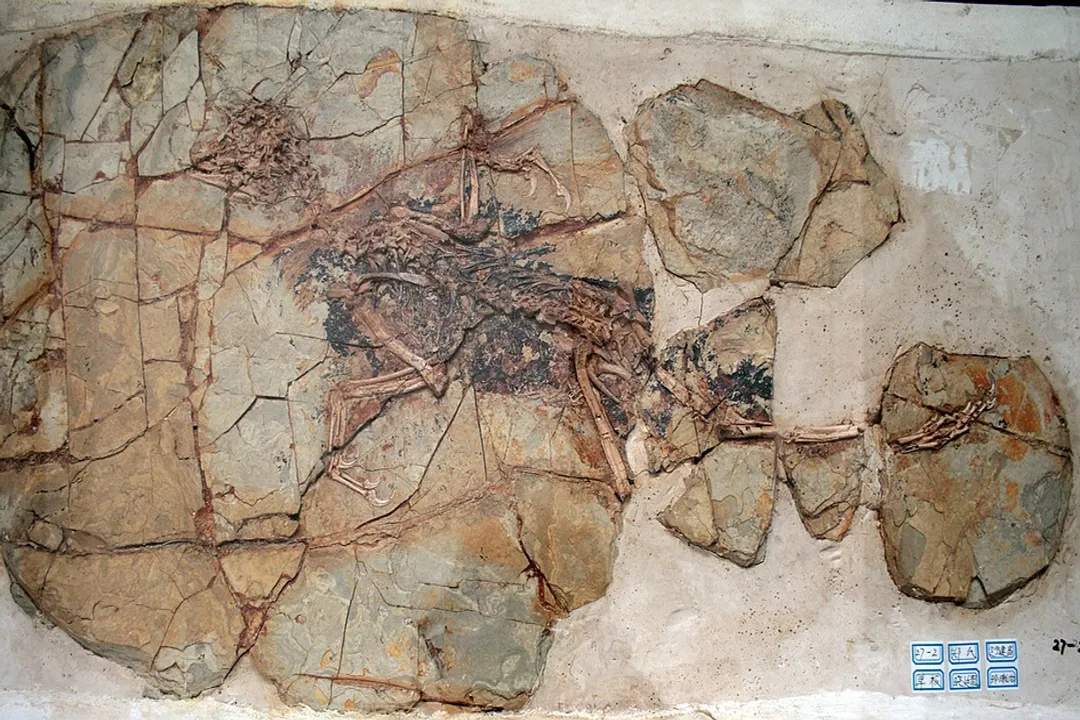
This small, feathered creature unearthed in China has played an outsized role in paleontology, primarily due to its inconvenient placement in the family tree of dinosaurs. Xiaotingia zhengi, known from an almost complete skeleton, belongs to a period of deep time roughly between the Bathonian and Oxfordian stages of the Middle to early Late Jurassic, existing approximately 165 to 153 million years ago. [2] Its discovery immediately complicated the established narrative surrounding the earliest members of the avian lineage.
# Discovery Naming
The genus Xiaotingia was formally introduced to the scientific world in $2011$ by researchers including Xu Xing. [2] The genus name, along with the specific epithet zhengi, serves as an honorific for the paleontologist Zheng Xiaoting. [2] The type specimen, designated STM $27-2$, represents an exceptionally well-preserved find: an articulated and nearly complete skeleton that includes the skull. [2] This specimen was likely recovered from the Linglongta area in Jianchang, situated within China’s Liaoning Province, specifically from the Tiaojishan Formation. [2] Having such a complete reference point is invaluable, even as its exact placement among feathered dinosaurs remains a topic of ongoing scientific debate. [2]
# Form Structure
Xiaotingia was a diminutive animal, which likely contributed to its survival as a fossil specimen. Estimates place its total length at around , with an estimated mass hovering near . [2] This creature was clearly covered in feathers across its head, body, forelimbs, and hind limbs. [2] A notable feature shared with the famous Archaeopteryx is the presence of notably long forelimbs. [2]
An interesting metric provided by the fossil data is the relative length of its leg and arm bones: the femur measured , while the humerus measured . [2] This observation suggests that the femur was longer than the humerus, potentially indicating that Xiaotingia spent time standing on its hind limbs and might have possessed the capability to use its forelimbs for flapping, perhaps even achieving some limited form of flight. [2] Furthermore, the feathers on the femur were quite substantial, reaching lengths of , and there were also long, vane-like feathers present on the tibia and metatarsus. [2] This extensive feathering on the legs raises the intriguing possibility that Xiaotingia could have employed its hind limbs as auxiliary wings during short flights. [2] Its teeth were distinct, likely numbering fewer than ten in the dentary bone, and possessed a morphology resembling those seen in basal avians. [2]
A significant anatomical marker mentioned in relation to its dinosaurian affinity is the presence of an extensible second pedo-digit, a feature considered a trademark characteristic of derived deinonychosaurs such as Velociraptor. The presence of this specific digit structure has been used to argue that Xiaotingia sat closer on the dinosaurian branch than the avian one.
# Dietary Habits
While much of the scientific discussion surrounding Xiaotingia centers on its plumage and position near the origin of birds, its role in the ecosystem is defined by its diet. Paleontologists categorize Xiaotingia as a Carnivore/Insectivore. Given its extremely small stature—weighing less than one kilogram—a diet primarily consisting of insects and other small, soft-bodied invertebrates seems highly probable. [2]
Considering its morphology, particularly the long forelimbs and the suggestion that it may have been arboreal, its method of securing food likely differed significantly from larger, ground-dwelling predators of the time. [2] The small, relatively simple teeth, similar to those of basal birds, would be perfectly adequate for gripping small, struggling prey like insects or perhaps very small lizards or amphibians, rather than tearing flesh from substantial carcasses. [2] A creature with an estimated body mass just over half a pound, inhabiting a Jurassic forest canopy or undergrowth, would naturally fill a niche similar to modern insectivorous birds or shrews, focusing on quick, agile acquisition of small caloric rewards. This specialized diet would have placed it in direct competition with other small terrestrial or arboreal animals, making efficient capture paramount to survival.
# Classification Conundrum
The classification of Xiaotingia has been anything but stable since its unveiling, highlighting the complexity of interpreting transitional fossils in the dinosaur-to-bird transition. [2] When Xu et al. first analyzed the specimen, their findings suggested that Xiaotingia grouped closely with Archaeopteryx, the Dromaeosauridae, and the Troodontidae, specifically excluding other groups traditionally considered birds. [2] This initially led to sweeping popular reports suggesting that Archaeopteryx was no longer considered a bird under their specific phylogenetic definition. [2]
However, this hypothesis met immediate challenges. Subsequent analyses using different methodologies quickly recovered Archaeopteryx back within the avialan grouping, while Xiaotingia was often positioned near Anchiornis within the Troodontidae family. [2] By $2012$, further examination saw Archaeopteryx confirmed as avialan, Anchiornis as troodontid, but Xiaotingia was then recovered as the most primitive member of the Dromaeosauridae clade. [2] More recent interpretations have placed it within the Anchiornithidae family, a group considered avialan in some $2017$ re-evaluations. [2] Even more recently, a $2025$ study placed Xiaotingia as a sister taxon to Avialae, though outside the Anchiornithids. [2]
This continuous shuffling demonstrates a key challenge in deep evolutionary history: when a creature exhibits a mosaic of traits—long feathers like a bird, a specific digit structure like a raptor, and proportions that suggest arboreal life—the analytical tools used to draw phylogenetic lines can yield different results depending on which traits are weighted most heavily. [2] The very existence of Xiaotingia—a feathered dinosaur with dinosaurian foot characteristics but bird-like wing proportions—forces scientists to define what a "bird" truly is, rather than simply identifying the "first" one. This suggests that the evolutionary radiation leading to birds was not a simple, linear path but a complex bush where various lineages experimented with flight, feathers, and specialized diets concurrently in the Jurassic ecosystem. [2] The creature remains a crucial data point for understanding the breadth of experimentation within the Paraves clade. [2]
Related Questions
#Citations
Xiaotingia - Wikipedia
Xiaotingia - Prehistoric Wildlife