Xiaotingia Scientific Classification
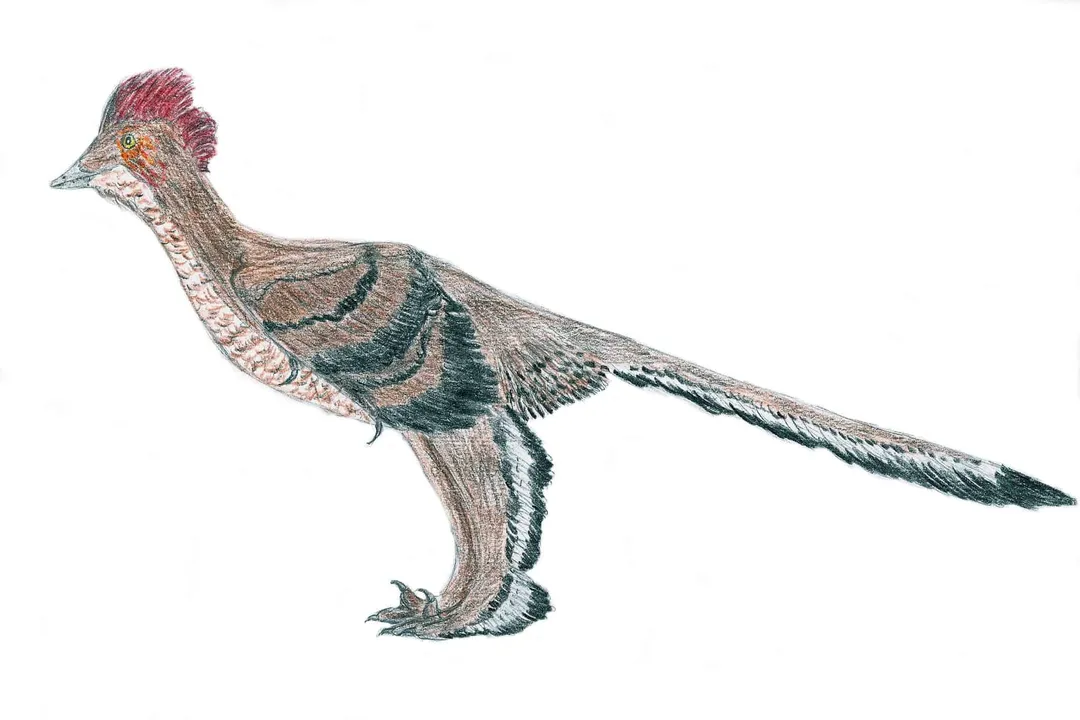
The classification of any extinct animal is rarely a settled matter, but few genera illustrate the shifting sands of avian origins as clearly as Xiaotingia. This small, feathered theropod, formally described in 2011, immediately sparked significant debate among paleontologists, largely because its anatomy forced a hard look at where the line between bird and non-avian dinosaur should be drawn. It joins a growing cast of enigmatic creatures from the Late Jurassic of China, creatures that blur the lines between the classic "missing link" (Archaeopteryx) and its closest dinosaurian cousins.
# Naming and Origin
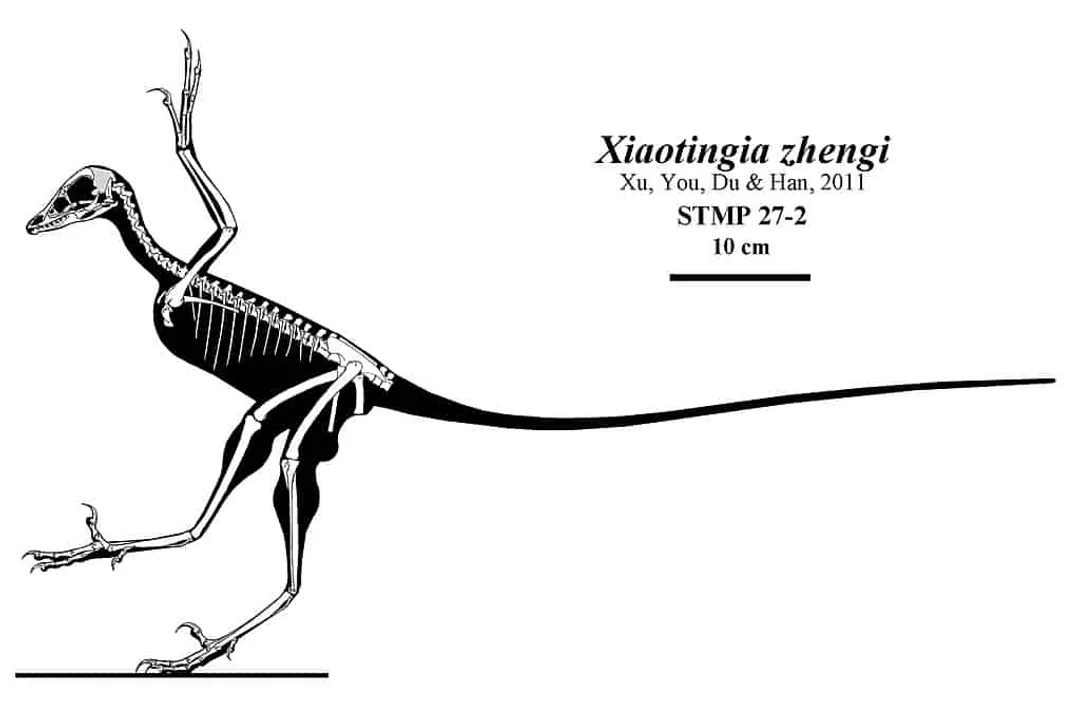
The story begins with the holotype specimen, STM 27-2, an articulated and nearly complete skeleton unearthed from the rich fossil beds of the Tiaojishan Formation in western Liaoning Province, China. The formal description was published by a team led by Xing Xu in 2011. The genus name, Xiaotingia, was chosen to honor Zheng Xiaoting, who is recognized as the founder of the Shandong Tianyu Museum of Nature, where the specimen resides. The specific epithet, zhengi, also honors him, recognizing his contributions to Chinese paleontology.
Xiaotingia lived during a fascinating interval, spanning the Middle to Late Jurassic periods, estimated around 165 to 153 million years ago, or roughly 155 million years ago. This places it in a paleontologically vital time and location—the Yanliao Biota—a Lagerstätte renowned for its exceptional preservation of early feathered dinosaurs. It is interesting to note that the more famous Archaeopteryx fossils, though superficially similar, come from slightly younger rocks in Germany, around 144 million years ago. This difference in age, combined with its unique anatomy, makes Xiaotingia a key player in understanding the diversification of Paraves.
# Physical Profile
Despite its scientific importance, Xiaotingia was tiny by dinosaur standards. Estimates place its length at around 60 centimeters, or about 23.6 inches, with a weight hovering near 0.82 kilograms, or 1.8 pounds. To put that into perspective, this little creature was roughly the size of a modern hen or chicken.
Its physical characteristics strongly point toward its close relationship with early birds. Much of its body—including the head, forelimbs, and hind limbs—was covered in feathers. Impressions show that these feathers included long pennaceous types on the tibia and metatarsus. Furthermore, the arm structure shows an adaptation for movement that might relate to the air: the femur was actually longer than the humerus, measuring 84 mm versus 71 mm. This morphology, combined with the long feathers, suggests it could use its limbs for flapping, potentially enabling short-distance flights or gliding. Experts have even suggested it might have used its feathery hind limbs as a secondary set of wings.
Cranially, Xiaotingia possessed features that resonated with early avians, such as a large orbit and a shallow snout, giving it a distinctive sub-triangular lateral profile. It also carried fewer than 10 teeth in its dentary, a count similar to that seen in basal birds. These features suggest a small carnivore, likely preying on insects, with a lifestyle that was both terrestrial and arboreal, favoring trees for safety from larger predators.
# Higher Grouping
The highest taxonomic assignments for Xiaotingia are fairly consistent across the gathered sources. It is firmly placed within the Kingdom Animalia and the Phylum Chordata. More specifically, it belongs to the Theropoda superorder.
The real intrigue begins when we narrow the focus to its place among the dinosaurs closely related to birds:
- It is generally classified as a Paravian.
- It has been specifically placed within the family Anchiornithidae.
This classification as an Anchiornithid—a basal group within Paraves—shows it as a sister taxon to the larger grouping that contains Deinonychosaurs (Dromaeosaurids and Troodontids) and Avialae (birds). This placement is derived from analyses that seek to harmonize traits found in both birds and their immediate relatives.
# Placement Debates
The placement of Xiaotingia is less about where it sits in the grand scheme of dinosaur evolution and more about how a few key skeletal features shift the balance between established clades. The initial 2011 analysis positioned Xiaotingia and Anchiornis within Archaeopterygidae, a grouping that, at the time, led to the controversial suggestion that Archaeopteryx might be excluded from Aves (birds) if a strict definition was applied. This highlights a key challenge: when a fossil possesses a mosaic of traits—some looking "bird-like" and others looking "raptor-like"—where does the phylogenetic anchor drop?.
Subsequent phylogenetic tests provided contrasting views on this evolutionary knot:
- Troodontid Alliance: One challenge suggested Archaeopteryx remained avialan, but shifted Xiaotingia to be closely allied with Anchiornis within the Troodontidae family.
- Dromaeosaurid Branch: A revised analysis by Senter et al. in 2012 suggested that Xiaotingia was the most primitive member of the Dromaeosauridae clade, while Anchiornis was firmly placed in Troodontidae.
The complexity arises because certain traits, like a relatively shallow, gracile skull, are found in Deinonychosaurs, whereas some basal birds exhibit a taller, more robust cranium. Xiaotingia, with its shallow snout, aligns morphologically closer to groups like deinonychosaurs and Archaeopteryx than it does to other basal avialans like Epidexipteryx or Jeholornis, which possess deeper, shorter snouts reminiscent of Oviraptorosaurs. This suggests that features like a gracile skull might be the primitive, ancestral condition retained by Deinonychosauria, rather than a specialized trait lost in the bird line.
The fact that multiple analyses, testing different character sets, produced varying results—placing Xiaotingia variously as basal Avialae, basal Deinonychosauria, or within a specific family like Anchiornithidae or Dromaeosauridae—demonstrates that its morphology is critical for testing the most parsimonious arrangement of Paraves.
A useful way to consider this is by looking at the defining characteristics. If one emphasizes features like the structure of the manual phalanges (hand bones), Xiaotingia clusters closely with Archaeopteryx and within Archaeopterygidae. However, if dental or other cranial features are weighted more heavily, it might slide toward the Dromaeosaurid or Troodontid side of the Maniraptoran family tree. This ongoing re-evaluation, driven by fossils like Xiaotingia from the Yanliao Biota, shows that the evolutionary acquisition of the bird "blueprint" was far from a straight line, involving a significant amount of mosaic evolution among feathered theropods.
# Classification Summary
For ease of reference, even recognizing the scientific flux, here is a general consensus of its higher classification, noting that the Order level assignment can differ based on the researcher's primary cladistic hypothesis:
| Rank | Classification (General) | Citation |
|---|---|---|
| Kingdom | Animalia | |
| Phylum | Chordata | |
| Class | Reptilia (Alternative/General) | |
| Superorder | Theropoda | |
| Clade | Paraves | |
| Family | Anchiornithidae (Current consensus in some studies) | |
| Genus | Xiaotingia | |
| Species | X. zhengi |
Considering the sheer number of studies that find Xiaotingia closely allied with Anchiornis and Archaeopteryx but often outside the direct line leading to crown Aves, one can infer that its discovery helped solidify the scientific view that flying dinosaurs—and thus the earliest birds—were not a single, sudden innovation but rather a diversified group where flight-related traits evolved independently across several closely related lineages inhabiting the Jurassic forests of China. The detailed study of this one small specimen, Xiaotingia zhengi, effectively widened the evolutionary gap between those lineages that would evolve into modern birds and those that remained specialized, feathered ground-dwellers or gliders.
Related Questions
#Citations
Xiaotingia - Jurassic Park Institute Wiki - Fandom
Xiaotingia Facts for Kids
Xiaotingia | fossil animal - Britannica
Xiaotingia - Grokipedia
Xiaotingia - Jurassic Park Wiki - Fandom
Xiaotingia zhengi - A-Z Animals
A simplified cladogram showing the systematic position of Xiaotingia...