Xiaotingia Facts

The discovery of Xiaotingia zhengi offers paleontologists a significant piece of the puzzle regarding the evolution of feathered dinosaurs and the origins of birds. [1][4] This genus represents a small theropod dinosaur unearthed in China, whose particular skeletal configuration has placed it right at a crossroads in dinosaurian taxonomy. [5][8] It is not merely another dinosaur name on a list; rather, its unique mix of primitive and advanced characteristics makes it a vital specimen for calibrating evolutionary relationships among the Coelurosaurs, the group to which it belongs. [1][6]
# Jurassic Setting
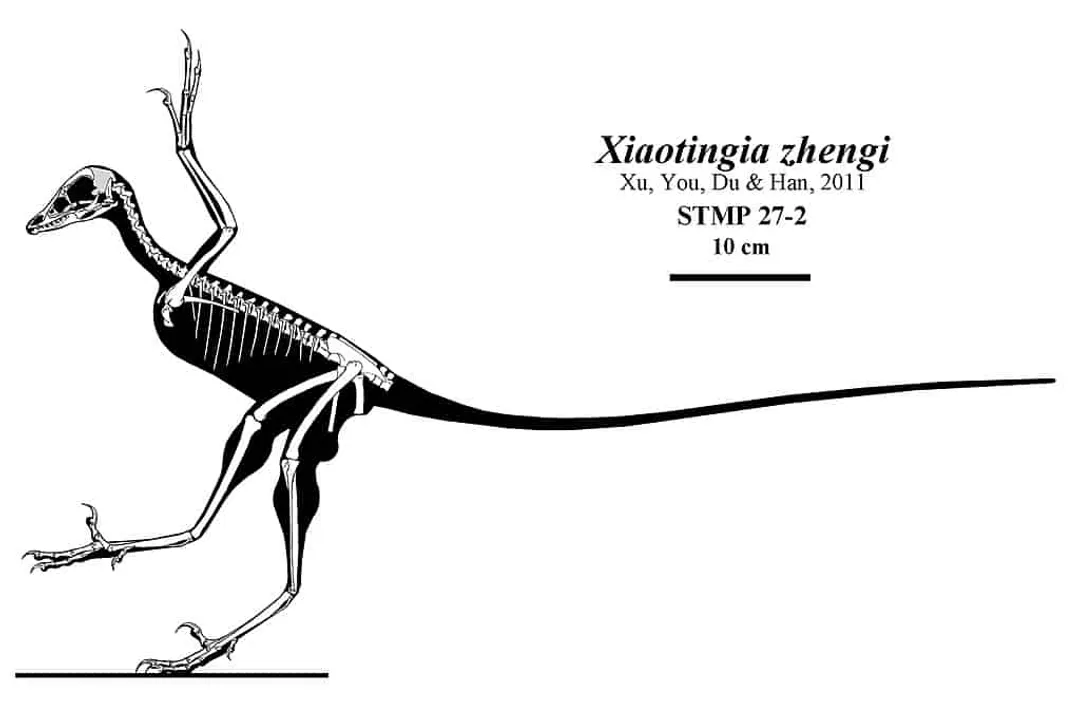
Xiaotingia lived during the Late Jurassic epoch, specifically within the Tithonian age, placing it temporally very close to the transition into the Cretaceous period. [1][9] The environment it inhabited was located in what is now Shandong province in China, a region that has yielded several important fossils illustrating the diversity of dinosaurs near the end of the Jurassic. [1][5] Finding a nearly complete individual like the one attributed to Xiaotingia allows for a detailed anatomical assessment that fragmentary remains often prohibit. [1][8] This specific fossil record provides essential context for understanding the faunal communities present in Asia during this critical time in Earth’s history. [9]
# Dinosaur Kinship

Scientifically, Xiaotingia is classified as a theropod, specifically nested within the Maniraptora clade. [1][5] This places it among the group containing some of the most bird-like dinosaurs, such as Dromaeosaurids (like Velociraptor) and Troodontids. [1] Most notably, Xiaotingia is positioned near the foundational split of Paraves, the clade encompassing birds and all dinosaurs more closely related to birds than to Ornithomimosaurs. [1][5] This proximity suggests that Xiaotingia exhibits many traits that were present in the common ancestor of these highly specialized dinosaurs. [7] Some modern phylogenetic studies have suggested that Xiaotingia belongs within or directly alongside the Anchiornithidae family, grouping it with small, feathered dinosaurs like Anchiornis and Aurornis. [6][9] This clustering highlights a burst of evolutionary experimentation in small theropods preceding the definitive emergence of powered flight. [6]
# Physical Traits
Xiaotingia was a small, bipedal creature. [3] While exact weight estimates vary, its slender build suggested it was not a massive predator. [9] Its overall posture was characterized by a relatively long neck and, importantly, a tail that was somewhat shorter compared to many other theropods of a similar evolutionary grade. [1]
A defining characteristic used in its classification involves the proportions of its hind limbs. The lower leg bone, the tibia, was noticeably longer than the femur (thigh bone). [1] This ratio () is often indicative of an adaptation for speed on the ground, suggesting an animal adapted for running. This specific leg length ratio strongly suggests an adaptation for running, perhaps indicating that while it was close to the bird lineage, its immediate lifestyle involved terrestrial speed rather than immediate aerial capabilities, providing a snapshot of an evolutionary path prioritizing swift movement. [1]
The holotype specimen, cataloged as IVPP V11339, is what most scientists base their understanding upon. [8] While the sources don't explicitly detail the presence of feathers for Xiaotingia in the way they do for its close relatives, its placement firmly within the advanced Maniraptoran group means it existed in an era where integumentary structures like feathers were likely present, even if they weren't fully developed for flight. [7]
# Evolutionary Role
The significance of Xiaotingia lies less in what it did and more in where it sits on the evolutionary map. [8] Its specific anatomy—displaying a collection of features that link it to multiple descendant groups—has made its placement a subject of phylogenetic debate. [6][8] When comparing its anatomy to other transitional forms, paleontologists look closely at features in the wrist, ankle, and pelvis to determine its exact relationship to the bird line. [8]
When comparing Xiaotingia to contemporaries, its relative primitiveness in certain skeletal aspects, despite being grouped with advanced forms, suggests that traits considered 'advanced' for bird origins might have appeared episodically or convergently across different small theropod branches, rather than in a strictly linear sequence. [8] For instance, if an analysis prioritizes wing structure precursors, it might fall slightly outside the main bird line, but if it prioritizes specific ankle or wrist structures, it moves closer. [8] This complexity underscores that the transition from ground-dwelling reptile to flying bird was not a simple, straight line but involved various side branches and experiments in body plan modification among small, fast dinosaurs like this one. [7] The very existence of Xiaotingia forces refinement of cladograms attempting to trace the path to Archaeopteryx and later birds. [1][6]
Related Questions
#Citations
Xiaotingia - Wikipedia
Xiaotingia Pictures & Facts - The Dinosaur Database
Xiaotingia zhengi - A-Z Animals
Xiaotingia Facts for Kids
Xiaotingia zhengi | fossil animal - Britannica
Xiaotingia - Jurassic Park Institute Wiki - Fandom
Dinosaur-Bird Confusion | Answers in Genesis
Xiaotingia - a mesozoic field guide
Xiaotingia - Prehistoric Wildlife