Xerus Evolution
The evolutionary story of the African ground squirrel genus Xerus offers a compelling look at how mammals adapt their forms and distributions in response to long-term shifts in climate. These diurnal rodents, belonging to the family Sciuridae and the subfamily Xerinae, provide a living laboratory for studying processes like speciation, adaptation to aridity, and the lasting impact of biogeographic barriers. [4][8] Tracing their history involves examining genetic markers alongside paleoclimatic data, revealing a close linkage between environmental pressure and physical expression. [5]
# Xerus Lineage
Ground squirrels within the Xerus genus are distinguished from other African rodents by their specific phylogenetic position. Research focused on establishing the relationships within the ground squirrel clade, particularly the Xerinae, often relies on analyzing genetic sequences, including mitochondrial DNA and various nuclear genes, to map divergence times and ancestral relationships. [4][5] The genus Xerus itself is recognized as distinct within this group, housing several recognized species across various parts of Africa. [1] Understanding the precise relationships among the Xerus species is vital for understanding how their ranges expanded or contracted over geological time scales. [4] Phylogenetic studies aim to resolve ambiguities in their evolutionary tree, providing a clearer map of where and when diversification events occurred relative to major African climatic shifts, such as periods of increasing aridity. [5][8]
# Climate Influence
The influence of climate change on the diversification and distribution of Xerus appears to be a defining factor in their evolutionary history. Analyses suggest that past climatic events, particularly the spread of drier conditions across the continent, have shaped the current biogeographic patterns observed within the genus. [4] Evolutionary models demonstrate that phylogenetic splits often correlate with significant environmental changes that would have created geographical barriers or dramatically altered available habitats. [5] This pattern is not unique to Xerus; research into related groups, including the broader Sciuridae family, indicates that historical biogeography and subsequent body form evolution have frequently been molded by these climate fluctuations. [8] The ability of these squirrels to persist in arid or semi-arid environments suggests a high degree of adaptive plasticity or selection for specific traits that favor survival where water is scarce. [3][4] Furthermore, in a broader context affecting many animal groups, warming trends have been associated with observable shifts in body size and coloration, suggesting that contemporary climate change continues to exert selective pressure on morphology. [2]
# Body Form
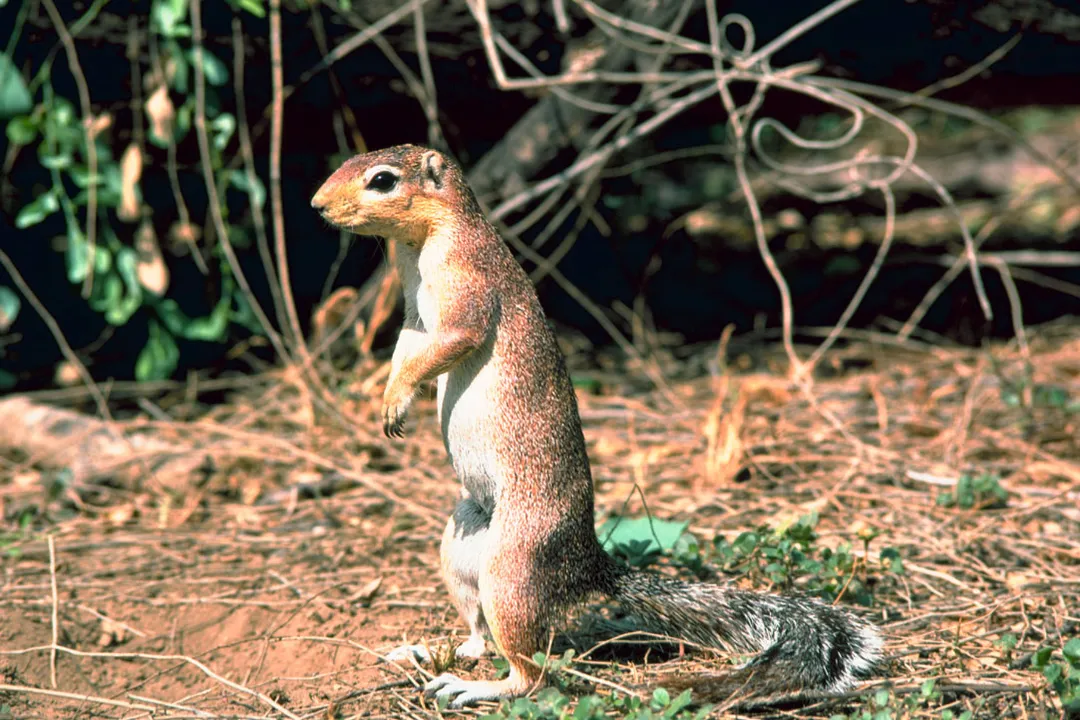
The morphology of Xerus species reflects their adaptation to open, terrestrial life in often harsh environments. Consider the Unstriped Ground Squirrel, Xerus rutilus, common in the arid and semi-arid regions of East Africa. [3] These squirrels are diurnal, meaning they are active during the day, and they live in extensive burrow systems, which provide critical refuge from extreme temperatures. [3] Their diet is omnivorous, leaning heavily on grass seeds, roots, and tubers, supplemented by insects and other invertebrates, a feeding strategy well-suited to environments where resources may fluctuate significantly. [3]
A defining feature of their interaction with their environment is their characteristic posture. Xerus rutilus individuals frequently stand upright on their hind legs to scan the surroundings for predators, a behavior that demonstrates high awareness of their exposed habitat. [3] This reliance on vigilance in open areas suggests that predation pressure is a strong, ongoing selective force shaping their behavior and perhaps even the cues they use for warning others. [3]
If one were to compare body size trends across species occupying progressively hotter or drier niches within the Xerus range, a subtle conflict in evolutionary theory might emerge. Generally, larger bodies can be advantageous for water storage and thermal inertia in extreme heat. However, in sun-exposed, arid environments, increased surface-area-to-volume ratio can facilitate faster cooling, favoring smaller forms. The actual trajectory of body size evolution across the Xerus clade would likely reveal a compromise, finely tuned to balance heat dissipation needs against water conservation requirements specific to their local thermal maxima. [3]
# Modern Change
While historical climate events drove major diversification, the ongoing, rapid shifts in global climate continue to present challenges and opportunities for Xerus populations. The evolutionary changes observed in the past, such as shifts in range boundaries or local adaptation of physiology, provide a model for understanding present-day resilience or vulnerability. [4] Understanding the historical role of aridification in shaping the genus allows researchers to better predict how modern warming might affect dispersal corridors or population viability. [5]
The social dynamics observed in species like Xerus rutilus are intrinsically linked to their reliance on burrows and their behavior in open areas. [3] The high level of social interaction and communication necessary for survival in exposed environments suggests that social complexity itself may be an adaptive trait that buffers populations against certain environmental stressors, provided the basic habitat structure (like access to suitable soil for burrowing) remains intact. In an era where habitat fragmentation compounds the effects of rising temperatures, the tight-knit colonies, despite their vigilance, might face distinct challenges related to maintaining genetic diversity across fragmented landscapes. [3]
In essence, the evolution of Xerus is a story written by continental climate shifts, dictating where these squirrels could successfully settle and the physical forms they adopted to thrive there. From their genetic roots to their upright sentinel stance, every feature reflects an ancient dialogue between life and a changing African landscape. [4][5][8]
Related Questions
#Citations
Unstriped ground squirrel - Wikipedia
Animals Shape-Shift in Response to a Warming World - MSU EEB
Xerus rutilus (unstriped ground squirrel) - Animal Diversity Web
Phylogeny and historical biogeography of African ground squirrels
Evolution of the African ground squirrel genus Xerus - Academia.edu
Phylogeny and historical biogeography of African ground squirrels
[PDF] MAMMALIAN SPECIES No. 370, pp. 1-5, 3 figs. - Xerus rutilus.
(PDF) Historical Biogeography and Body Form Evolution of Ground ...
Squirrel phylogenetics and phylogeography - Matthew Herron