Wolffish Physical Characteristics
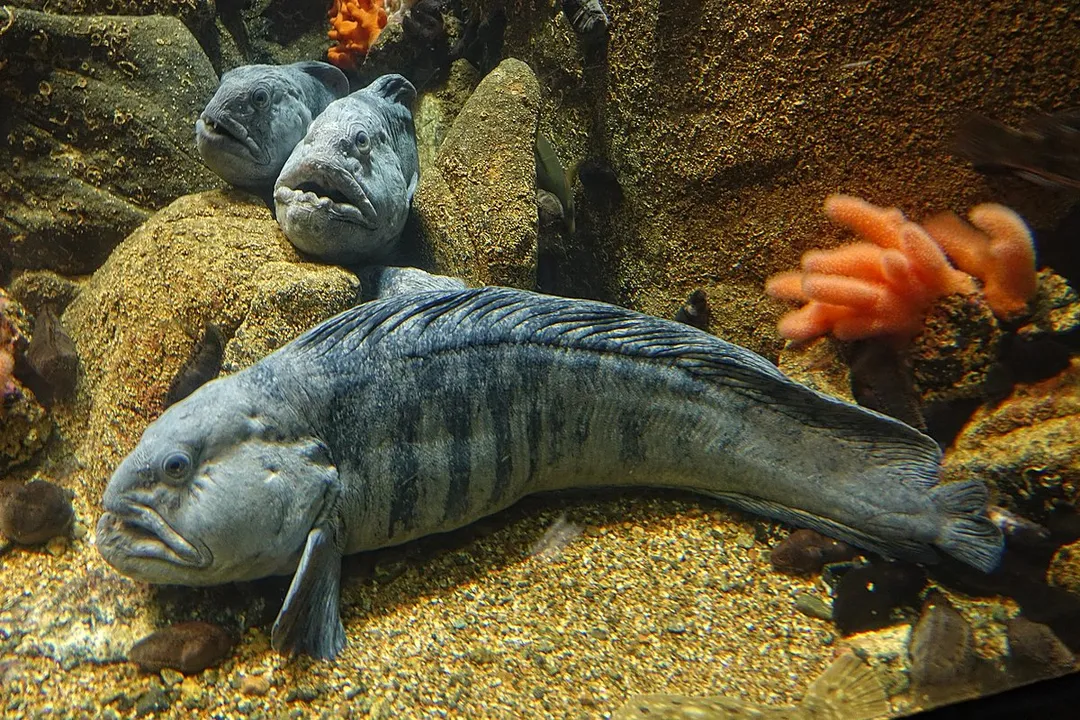
The Atlantic Wolffish, scientifically named Anarhichas lupus, presents a silhouette quite distinct from the streamlined torpedoes many associate with powerful fish. This inhabitant of the cold North Atlantic waters possesses an almost serpentine, eel-like body structure, yet it is substantially more robust and thickset than a true eel. [1][2] Its form is elongated and laterally compressed, giving it a somewhat flattened appearance from the front. [2] This body plan is perfectly suited for navigating the complex, often rocky or gravelly bottoms of its preferred habitat, rather than open-water pursuit. [3]
# Body Shape
The sheer muscularity of the wolffish contributes significantly to its powerful appearance. [2] The long dorsal fin starts very near the head and runs along the entire back, merging almost seamlessly with the caudal (tail) fin before meeting the anal fin in a relatively short, continuous skirt around the rear end. [2][5] Unlike many groundfish, it lacks pelvic fins entirely or possesses very small ones, suggesting limited need for precise, high-speed maneuvering, relying instead on undulating movements powered by its elongated trunk and tail musculature. [1] The skin itself is noteworthy; it is thick, tough, and entirely scaleless, often described as gelatinous or rubbery, offering physical protection against abrasion and perhaps minor predation attempts. [1][5]
# Jaw Structure
Perhaps the most defining physical characteristic of the wolffish is its formidable head and jaw apparatus, which speaks directly to its specialized diet. [2] The head is large relative to its body size, often featuring a high, somewhat blunt forehead. [1][2] Within this substantial mouth lies a set of teeth evolved entirely for crushing hard-shelled prey. The front portion of the jaws is equipped with sharp, canine-like teeth that are prominent and robust. [5] These teeth are designed for gripping and piercing tougher outer layers of crustaceans or mollusks. [4]
Behind these grasping canines, the structure transitions dramatically. The rear portions of both the upper and lower jaws house several rows of blunt, pavement-like, molar teeth. [4][5] These molars are immensely strong, acting as natural nutcrackers for breaking apart sea urchins, crabs, and clams found on the seafloor. [4] This dual-tool approach—gripping/tearing upfront and crushing in the back—is what allows the wolffish to exploit a food source unavailable to fish with simpler dentition. The sheer mechanical advantage offered by this dental architecture shapes its ecological role, placing it as a specialized benthic predator whose main challenge is structural failure of its prey's defenses, not evading faster-swimming competitors. [2]

# Coat Color
Coloration in the Atlantic Wolffish offers little in the way of fixed identification, as it exhibits considerable variation depending on age, environment, and individual genetics. [1][2] Most commonly, the background color ranges across shades of brown, grey, or greenish hues. [1][5] This variability is patterned, often appearing mottled, spotted, or barred. [2] These markings typically help the fish blend into the mottled, uneven substrate of the deeper ocean floor where it resides. [1] Generally, the underside tends to be paler than the dorsal surface, providing a degree of countershading, though this is less pronounced than in pelagic species. [1]
# Size Metrics
The potential size of an Atlantic Wolffish can be impressive, lending credence to its imposing appearance. [1] While smaller individuals are common, this species is known to grow quite large, sometimes reaching lengths of up to 1.5 meters, or approximately five feet. [1][2] Correspondingly, significant weights are possible, with reports reaching over 18 kilograms, or about 40 pounds. [1] In terms of longevity, data suggests they can inhabit the cold depths for a considerable period, potentially living up to 17 years or more. [1] Observing a fish this large, built with such dense musculature and armored skin, provides a good visual gauge for anglers or researchers encountering them on the bottom. [2]

# Fin Detail
The primary drivers for movement are concentrated in the posterior half of the fish, supported by the extensive dorsal and anal fins. [5] Counting the fin structures reveals specific taxonomic markers. The dorsal fin typically contains between 65 and 72 spines. [1] In comparison, the anal fin is shorter, containing between 40 and 48 rays. [1] The pectoral fins, situated just behind the gills, are relatively modest in size, usually featuring between 10 and 13 rays. [1] These fins primarily assist with steering and subtle positional adjustments near the bottom, while the powerful body undulation propels it forward or holds its position against currents. [5]
When observing multiple specimens, one might notice that the eyes, while large, are positioned somewhat laterally, perhaps suggesting that while vision is useful for detecting movement or proximity, the reliance on tactile sensation or lateral line systems in the murky depths may be higher than in shallow-water relatives. [2] The overall construction—tough hide, specialized dentition, and powerful, elongated body—points toward a creature built for stability and sustained life in a relatively stable, resource-scarce benthic environment. This durability is likely a key factor enabling the long lifespan observed in the species. [1]
Related Questions
#Citations
Atlantic wolffish - Wikipedia
Maine Seafood Guide - Wolffish - Maine Sea Grant
Atlantic Wolffish - Oceana Canada
Wolffish: What you need to know
[PDF] Wolffish (Anarhichas lupus) - Maine.gov
Wolf fish or Catfish (Anarhichas lupus) - MarLIN
Atlantic Wolffish - Arca del Gusto - Slow Food Foundation
Atlantic Wolffish - Oceana
Wolffish Anarhichas lupus Linnaeus 1758 - FOMB Cybrary