Why did tigers go extinct in China?

The disappearance of tigers from large swathes of China represents one of the most tragic losses in modern conservation history, primarily centered around the fate of the South China tiger (Panthera tigris amoyensis). While historical records suggest a much wider distribution, with up to nine subspecies roaming across Asia a century ago, the reality today is that the South China tiger, once native to provinces such as Fujian, Guangdong, Hunan, and Jiangxi, is functionally extinct in the wild. No physical sighting of this specific subspecies has been recorded in its native wilderness for decades, leading conservationists to confirm its wild extinction by 2007. To understand why this happened, we must examine a confluence of deliberate human action, unsustainable development, and a persistent market demand for tiger products.
# Historical Eradication
The initial collapse of China's tiger populations was not simply a byproduct of slow encroachment; it was a result of targeted, state-sponsored extermination. During the mid-20th century, particularly under the banner of the Great Leap Forward initiative between 1958 and 1962, the focus was rapid industrialization and transforming subsistence farming into commercial agriculture. In this environment, the tiger, once revered as the 'King of Beasts,' was officially redefined and declared an agricultural pest.
This declaration immediately sanctioned widespread killing. Bounties were placed on the animals, resulting in thousands being killed by farmers defending livestock or participating in eradication campaigns. This state-endorsed massacre, combined with the ongoing practice of hunting tigers for bones used in traditional Chinese medicine, devastated the wild population. By 1982, the population of the South China tiger had been reduced to fewer than 200 individuals.
It is compelling to consider this historical directive against conservation trajectories elsewhere. While China’s leadership at that time actively promoted extermination to clear land and secure agricultural output, countries like India began prioritizing protection measures in the 1970s, leading to today's situation where India harbors over 70 percent of the world's remaining wild tigers. The speed of the tiger's disappearance in China—from a sizable population to functionally gone in a few decades—serves as a grim case study in how quickly political will can erase a species when a species is reframed from a natural icon to an economic liability.
# Habitat Loss

The sheer scale of habitat destruction necessary to support China’s burgeoning human population and agricultural growth severely limited the space available for apex predators like tigers. Tigers require vast, contiguous territories to roam, hunt, and maintain their territorial needs. As forests were cleared to make way for farms and development, the natural habitat for the South China tiger was fragmented and severely reduced.
This deforestation did more than just shrink their living space; it directly impacted their ability to survive by decimating their prey base. A lack of sufficient natural food sources pushes surviving tigers closer to human settlements out of desperation. This increased proximity inevitably leads to deadly encounters, as tigers are forced to prey on livestock, triggering retaliatory killings by farmers protecting their livelihoods. Infrastructure development, such as the roads built to access new farms, further complicated matters by breaking up the remaining pockets of habitat.

# Trade Demand

Even as the wild population plummeted due to pest campaigns and habitat loss, the demand for tiger parts persisted, acting as a relentless, final pressure point. Across many cultures, tiger parts—bones, eyes, teeth, fur, and organs—are highly sought after, whether as status symbols or ingredients in traditional medicines, believed to cure ailments ranging from arthritis to virility issues.
The intense consumer demand within China historically drove poaching crises not only domestically but also in neighboring tiger range countries. This trade is not just a historical footnote; it remains a major factor contributing to the endangerment of all remaining subspecies, including the Siberian tigers clinging to survival near China's northern border. The issue of demand is so powerful that even as overall global tiger numbers sit critically low—around 4,000 remaining worldwide—the market value of their parts continues to fuel illegal activity.
# Legal Ambiguity
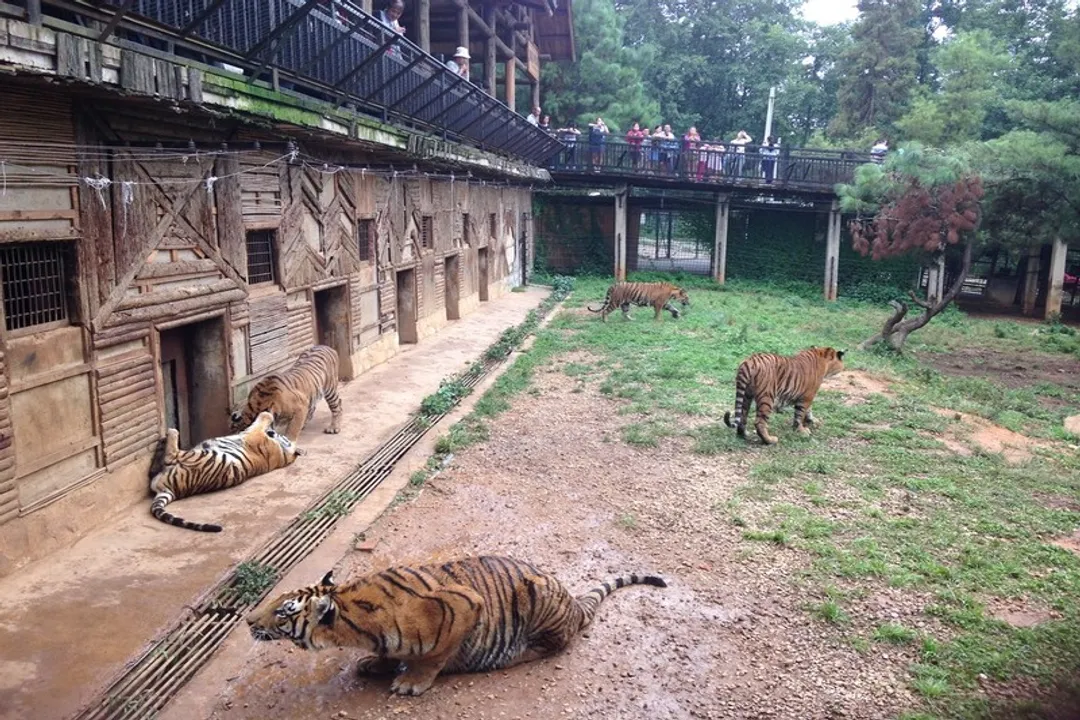
A peculiar and damaging paradox emerged in China regarding the trade in tiger parts: the rise of commercial tiger farming. Initially, these farms, which began appearing in the late 1980s, were purported to be a conservation measure—a way to satisfy market demand with captive-bred animals, thus alleviating pressure on wild populations.
However, this commercial enterprise has demonstrably failed its conservation mandate. Today, these captive operations house thousands of tigers, numbering more than the total wild population globally. The commercial success of these farms, which can legally trade skins and potentially bones under a permit system, has created a state of ambiguity in Chinese law and messaging. This ambiguity allows consumer demand to flourish, as it becomes nearly impossible to distinguish between legally sourced captive parts and illegally poached wild parts, thereby creating an ideal laundering system for the black market. Even after a 1993 ban on using tiger bone in medicine was passed, the subsequent rules created loopholes that allowed trade from captive sources to continue. This perpetuation of a legal, domestic trade acts as a continuous stimulant for demand, undermining enforcement against the poaching of the few remaining wild tigers in the northeast.

# Shifting Focus
While the South China tiger appears lost to the wild, China's approach to other subspecies inhabiting its territory, particularly the Siberian (Amur) tiger, suggests a recent, significant policy pivot in certain regions. In the country's northeastern borderlands, the establishment of the massive North-East Tiger Leopard National Park (NCTLNP) has provided a sanctuary. This protected area has resulted in positive news: researchers estimate the wild Siberian tiger population within China has grown from a mere dozen to around 70 individuals.
This localized success—the recovery of the Siberian tiger population in the NCTLNP—stands in sharp relief to the eradication of the South China tiger decades prior. This contrast suggests that while the historical drivers of extinction remain a powerful precedent, the modern conservation mechanisms, focused on establishing large, strictly protected habitats and allowing prey populations to recover, can yield tangible results for tigers that still exist in the country.
Despite these bright spots for the Siberian population, the challenges of human-tiger conflict, habitat loss due to development, and the ongoing threats of climate change continue to challenge conservationists across the remaining range countries. Furthermore, the near-total loss of the South China tiger has led some mainstream conservationists to suggest that resources might be better spent focusing on subspecies with a better chance of recovery, effectively writing off the prospect of reintroducing the native Chinese subspecies back into its historical southern territories. The legacy of extinction in China is a complex narrative built on official campaigns, relentless human demand, and legal frameworks that inadvertently supported the very industry they sought to curb.
Related Questions
#Citations
Tiger comeback highlights successes, challenges in China's wildlife ...
What Happened To The South China Tiger? - World Atlas
Why Are Tigers Endangered and Who is Responsible?
It's a new Year of the Tiger and China needs to get serious about ...
Tigers in Crisis Overview