White Sturgeon Facts

The white sturgeon, scientifically known as Acipenser transmontanus, holds a venerable position as the largest freshwater fish native to North America. [2][7] These living fossils, sometimes called "giants of the deep" or "living dinosaurs," have persisted in the world’s waters for millions of years, offering a direct connection to ancient aquatic ecosystems. [5][7] Their sheer scale is astonishing; adults can potentially surpass lengths of 20 feet and weigh more than 1,500 pounds, though modern-day encounters with fish of that magnitude are exceedingly rare. [2]
# Ancient Lineage
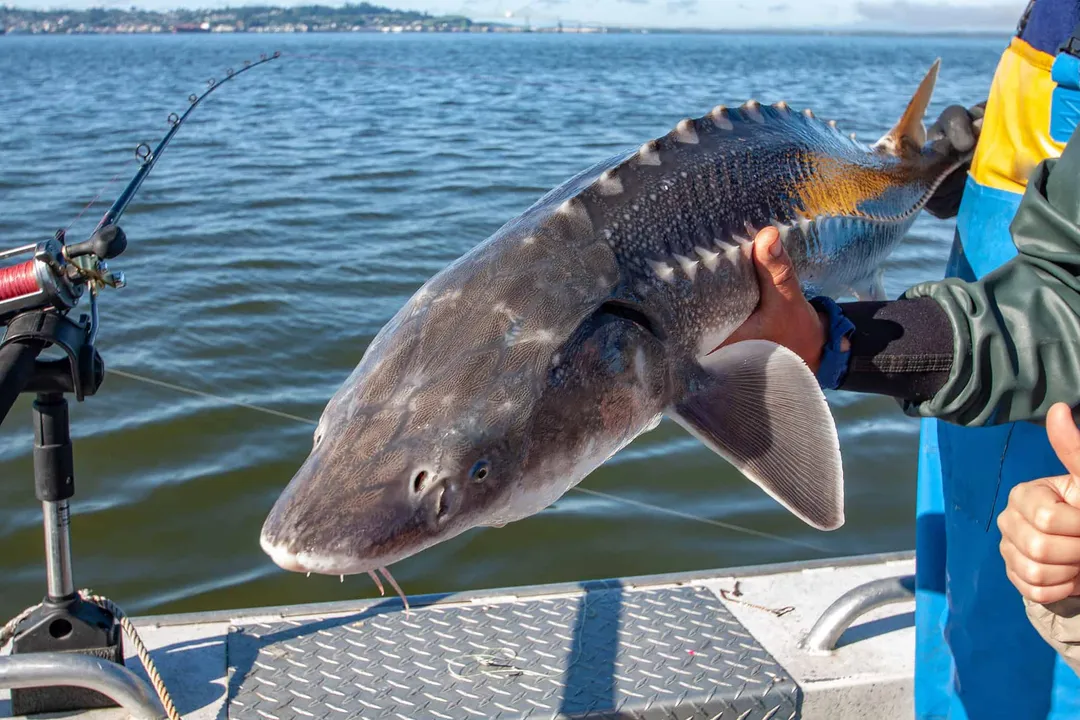
Sturgeon belong to an ancient group of ray-finned fish, distinct from modern bony fishes because their skeletons are largely composed of cartilage. [5] Unlike most familiar fish, the white sturgeon does not possess the typical overlapping scales. Instead, its body is covered with five rows of bony plates, known as scutes, which serve as a form of external armor. [5][7] This physical characteristic alone sets them apart from the vast majority of species encountered in North American rivers today. Their long, somewhat shark-like body shape, combined with a flattened underside, makes them perfectly adapted for life near the river or seafloor. [1]
# Physical Markers
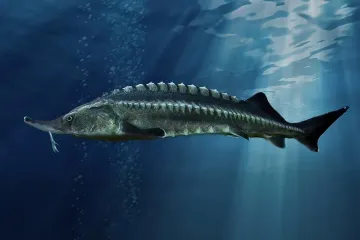
The coloration of the white sturgeon is typically described as dark gray or olive-green on the back, fading to a pale or white underside, which gives the species its name. [1][9] A key sensory feature for these bottom-dwelling scavengers is the presence of four barbels—whisker-like organs—located just in front of their mouth. [5] These barbels are crucial for sensing vibrations and detecting food buried in the substrate, acting as sophisticated underwater noses and touch receptors in often murky conditions. [7] They have a protrusible, toothless mouth that allows them to vacuum up prey from the river bottom. [3]
When observing these magnificent creatures, one immediate point of difference from common sport fish is the arrangement of their fins. The dorsal fin is positioned far back on the body, close to the small, somewhat heterocercal tail fin, another primitive trait. [2] It is interesting to note that while they are primarily known as freshwater residents, they spend significant time in brackish or saltwater environments near coastal areas, demonstrating a high tolerance for varying salinity levels as they move between estuaries and the open ocean. [6]
# Habitat Range

The historical distribution of the white sturgeon spanned across Pacific coast drainages, reaching from the Bering River in Alaska southwards down to the San Joaquin-Sacramento River Delta in California. [4] Their range also extends to the upper Gulf of California. [2] In Washington State, for instance, they inhabit the Columbia River and Puget Sound basins, often preferring the deepest parts of the water columns where temperatures remain colder year-round. [6]
While they thrive in the deep, cold waters of rivers, estuaries, and coastal marine environments, [1][6] they are anadromous, meaning they migrate from saltwater or estuaries upriver to spawn. [2] For many populations, the river system is the critical nursery and spawning ground, while the ocean or large, deep river pools serve as the primary feeding grounds for adults. [4] The environmental health of both the upstream spawning grounds and the downstream feeding areas is therefore intrinsically linked to the species' survival.
# Life Cycle Secrets
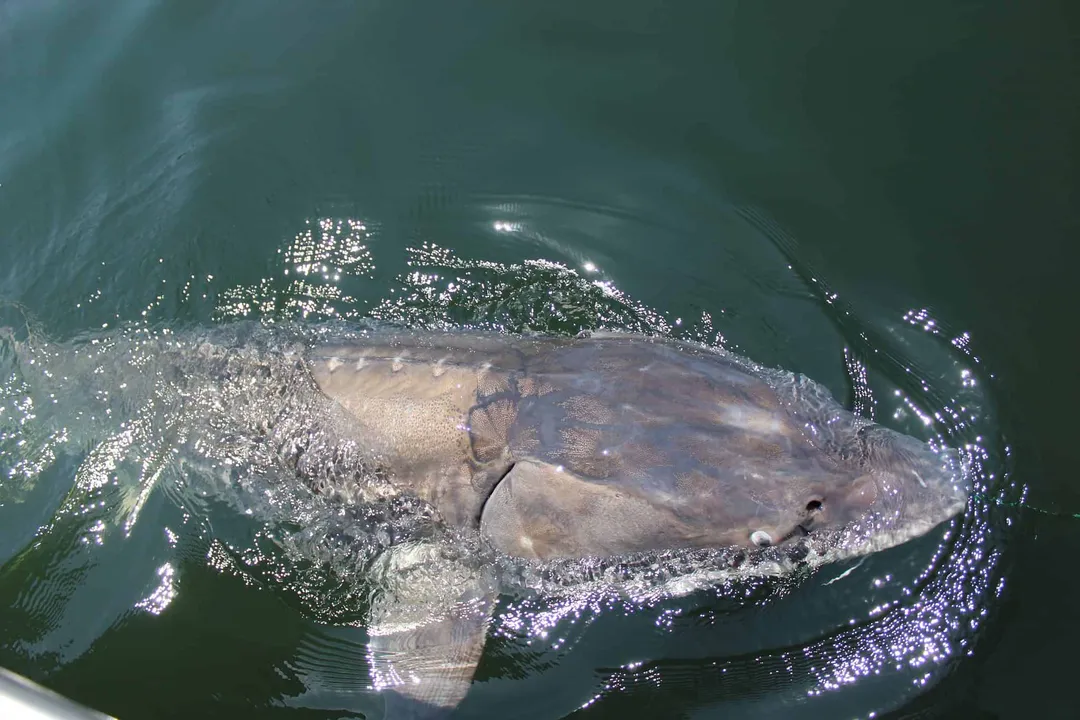
The life history of the white sturgeon is characterized by extreme longevity and slow maturation rates, factors that have made them particularly vulnerable to overexploitation. [4] A female white sturgeon may not reach sexual maturity until she is around 20 years old, and males often begin reproducing closer to 15 years of age. [2][4]
Spawning events are infrequent, occurring only once every few years for an individual fish. [4] When spawning does take place, it happens in deep, fast-flowing sections of rivers, often over gravel beds. [4] After fertilization, the eggs drift downstream until they settle in suitable gravel.
This slow reproductive cycle presents a significant ecological hurdle for population recovery. If fishing pressure removes large, mature females from the population—the very fish responsible for the largest and most successful batches of eggs—it takes decades for the next generation of large females to mature and replace them. [4] This time lag means that conservation management must be extremely patient and forward-looking, as the effects of current protective measures may not be fully measurable in terms of mature recruitment for over a decade.
# Feeding Ecology
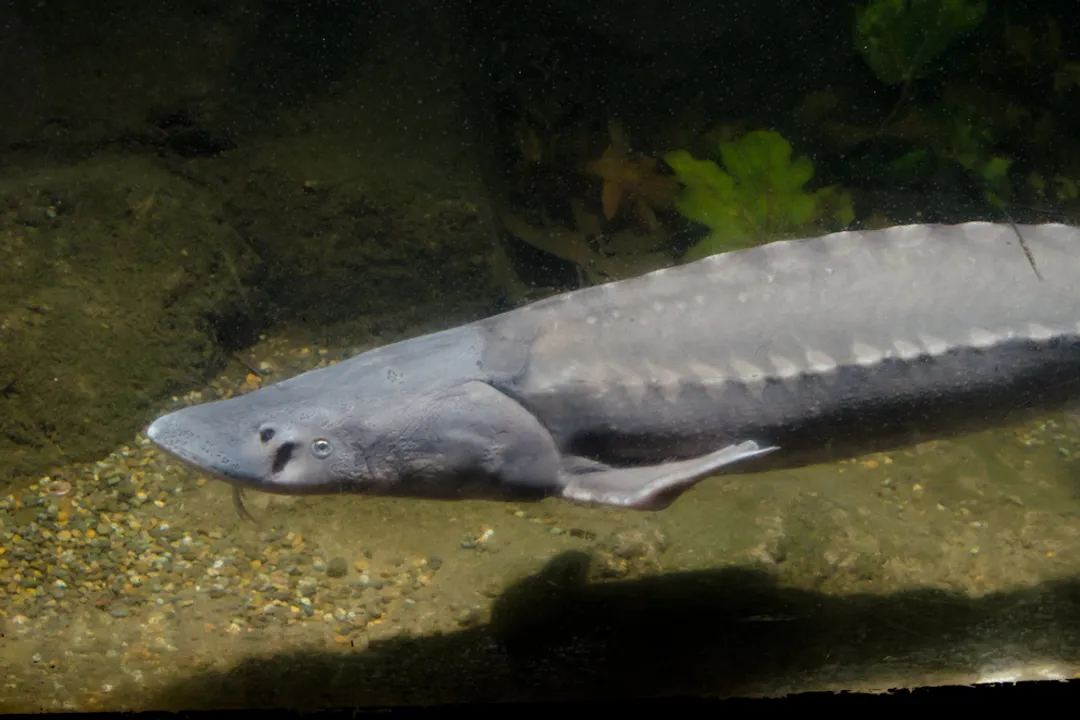
As benthic, or bottom-dwelling, fish, white sturgeons have specialized feeding behaviors that target organisms living in or on the riverbed. [7] Their diet is varied and depends heavily on the local environment, but it generally consists of invertebrates like crustaceans, mollusks, and aquatic insects, alongside smaller fish that share their habitat. [3][7] The barbels mentioned earlier are the primary tools used to locate this food beneath silt and gravel. [5]
The ecological role of the white sturgeon is that of a large, generalized scavenger and predator near the bottom substrate. They are not fast, open-water pursuit predators, but rather methodical foragers. Observing their feeding patterns in captivity, such as at the Oregon Zoo, shows a preference for consuming items that settle on the bottom, confirming their adaptation to this ecological niche. [3]
# Threats And Protection
Historically, the primary driver of decline for white sturgeon populations was intense overfishing, targeting both their meat and their valuable eggs, which are processed into caviar. [4][6] The species' slow growth and late maturity meant that sustained, heavy fishing pressure quickly decimated adult stocks without allowing for natural replenishment within a human timeframe. [4]
Beyond direct harvesting, habitat degradation poses a continuous threat. Dams block access to historical spawning grounds upstream, while pollution and sedimentation can destroy the necessary gravel beds required for successful egg incubation. [4][6] Because these fish require connectivity between deep-water feeding areas and specific upstream spawning habitats, barriers or poor water quality in any segment of their necessary range can fragment or eliminate entire local populations. [2]
Conservation efforts vary across their range, reflecting different regional statuses. [4] Some areas maintain highly regulated sport fisheries with strict catch-and-release rules, while other, more depleted populations are completely closed to harvest. [6] In California, for instance, the species is listed as threatened, and recovery plans focus heavily on habitat restoration and protection against unauthorized take. [4] The collective management across the Pacific Northwest and British Columbia aims to secure the long-term viability of these ancient species through monitoring and habitat defense. [6]
# Captive Environments
For many people today, seeing a white sturgeon means visiting an aquarium or zoo, as wild encounters are increasingly rare or restricted. [1][3] Institutions like the Vancouver Aquarium and the Oregon Zoo house these magnificent animals, often providing them with large tanks that simulate their deep, cold water environments. [3][8]
In these controlled settings, it is sometimes possible to observe their unique swimming style and feeding behaviors up close. [8] For example, in tanks designed to mimic river systems, staff must ensure adequate depth and water turnover to meet the needs of such a large, migratory species. [3] These captive populations also serve an educational purpose, connecting the public with one of North America's most unique native fishes and emphasizing the necessity of conservation. [1][10]
When looking at a large sturgeon in an aquarium setting, one might compare its rugged, armored appearance to a large reptile or even a shark, yet it is distinctly a fish adapted for freshwater or estuarine life. [5] This visual comparison often helps visitors grasp just how different sturgeon are from the common salmon or trout they might be used to seeing. [2] Understanding that the plates protecting this ancient fish are essentially specialized scales—not true dermal bone like a turtle shell—highlights a fascinating point in bony fish evolution. [5]

# Management Insights
Considering the life history data—maturing around 15 to 20 years and spawning infrequently—the key takeaway for effective management is that recovery is measured in decades, not seasons. [4] This necessitates regulations that remain stable over long periods, even when immediate population increases are not visible. Any localized fishing management strategy must account for the upstream-downstream migratory connectivity, recognizing that the health of the lower estuary directly impacts the reproductive success upstream. [6]
Furthermore, due to their great size and longevity, white sturgeons can accumulate environmental contaminants from the water column and their food sources over their long lives. While the provided sources focus on population and habitat health, it is a logical extension that monitoring contaminant levels in these apex benthic feeders can serve as a useful barometer for the overall long-term ecological condition of large river systems like the Columbia or Fraser Rivers. [2] This long-term presence makes them excellent, if slow-responding, bioindicators of environmental quality.
Related Questions
#Citations
White sturgeon | Animals - Monterey Bay Aquarium
White sturgeon - Wikipedia
White sturgeon | Oregon Zoo
White Sturgeon - California Department of Fish and Wildlife
White Sturgeon - National Maritime Historical Society
White sturgeon | Washington Department of Fish & Wildlife
White Sturgeon Fish Facts - Acipenser transmontanus - A-Z Animals
White Sturgeon - Vancouver Aquarium
White Sturgeon - Montana Field Guide
White Sturgeon - Oregon Coast Aquarium