White Marlin Facts
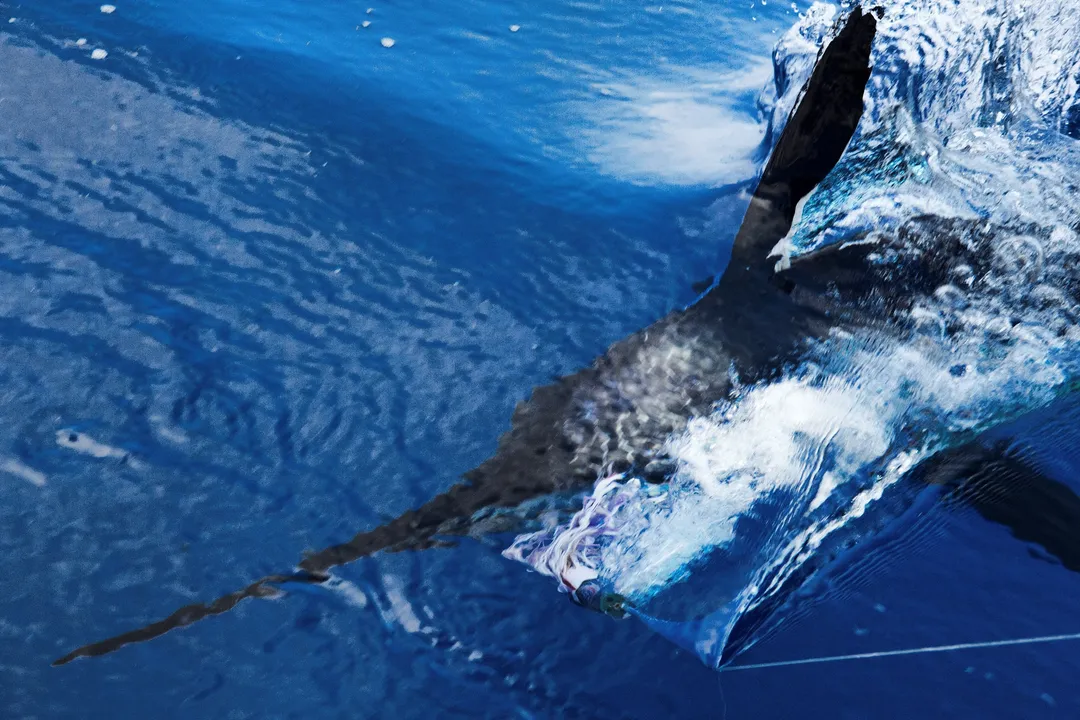
The white marlin, scientifically known as Istiophorus albicans or sometimes Tetrapturus albidus, presents an elegant silhouette against the blue of the open ocean, earning its place as one of the most sought-after big game fish in the world. [1][2][5] These magnificent creatures belong to the billfish family, Istiophoridae, a group renowned for speed and acrobatic leaps when hooked. [2][5] Distinguishing them accurately from their close relatives, like the blue marlin, requires a close look at specific physical characteristics that define the species. [1][5]
# Appearance Details
A mature white marlin typically reaches lengths of about 8 to 9 feet, though specimens reaching 11 feet have been recorded. [2] In terms of weight, they are generally smaller than blue marlin, usually weighing between 100 and 150 pounds, with some individuals approaching 200 pounds. [1][2] Their coloration is striking: the back is usually an iridescent, dark bluish-black or purplish-blue, which fades to silvery-white on the flanks and belly. [2][5][6] This countershading provides excellent camouflage in the water column. [5]
One of the defining features is their dorsal fin, which is tall and distinctly curved, giving them a sail-like profile, although this feature is less pronounced than in the sailfish. [5][6] The dorsal fin is often a deep blue color. [5] Unlike blue marlin, the white marlin tends to have more than 15, and sometimes as many as 19, stiff, short, non-overlapping finlets following the second dorsal and anal fins. [1][6] Their bill, or rostrum, is long and slender, which they use in feeding. [5] The lower sides of their bodies display subtle, darker vertical bands, which are visible when the fish is fresh or excited, though these bands can fade quickly after death. [2][5][6] The pelvic fins are very long, reaching the anal fin origin, which is a key feature separating them from other billfish in the region. [1][6]
# Global Range

The distribution of the white marlin is widespread throughout the tropical and subtropical waters of the Atlantic Ocean. [2][5] This vast range encompasses areas from the western North Atlantic, stretching down to the Gulf of Mexico and the Caribbean Sea, and extending along the coasts of South America. [1][2][5] In the western North Atlantic, their presence is well-documented from the waters off New England southwards. [5][6]
State agencies in the US track their presence closely. For instance, they are found in the Atlantic waters off the coasts of North Carolina and Delaware, where they are considered a seasonal or migratory visitor rather than a year-round resident in many nearshore areas. [4][8] Maryland fisheries also monitor their presence in the Atlantic Ocean waters adjacent to the state. [1] Their presence in these Mid-Atlantic regions is closely tied to seasonal water temperatures, prompting significant north-south migrations throughout the year. [1][5] This migratory nature means that understanding their oceanic movements is key to tracking their populations and recreational opportunities. [5]
# Habitat Preferences

White marlin prefer offshore, pelagic environments, generally inhabiting the open ocean rather than coastal estuaries or shallow bays. [1][2] They are most frequently found in waters where the bottom is deeper than 60 feet, often congregating near structural features such as ledges, offshore wrecks, or temperature breaks—areas where nutrients concentrate and baitfish gather. [1][5]
Water temperature plays a significant role in dictating their location. They thrive in warmer oceanic waters, typically favoring temperatures between the mid-60s and the high 70s Fahrenheit range. [1][5] In the summer months, for example, they move northward into cooler waters off the Mid-Atlantic states, following the warmth and the corresponding abundance of food. [1][6] Their preference for deeper, warmer, offshore waters helps explain why they are rarely encountered by inshore anglers. [2] It is interesting to note that while they share the open ocean with many other species, their specific preference for certain thermal layers within that water column influences where anglers search for them year after year. [5]
# Feeding Ecology
As apex predators in their environment, white marlin primarily feed on smaller pelagic fish and squid. [2][5] Their diet is varied, consisting of creatures like mackerel, herring, small jacks, and flying fish, depending on what is locally abundant. [2][5]
Their feeding technique is a marvel of coordination and speed. White marlin often hunt in small schools or groups, using their long, sharp bill to slash through schools of baitfish. [2][5] This slashing action stuns or injures the prey, making it much easier for the marlin to circle back and consume the stunned individuals. [5] This coordinated method contrasts with solitary hunting seen in some other large pelagics and showcases a sophisticated social or cooperative hunting strategy, even if temporary. [2] The speed at which they can move through the water to execute this feeding strategy is remarkable, positioning them as one of the fastest animals in the sea, capable of bursts exceeding 50 miles per hour. [5]
# Life Cycle
Information regarding the complete life cycle of the white marlin, especially in the wild, is still developing, which highlights the need for continued research and conservation efforts. [9] They are long-lived fish, though exact lifespans in the ocean are difficult to pin down for specific individuals. [9]
Spawning behavior for white marlin is believed to occur in warmer, offshore waters, likely during the late spring and summer months, though specific spawning grounds are not fully delineated across their entire range. [9] Females are highly fecund, meaning they can produce a large number of eggs in a single season. A single large female can potentially release millions of eggs. [9] This high potential reproductive capacity is vital for sustaining a population that is heavily targeted by commercial and recreational fishing interests, yet their vulnerability during these early life stages remains a major population challenge. [9]
# Conservation Status
The status of the white marlin population has been a significant point of concern for conservation groups and fisheries managers for decades. [3][9] The species has experienced substantial declines due to historical overfishing, making its current status a sensitive topic for the fishing community. [3][9]
Because of these declines, the white marlin is listed as Threatened under the U.S. Endangered Species Act (ESA). [1][3][9] This listing acknowledges the serious risk the species faces throughout its range. [3] In many areas, particularly in the Atlantic, strict regulations are in place to protect them. For example, in the waters managed by the state of Maryland, the white marlin is designated as a Game Fish, and a strict catch-and-release policy is generally mandated for recreational anglers to help preserve the remaining stock. [1] Similarly, in North Carolina, management practices focus on conservation, requiring that white marlin caught recreationally be immediately released. [4]
It’s important for recreational anglers to understand that regulations can shift based on stock assessments. When you are actively fishing for billfish in federal waters off the coast, the expectation should always be immediate release, regardless of local state rules closer to shore, because the federal management structure often dictates the most conservative approach for this threatened species. [3][4] While conservation efforts are aimed at recovery, the combined pressures from domestic and international fisheries still place significant stress on the population. [3][9]
# Recreational Significance
The white marlin is extremely highly regarded by sport fishermen, often prized more highly than its larger relatives due to its speed, fighting spirit, and the difficulty in landing it. [5] The pursuit of the white marlin is a major driver for specialized offshore charter fishing operations along the Atlantic coast. [5] Anglers are drawn to their spectacular surface activity, which includes powerful jumps and long, high-speed runs when hooked. [2]
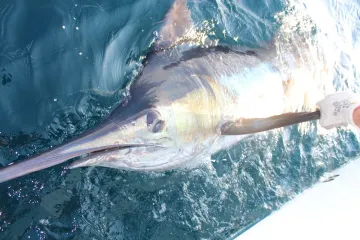
When an angler hooks into a white marlin, the fight is often characterized by these spectacular aerial displays, as the fish attempts to throw the hook by leaping clear of the water repeatedly. [5] This intense behavior is what earns them the nickname "spearfish". [5] Due to the threatened listing, most recreational encounters result in a photo opportunity before a careful release, ensuring the fish has the best chance to survive and contribute to the next generation. [1][4]
If one were to look at historical catch data versus modern catch-and-release statistics across the Mid-Atlantic, a clear trend emerges: the primary value of the white marlin to modern fisheries management is its trophy value achieved through sporting capture, rather than its value as a food source, due to the necessary protective regulations. [1][3] Anglers targeting these waters often focus their efforts during the warmer summer months, as this is when the fish are most reliably present in high concentrations near the continental shelf edge, following their food sources northward. [6] Recognizing the seasonal migration patterns derived from distribution data suggests that the best chances for an encounter often align with the months immediately following the peak sea surface temperatures near the coast. [1][5] For those looking to maximize their chances while adhering to conservation ethics, targeting areas known for temperature breaks in summer is sound tactical advice, even if the fish are only passing through on their way further north. [5]
Related Questions
#Citations
Maryland Fish Facts - White Marlin
White marlin
White Marlin Animal Facts - Kajikia albida
White Marlin
SPECIES PROFILE: White Marlin
White Marlin – Discover Fishes
White Marlin | NC DEQ
White Marlin - Delaware Fish Facts for The Recreational Angler
White Marlin
Natural History: Atlantic White Marlin