White-Eyed Vireo Facts
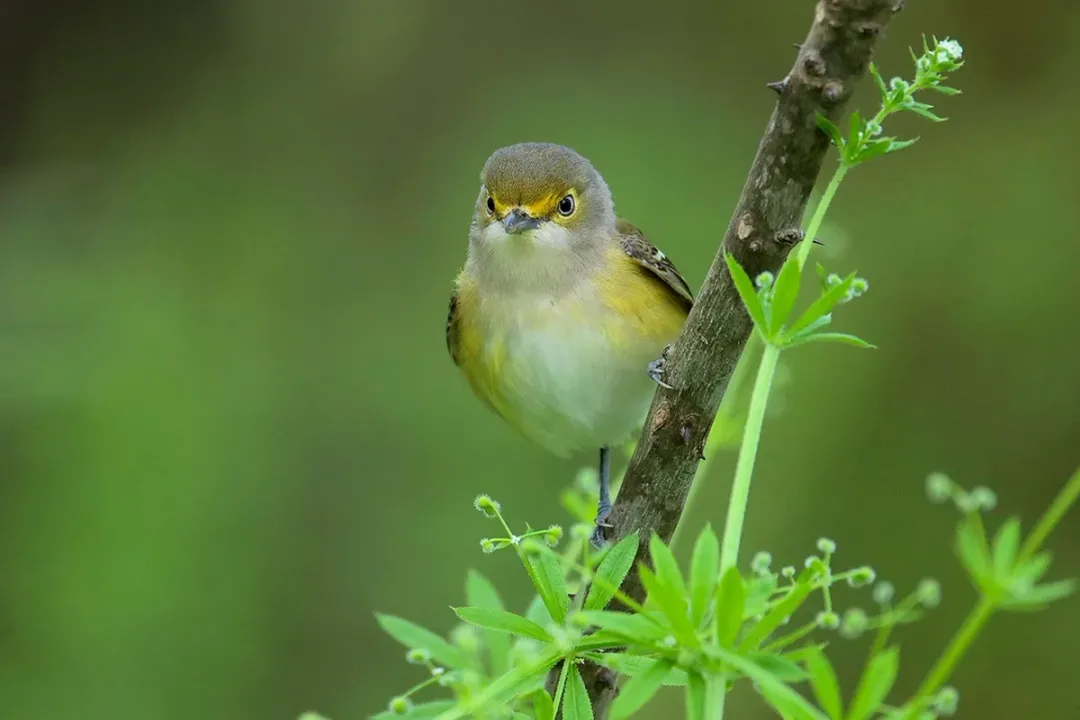
The White-eyed Vireo, Vireo griseus, is a small, spunky songbird that inhabits the dense, scrubby understory across the eastern United States, making it a species more frequently heard than seen. [4][1] Despite its preference for deep cover—tangled thickets, forest edges, and overgrown fields—its presence is announced by a snappy and distinctive song that often continues well into the heat of the day. [5][4] This bird possesses several striking features that help distinguish it from other members of the vireo family, provided you manage to catch a glimpse through the foliage. [1]
# Appearance Detail
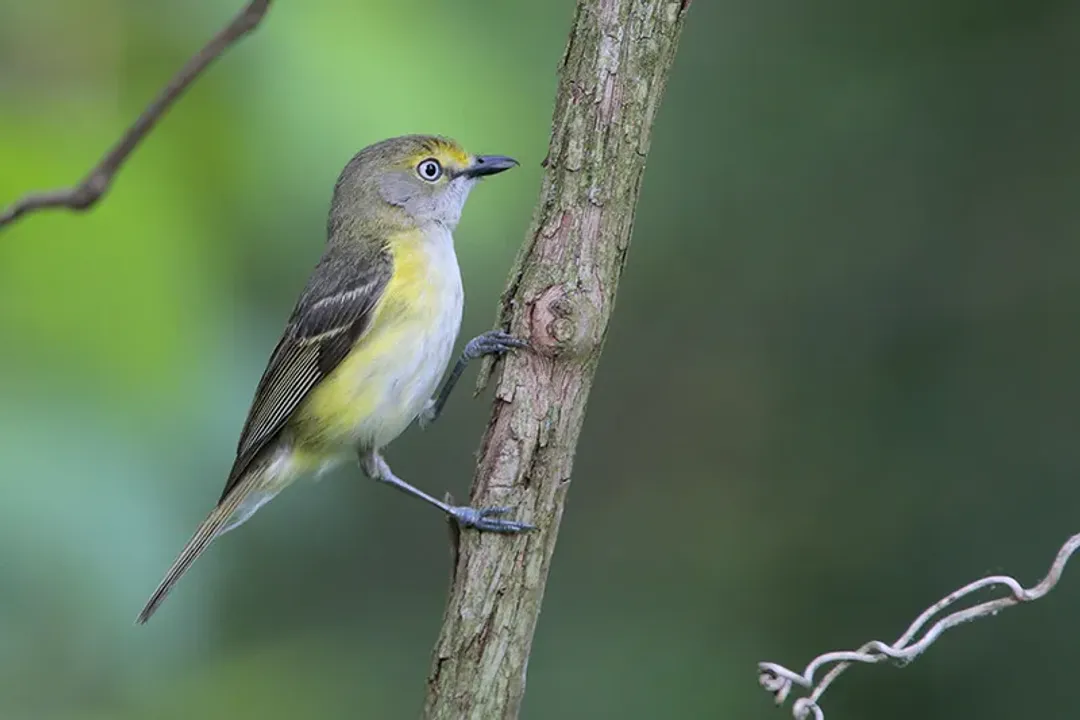
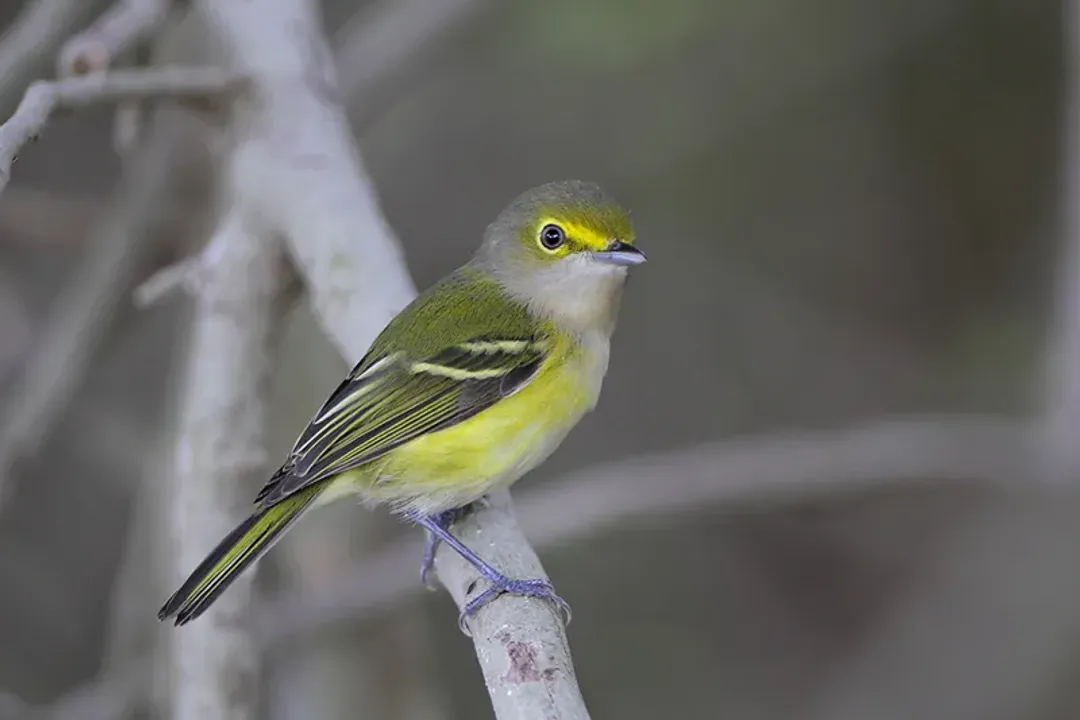
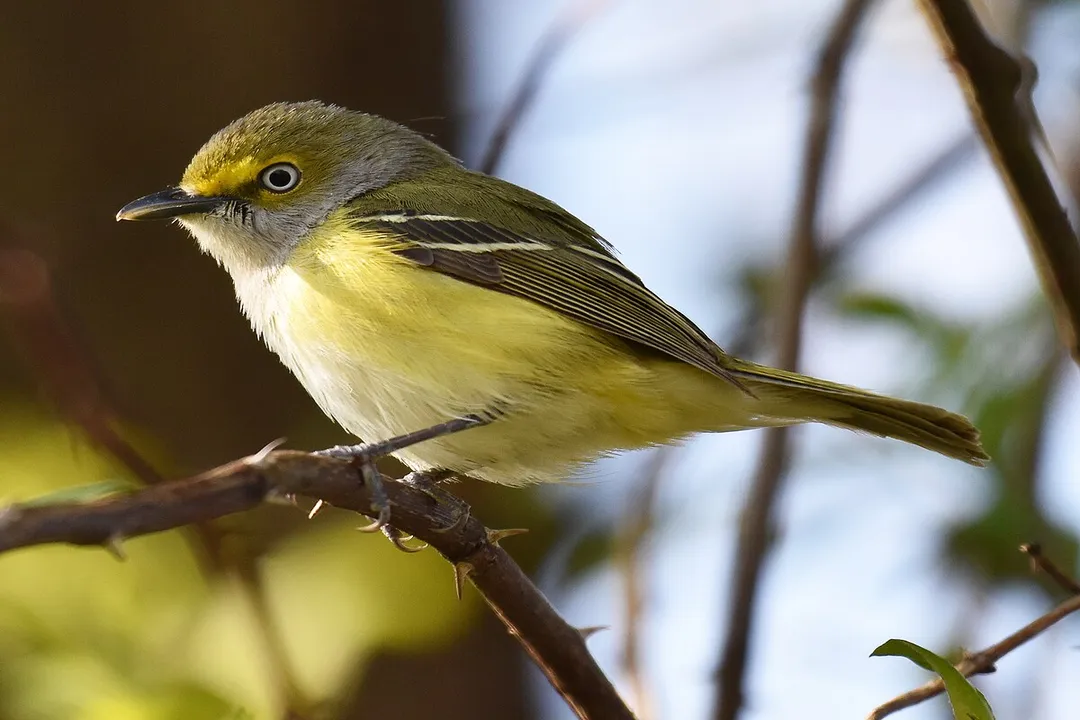
This compact songbird is characterized by a thick, straight bill that is slightly hooked at the tip. [3] Adults display an olive-green back that contrasts with a gray head. [3] The most recognizable features, however, are the bright yellow rings surrounding the eyes, often termed "spectacles," and the eponymous white iris. [2][1] The bird’s undersides are generally white, featuring a white throat and belly, though the flanks carry a distinct wash of yellow. [3] Its wings are dark, marked with two prominent white wingbars. [4][3]
When searching for this bird, remember that not all individuals look alike year-round. A key identifier for separating adults from young birds is the eye color. [1] Juveniles possess dark eyes, which remain dark until they reach their first winter or spring, at which point they develop the adult white iris. [2][3] In addition to the eye difference, young birds may present with an entirely pale gray head and generally paler plumage compared to adults. [6] While males and females appear similar in plumage, they differ notably in their vocal roles. [6]
In terms of size, the White-eyed Vireo is small, measuring about $4.3$ to $5.1$ inches ($11$ to $13$ centimeters) in length. [3][4] It weighs between $0.3$ and $0.5$ ounces ($10$ to $14$ grams), making it roughly the size of a sparrow or even smaller. [3][2] The wingspan generally measures around $6.7$ inches ($17$ centimeters). [4]
The sharp contrast between the bright yellow spectacles and the gleaming white iris creates a highly visible facial pattern. This distinct marking, set against the bird's preference for the deep shadows of the thicket, suggests an evolved visual signal that may aid in short-range pair bonding or territorial signaling within the dark understory, even as the bird remains mostly concealed. [6][4]
# Song Machine
The White-eyed Vireo relies heavily on acoustic communication, particularly the male's loud, expressive song used to declare territory and attract a mate during the breeding season. [6][1] The song is known for its rapid, energetic delivery, often described as a nasally jumble of notes. [1][3] A common way to characterize the tune is a phrase like "Quick, give me a rain check!" or the pattern "chip-a-wheeoo-chip". [5][6] Regardless of the exact phrasing captured, the song is typically bookended by short, sharp chip notes at the beginning and end. [4][3]
The male’s dedication to singing is notable; he can be heard singing almost constantly from sun-up well into the day on his breeding grounds. [2][4] Interestingly, this vigorous singing duty is shared during the non-breeding season, as both males and females sing while on their wintering grounds, a behavior restricted only to the male during the summer. [1][4] When disturbed or facing a threat, the bird emits a harsh, rapid chattering call. [6][1] Partners also use brief contact calls described as short 'pik' sounds to stay connected. [6]
# Range Habitat
White-eyed Vireos are Neotropical migrants, meaning they move seasonally between North America and Central America. [6] Their breeding range spans much of the eastern United States, extending from New England west to areas like northern Missouri and eastern Nebraska, and south through Texas to Florida. [4][7] During the colder months, most northern breeders travel south to winter along the Atlantic and Gulf coastal plains, reaching as far as the Yucatan Peninsula in Mexico, Cuba, and the Bahamas. [4][6][7]
However, not all populations make the long journey. Year-round residents can be found along the southeastern US coast from South Carolina down through Texas, and also along the Gulf Coast of Mexico. [4][6] The northern limits of their breeding range are considered the fringe, with Massachusetts sitting at the extreme northeastern edge. [9]
Whether breeding or wintering, the preferred habitat remains consistent: dense, shrubby vegetation. [1] They favor areas where low, thick growth has been allowed to develop, such as old fields that have lain fallow for decades, streamside thickets, and woodland understory. [3][5][6] They thrive in areas near water, including brushy canyons and marsh-side tangles, though they can also be found in scrub within open woods. [7][5] Their habit of staying low in these dense tangles is what often keeps them hidden from view, even when their loud song is present. [1][5]
# Foraging Nests
The diet of the White-eyed Vireo shifts significantly with the seasons. [6] During the breeding season, they are primarily insectivorous, actively flitting among branches and foliage to search for prey. [2][1] They are foliage gleaners, capturing insects through quick maneuvers such as hovering, lunging, or hanging from a branch tip. [3] Caterpillars appear to be a favorite food source, though their diet also includes beetles, flies, wasps, ants, and spiders. [5][6]
As they migrate or settle on their wintering grounds, their diet becomes significantly more frugivorous, relying on small berries and fruits. [5][2] They have a particularly strong link with the gumbo-limbo tree in Central America, acting as a primary seed disperser for its fruit. [6] They may consume fruit from sumac, dogwood, poison ivy, and waxmyrtle in other regions. [6]
Reproduction involves the male vigorously defending his established territory, often through song, before a pair bond is formed. [1][6] The pair is monogamous, though the bond usually lasts only one season. [6] The nest-building process is shared, resulting in a deep, suspended, cup-shaped structure. [5][7] The female typically selects the site, which is usually placed quite low—often less than one meter off the ground—in the fork of a shrub or small tree branch. [7][5] The construction materials are quite varied, incorporating twigs, strips of bark, leaves, and fine grass, all held together and reinforced with spiderweb silk. [1][7] The female usually lays three to five white eggs speckled with dark brown or black spots. [5][7] Both parents share incubation duties for approximately $13$ to $15$ days. [7][5] Once hatched, the young are altricial, requiring constant care. [6] Fledging occurs after $9$ to $11$ days, but the young remain reliant on parental feeding for up to $23$ additional days. [6][7]
# Status Ecology
Globally, the White-eyed Vireo is listed as Least Concern by the IUCN, attributed to its large population size, relatively extensive geographical range, and, in some assessments, noted population increases across the broader Eastern US. [2][5][6] However, local population trends paint a more complex picture.
Data from bird atlases reveals potential vulnerabilities at the margins of the species’ range. For instance, in Massachusetts, the species is described as local and strongly declining, having vanished from nearly half of its historically occupied breeding blocks between the first and second major atlas surveys. [9] This sharp retraction at the northern edge suggests that while the species is common in the southeast, peripheral populations may be highly sensitive to subtle changes in habitat quality or climate that make their northern scrub growth less viable over time. [9] Meanwhile, data from the Texas Breeding Bird Survey (BBS) showed a population trend that was essentially flat over several decades, with a $95$% confidence interval suggesting potential change between a slight annual decrease of $2.3%$ and a slight increase of $2.5%$. [7]
A significant ecological factor impacting reproductive success across the range is brood parasitism by the Brown-headed Cowbird, with rates sometimes exceeding $50%$, often resulting in the nest failing to produce any vireos. [7] On the positive side, as an insect-eater during the breeding season, this vireo likely exerts a useful check on local insect populations, and its fruit consumption in winter supports its role as a seed disperser. [6] As a curiosity, this species holds a unique place in avian history: the oldest North American fossil record for the entire vireo family comes from a $400,000$-year-old White-eyed Vireo wing bone found in Florida. [4]
The primary threat to the species overall remains habitat loss. The scrubby, brushy environments they depend on are often readily converted for agricultural use or urban development, posing a risk despite the current "Least Concern" rating. [6] Birdwatchers hoping to find one should focus their efforts by following the persistent song to shrubby areas, especially near the Gulf Coast where they are year-round residents. [1]
Related Questions
#Citations
White-eyed Vireo Overview, All About Birds, Cornell Lab of Ornithology
White-eyed Vireo | Audubon Field Guide
White-eyed vireo - Wikipedia
White-eyed vireo - National Zoo
WHITE-EYED VIREO | The Texas Breeding Bird Atlas
Kids' Inquiry of Diverse Species, Vireo griseus, white-eyed ... - BioKIDS
White-eyed Vireo - Find a Bird
White-eyed Vireo | Bird Gallery - Houston Audubon Society