Where are orchard orioles found?
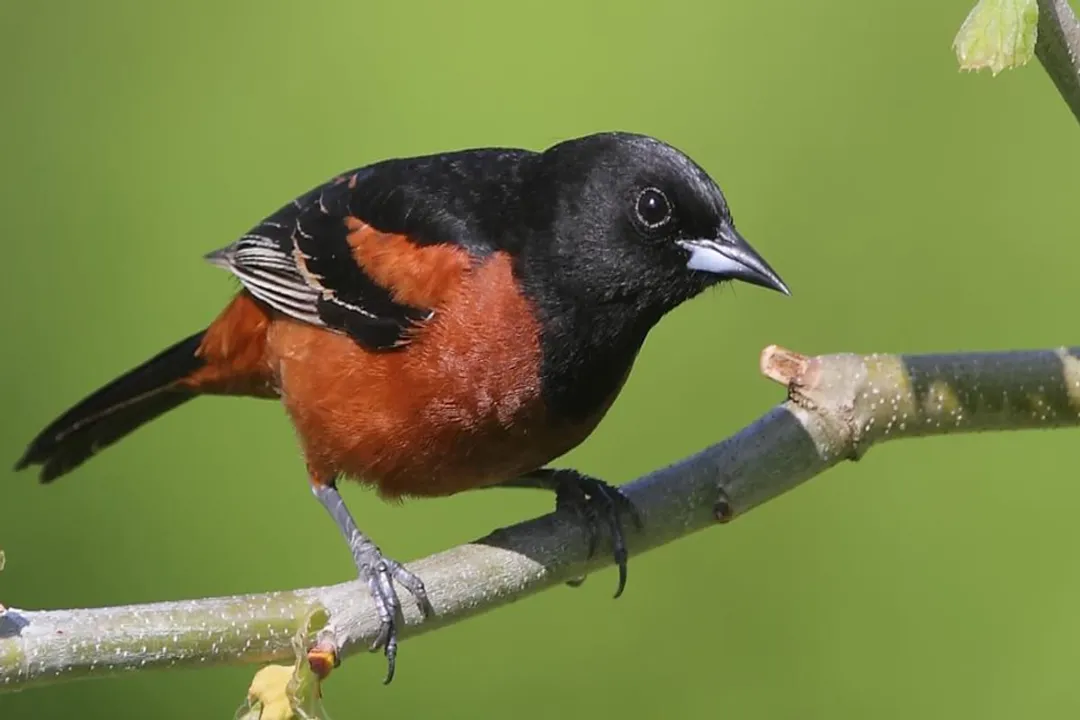
The Orchard Oriole, Icterus spurius, is a migratory bird whose whereabouts depend entirely on the season, painting a picture of North American summers giving way to Central American warmth. [2][3][4] Knowing where to find this species requires tracing its path across continents, from the northernmost reaches of its summer home to the tropical locales where it escapes the winter cold. [2][3][4] This bird is generally less common and less widespread than its more famous cousin, the Baltimore Oriole, making a sighting feel a little more special. [4]
# Summer Home
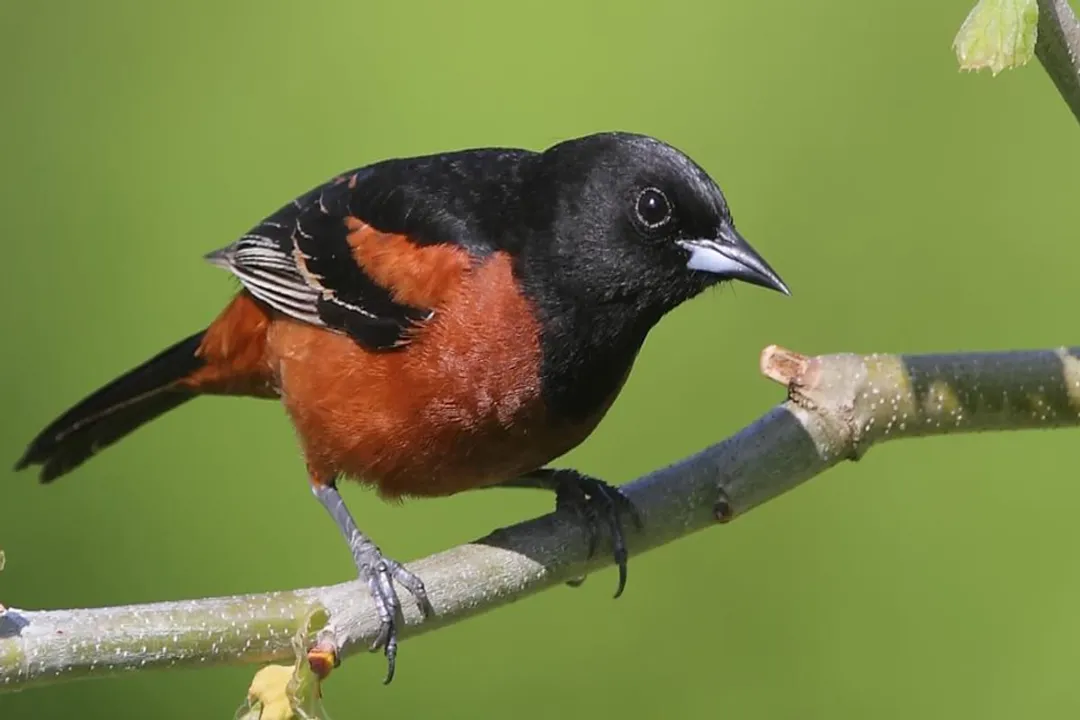
The breeding season for the Orchard Oriole generally spans from late spring through summer, occupying a territory that stretches across a broad swath of North America. [4][7] Their summer residency begins in southern Canada, where populations establish themselves in provinces like southern Ontario and Quebec, though they are sparse there. [2][6] Moving south across the border, the core of their breeding range covers a significant portion of the United States. [3][5]
In the US, they favor the middle latitudes, typically avoiding the colder climates of the far north and the extreme heat and aridity of the deep Southwest deserts. [2][7] You can expect to find them establishing nests from the mid-Atlantic states westward through the Ohio and Mississippi Valleys and into the Great Plains. [1] For instance, while they are present across much of the central and eastern US, their presence becomes patchier or more southerly in the far western states like Washington or Oregon, although some individuals may push into the intermountain West during breeding. [1][8] Their southern edge in the US often meets northern Mexico, where they also establish breeding populations. [3][6]
What's fascinating is that while they are widespread, they are not uniformly distributed within this area. Areas like the Great Plains seem to support robust breeding populations, though they are often described as "local" or "patchy" across their entire range, suggesting that suitable microhabitats are the real limiting factor, not just broad latitude and longitude. [4] If you compare the range maps from different birding resources, you might notice slight variations in the exact boundaries, which often reflects the difficulty in precisely mapping populations that are naturally somewhat scattered rather than continuous. [1][8] This slight ambiguity in the outer edges highlights that observing them locally, even near the supposed border of their range, is always worth the effort.
# Habitat Needs

Understanding where they are found is incomplete without knowing what they look for when they arrive to breed. Orchard Orioles are strongly associated with scattered trees and woodland edges, making them creatures of transition zones. [4] Unlike some other orioles that favor tall, dense stands of riparian cottonwoods or open parklands, the Orchard Oriole seems quite content in areas that offer both open foraging space and nearby nesting cover. [3]
During the breeding season, look for them near orchards—hence the name—but also in suburban parks, residential areas with mature trees, riparian corridors, and groves along streams or farm fields. [4][5] They show a particular affinity for deciduous trees, especially those with dangling, drooping structures, which are ideal for weaving their distinctive, pendulous nests. [4] Think about elms, willows, sycamores, or even large ornamental trees in a backyard setting; these spots provide the necessary structure for their intricate homes. [4] The need for these specific nesting sites is a key reason why their distribution can appear fragmented even within suitable climates. A stretch of perfect climate without the right kind of nesting tree simply won't host a pair. [4]
If you are observing in the Midwest during late May or June, scouting agricultural areas where hedgerows or isolated clumps of mature trees border open fields might offer a better chance of discovery than thick, unbroken forest. [6] They are often seen foraging low to the ground or in shrubs, which differs from the high canopy searching habits of some related species. [3] This preference for lower foraging levels is a practical detail that birders scanning only the treetops might miss.
# Migration Timing
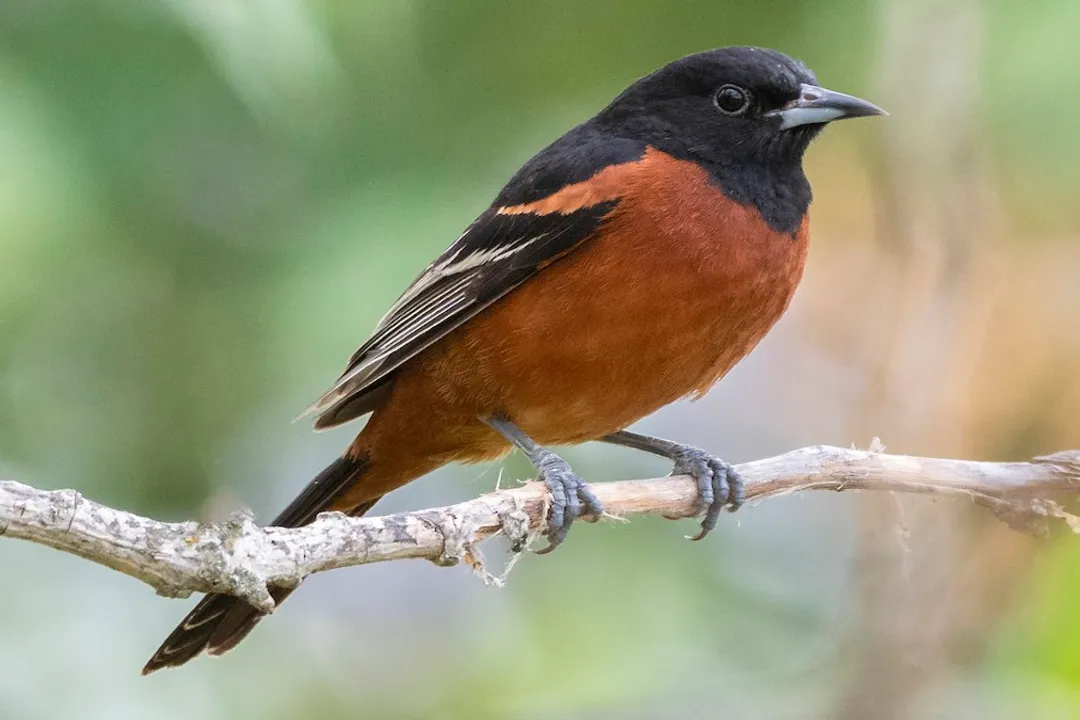
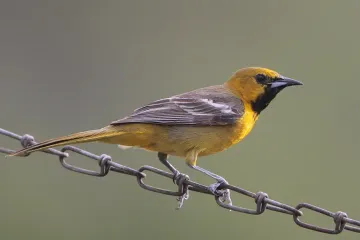
As summer wanes, the Orchard Orioles begin their southward migration, leaving their northern breeding territories behind for warmer latitudes. [4] Their departure from the northernmost US and Canadian breeding grounds usually starts in August. [2] This movement is directional, heading south and often slightly southeast, funneling them toward the land bridges that lead into Mexico and Central America. [4]
For those living in the middle of their breeding range, such as in the central US states, the migratory passage is often brief, occurring throughout September and into early October. [2] Unlike species that migrate in massive, easily noticed flocks, Orchard Orioles tend to travel more discreetly, often appearing as individuals or in small family groups when passing through migration hotspots. [4] Spotting them during migration can be tricky because they are not as vocally conspicuous as they are when defending a nesting territory. [9]
A key feature of their migration is the speed with which they move once they leave their breeding grounds. They are not long-distance ponderers; they aim to reach their wintering grounds efficiently. [4] This means that if you haven't seen them by mid-October in, say, Texas, you are unlikely to see them again until the following spring, as the bulk of the population will have already passed through or reached their destinations further south. [2]
# Winter Quarters
The destination for the Orchard Oriole is firmly rooted in the neotropics, specifically Central America, where they spend the non-breeding season. [3][5] Their winter range is extensive, stretching from southern Mexico down through the landmass of Central America. [2][6]
Specifically, reliable reports place them throughout Mexico, west to eastern Panama, and south along the northern coasts of South America, including countries like Colombia and Venezuela. [2][4][7] Within this region, they exhibit a preference for semi-open habitats, often favoring scrubby woodlands, shade coffee plantations, and gallery forests rather than deep, unbroken rainforest. [4] This preference for semi-open or disturbed areas means they can sometimes be found relatively close to human habitation or agricultural frontiers within their wintering range. [7]
If you are interested in seeing an Orchard Oriole during the northern winter months (say, December through February), you would need to look south of the US border. [1] It is important to note that while the map shows a broad coverage across Central America, their actual density in any one spot will depend on local food availability and habitat quality, much like their summer grounds. [1][8] For instance, while they are expected in Costa Rica, a birder there might still have to work to find one among the many other colorful tropical birds. [4]
# Arrival and Departure
The return trip north signals the true start of spring in the northern latitudes. [4] Orchard Orioles generally begin arriving on their southern US breeding grounds starting in late April, with peak arrival times often falling in the first two weeks of May. [2][6] This is slightly earlier than some of their relatives, like the Baltimore Oriole, which often arrives later in May. [4]
For the keen observer in states like Texas or Oklahoma, catching the first returning male in early May is a reliable sign that the nesting season is about to kick off. [6] Their arrival is often heralded by the male’s distinct, somewhat disjointed song, which sounds less musical than other orioles but is a definitive marker of the season's change. [9]
When considering the timeline of their entire annual cycle, it becomes clear that the Orchard Oriole dedicates a significant portion of the year—roughly six months—to breeding in North America and the remaining six months to wintering in Central America. [4] This clean division makes them excellent indicators of seasonal transitions across the Americas. Tracking the earliest and latest reliable sightings on citizen science platforms like eBird can offer a fascinating, real-time insight into how climate variability might be subtly nudging their arrival or departure dates year-to-year, a dynamic worth watching as the climate continues to shift. [8]
# Localized Sightings Versus Range Maps
While range maps provide a generalized overview, the actual experience of locating an Orchard Oriole involves understanding the nuances between the breeding, migration, and wintering zones. [1][8] An expert birder knows that a spot on the map isn't a guarantee; it’s a probability estimate based on where other people have seen them historically.
Consider the area along the US-Mexico border, particularly the Rio Grande Valley in Texas. This area serves as both a major late-season staging ground for birds moving south and a very early arrival point for birds moving north, functioning as a critical corridor. [6] If you are in that corridor in mid-September, you are seeing transient birds that will soon be in Mexico. Conversely, if you are there in late April, you are seeing the vanguard of the breeding season population. [2]
One unique perspective comes from comparing their distribution to areas where they are absent. Notice that their primary breeding range avoids the high elevations of the Rocky Mountains and the extremely arid Great Basin deserts. [1][4] They are distinctly a bird of lower elevations, open woodlands, and agricultural landscapes, which gives a subtle clue to where they won't be found, even if the climate seems moderate enough on paper. If you are hiking high in the Rockies, you are unlikely to find one, whereas a stop at a small, tree-lined municipal park in Kansas might reward you instantly. [4][5] This strong habitat selection over pure climate zone is a defining characteristic of their geographic spread.
Another way to frame their location is by considering the difference in density between the sexes during migration. While the bright male is obvious on the breeding ground, during the southbound migration, the less conspicuous females and young birds might be more frequently encountered in mixed-species foraging flocks further north than the males, who may depart earlier or follow a slightly different route once breeding duties are done. [4] Therefore, where you look during migration might depend on what you hope to see—a lingering female versus an early-departing male.
# Summary of Geographic Presence
To distill the findings, we can summarize the Orchard Oriole's distribution into three distinct seasonal chapters: [1][4]
| Season | Approximate Time Frame | Primary Location | Habitat Association |
|---|---|---|---|
| Breeding | May - August | Southern Canada, US (Mid-latitudes), Northern Mexico | Deciduous trees, riparian areas, parklands |
| Migration | March - Early May (Northbound), August - October (Southbound) | US Gulf Coast, Lower Mississippi Valley, Mexico Corridor | Transient stops, small groves |
| Wintering | November - February | Mexico south through Central America to Colombia/Venezuela | Semi-open woodland, shade plantations |
This migration pattern shows the species is deeply intertwined with the seasonal availability of resources across two distinct ecological zones: the temperate deciduous forests and the subtropical/tropical scrublands. [7] Their ability to successfully navigate the large geographical gap between these two regions is what defines their entire existence, making the areas they pass through, like the southern US states, vital but temporary staging posts. [2][6]
For bird enthusiasts hoping to check the Orchard Oriole off their life list, the key takeaway is simple: timing is everything, and location matters immensely. If you are in Maine in July, the chances are very slim, but if you are in southern Texas in early May, you are in prime real estate for a new arrival. [1][3] The next time you hear a call that sounds slightly odd coming from a suburban elm, remember the vast journey that small, black-headed bird undertook to arrive there. [4][9]
Related Questions
#Citations
Orchard Oriole Range Map, All About Birds, Cornell Lab of Ornithology
Orchard oriole - Wikipedia
Orchard Oriole | Audubon Field Guide
Orchard oriole | Smithsonian's National Zoo and Conservation ...
ORCHARD ORIOLE | The Texas Breeding Bird Atlas
Icterus spurius (orchard oriole) | INFORMATION | Animal Diversity Web
Orchard Oriole Icterus spurius - eBird
Orchard Oriole Facts - Perky-Pet