Where are jacana found?
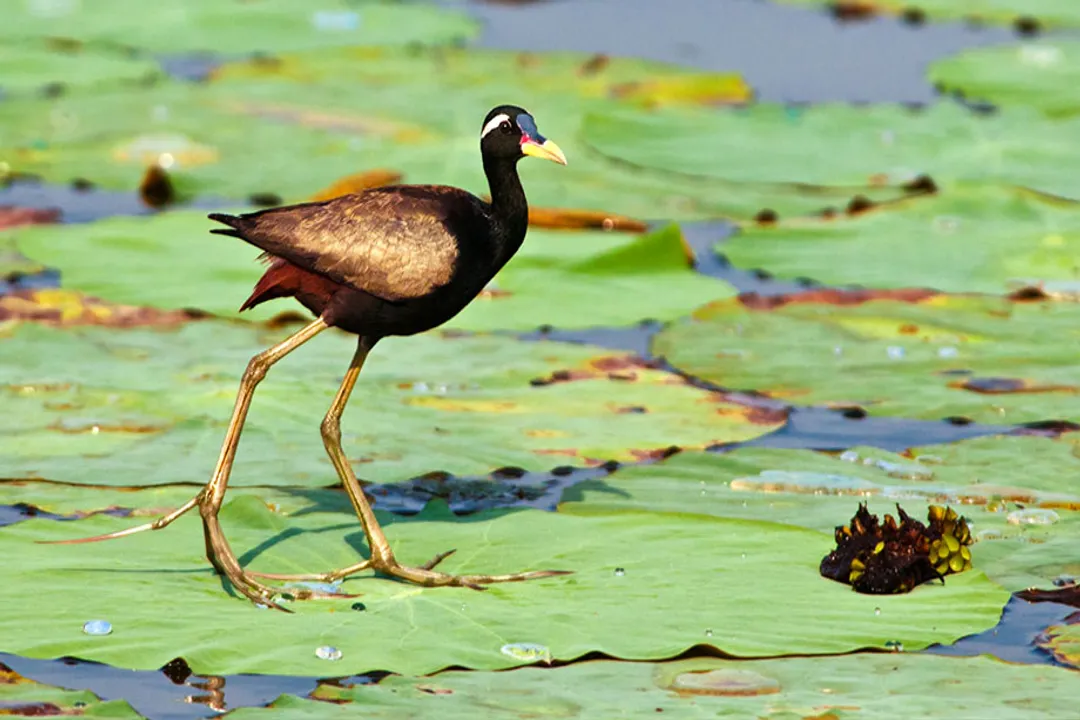
The Jacanidae family, characterized by their astonishingly long toes and claws that allow them to walk across floating vegetation, inhabits freshwater wetlands across vast stretches of the world’s tropical and subtropical regions. [1][8] The distribution of these unique birds, often called lily trotters or Jesus birds due to their seemingly miraculous ability to stride upon water surfaces, varies significantly depending on the specific species within the family. [2][8] Understanding where to find them requires looking beyond general regions and focusing on the ecological niches they occupy, which are almost universally tied to calm, water-based habitats. [1]
# Global Presence
The Jacanidae family encompasses several species spread across two major continental regions: the Americas and the Old World (Africa, Asia, and Australasia). [1] The distribution of the family demonstrates a clear separation between New World and Old World members, with no species naturally occurring across both continents. [1]
In the Americas, the family is represented by species like the Northern Jacana (Jacana spinosa) and the Wattled Jacana (also often Jacana spinosa or closely related species, depending on classification context, but clearly inhabiting the New World tropics). [4][5] These American jacanas are generally found from the southern United States down through Central and South America. [4]
The Old World species, such as the Comb-crested Jacana (Irediparra gallinacea) in Australasia and the Pheasant-tailed Jacana (Hydrophasianus chirurgus) in Asia, occupy entirely different geographical zones, highlighting parallel evolution in wetland environments separated by oceans. [1] While the specific ranges of all eight species within the family are extensive, our detailed information often centers on the more commonly observed species in specific regions, like the Northern Jacana in North America. [4][6]
# Northern Jacana Territory
The Northern Jacana (Jacana spinosa) is the species primarily associated with the warmer parts of North America. [4] Its range begins in the southern United States, with breeding populations concentrated in states bordering the Gulf of Mexico. [6] Specifically, historical and current records place their U.S. presence in southern Florida, where they are a year-round resident, and sometimes in the southern parts of Texas and Arizona, though these latter sightings can often represent vagrants or non-breeding visitors. [6] The identification of jacanas in the Carolinas, for instance, generally points toward vagrant Northern Jacanas that have wandered far outside their established breeding zones, a rare occurrence that birdwatchers note with excitement. [8]
Moving south from the U.S., the range of the Northern Jacana becomes more continuous and established throughout Central America. [4][5] They are found across Mexico, extending through the humid lowlands of Central America, including countries like Belize, Guatemala, Honduras, Nicaragua, Costa Rica, and Panama. [5] The presence of Jacana spinosa in these regions is tied directly to the availability of suitable aquatic vegetation.
It is worth noting a potential point of confusion in naming: the term "Northern Jacana" is used for the species found closest to the U.S. border, but the Wattled Jacana is also Jacana spinosa. [5] In many contexts, particularly when discussing the range north of South America, the Northern Jacana is the primary focus. [4][6]
To better visualize this significant North/Central American distribution, one can consider the contrast between the fixed, year-round residency in South Florida and the more extensive, though still wetland-dependent, breeding grounds further south in Central America. [4][6] A fascinating observation for birders tracking this species is that while they are present year-round in Florida, their movements elsewhere in the U.S. are erratic, making them a highly sought-after but unpredictable sighting far from the tropics. [6]
# Wattled Jacana Habitat
The Wattled Jacana (Jacana spinosa) shares its range with the Northern Jacana and is often considered synonymous or a very close relative, inhabiting the same tropical wetlands from Mexico southwards. [5] The core of their existence is dictated by the presence of extensive mats of aquatic vegetation, which serve as their feeding ground, walking surface, and nesting substrate. [1][2][5]
These birds require slow-moving or stagnant fresh water, such as marshes, ponds, lakes, and lagoons. [2][5] The key feature is the depth and coverage of floating plants. Jacanas thrive where plants like water lilies, lotus, and other broad-leaved aquatics create a continuous surface that can support their weight. [1] This specific habitat requirement imposes a strict boundary on their distribution; one will not find a jacana in an open lake without sufficient floating flora or in a fast-flowing river, regardless of the ambient temperature. [2]
When considering the distribution across their range, which spans from Mexico down to tropical South America, one might expect species differentiation based on latitude. However, the fundamental ecological requirement—the presence of suitable floating plants—acts as a stronger governor on their localized presence than political or even broad climatic boundaries. [1] If a wetland meets the vegetation criteria, a jacana is likely present, provided it is within the species' overall geographic area.
# Distribution Beyond the Americas
While the Northern and Wattled Jacanas anchor the family in the New World, the Jacanidae family presence extends globally into the Old World tropics and subtropics. [1] The Pheasant-tailed Jacana (Hydrophasianus chirurgus), for instance, is widespread across South and Southeast Asia, from India and China down through the Malay Archipelago. [1] This species shows a marked difference in residency patterns compared to its American relatives, as it often migrates seasonally between breeding grounds in the north and overwintering areas further south. [1]
In Africa, species such as the African Jacana (Actophilornis africanus) and the Lesser Jacana (Microparra capensis) occupy the continent's numerous shallow lakes and swamps, particularly in the eastern and southern regions. [1] These species are found where conditions allow for their characteristic foraging behavior on the water surface, demonstrating that the evolutionary solution for walking on water evolved independently in different lineages across the globe. [1]
# Habitat Fidelity and Range Limits
The physical boundaries of jacana ranges are intrinsically linked to the climatic limits that support their preferred vegetation. Jacanas are generally associated with tropical and warm temperate zones. [2] The ability of a jacana to survive is less about air temperature directly and more about whether the water remains liquid and whether the dominant floating plants can complete their life cycle. [1]
For the Northern Jacana in the U.S., the lack of breeding further north than Florida or the extreme southern edges of Texas is primarily due to freezing temperatures that would eliminate their necessary plant substrate during winter months. [6] In areas where the water freezes solid or the lily pads die back completely for an extended period, the jacanas either must migrate or perish. [1] Their dependence on these specific, often ephemeral, wetland conditions means that even within their broad geographic range, localized populations can disappear if a specific pond or marsh degrades or dries out. [2]
It’s an interesting ecological constraint to consider: while the general range maps might show a broad swath for the species, the actual density of the population is likely a patchy mosaic reflecting only those micro-habitats that maintain year-round, stable floating vegetation, making their true local distribution far more fragmented than a simple continental map suggests. [1][5] This level of habitat specificity means that conservation efforts must focus on maintaining the integrity of these specific wetland patches, rather than just protecting large areas of general "tropical land."
# Comparing Distribution Patterns
When comparing the distribution of New World species like the Jacana spinosa with Old World counterparts, a key difference emerges in residency versus migration. [1] The Northern Jacana in Florida is largely non-migratory because the climate allows for year-round open water and vegetation. [6] In contrast, Asian species like the Pheasant-tailed Jacana exhibit clear migratory patterns, moving from temperate breeding grounds to tropical overwintering spots to follow the seasonal availability of suitable water bodies. [1]
This comparison highlights that 'where they are found' is dynamic. For the American species, "where they are found" is a relatively fixed set of tropical/subtropical wetlands. For some Asian species, "where they are found" is a migratory corridor spanning thousands of miles, dictated by seasonal shifts in monsoons and water levels. [1]
| Jacana Group | Example Species | Primary Distribution Area | Key Range Characteristic |
|---|---|---|---|
| New World | Northern Jacana (J. spinosa) | Southern US, Mexico, Central America [4][6] | Fixed tropical/subtropical residency [6] |
| Old World (Asia) | Pheasant-tailed Jacana | South/Southeast Asia [1] | Marked seasonal migration [1] |
| Old World (Africa) | African Jacana | Sub-Saharan Africa [1] | Resident near permanent wetlands |
This table illustrates that while the family shares a common adaptation, the climatic pressures of their respective continents have shaped their residency patterns differently, influencing where observers might expect to find them throughout the year. [1]
# Insights on Range Expansion and Presence
The status of the Northern Jacana in the United States offers a chance to think about range shifts. While typically a year-round resident in South Florida, occasional sightings further north, such as in South Dakota or the Carolinas, suggest a bird capable of significant dispersal, even if these individuals do not establish permanent populations there. [6][8] If climate change causes northern wetlands to retain open water for longer periods, we might see the potential for a gradual northern creep in the breeding range, though this is contingent on the survival of their specific food plants. [4]
Another interesting aspect of their localized distribution is related to human alteration of wetlands. Jacanas often utilize human-created environments, such as drainage ditches, reservoirs, or rice paddies, provided these areas mimic the required calm, vegetated conditions. [2] This adaptability means that a jacana’s range map might not perfectly align with protected natural reserves but instead follow patterns of agricultural water management, a factor that often complicates precise range mapping and population surveys. [5] They are masters of exploiting newly formed, still-water habitats across their tropical range.
In sum, to locate a jacana, one must look not just at a map of latitude and longitude, but at the quality of the local aquatic environment. They are found where water lilies float thickly, where the current is gentle, and where the tropics or warm subtropics provide an enduring growing season for these essential floating platforms. [1][2] Whether on the marshes of Florida or the extensive wetlands of Asia, the distribution of the Jacanidae family is fundamentally a map of floating vegetation. [1]
Related Questions
#Citations
Jacanidae
Jacanidae - jacanas | Wildlife Journal Junior
Jacana | San Diego Zoo Animals & Plants
Northern Jacana | Audubon Field Guide
Jacana spinosa
Northern Jacana - Species Information and Photos
Under his wings
Jacanas (Jacanidae); Painted-Snipes (Rostratulidae)