Where are fruit flies commonly found?

The pervasive presence of tiny, buzzing insects in a clean home often leads to immediate suspicion centered on the fruit bowl. Yet, understanding precisely where fruit flies are found requires looking far beyond a few forgotten bananas. These common household pests, formally known as Drosophila melanogaster or sometimes called vinegar flies or pomace flies, have an almost uncanny ability to materialize when fermenting organic material is present, whether that material is obvious or hidden deep within the structure of your home. While they are indeed strongly attracted to ripening or rotting fruits and vegetables, their true habitat is any spot offering moisture and the yeast byproduct of decay.
# Entry Points

To understand where fruit flies establish a foothold, we must first acknowledge how they arrive. It's a common misconception that they simply generate spontaneously from the fruit itself, but adults must enter the environment somehow, or they must have been brought inside.
# Traveling Guests
One of the primary ways these pests infiltrate a residence is by hitching a ride. Adult fruit flies or, more commonly, their extremely tiny eggs, are often laid on produce before it ever leaves the grocery store shelf or the field. Since the fruit fly life cycle can conclude in as little as a week under optimal, non-refrigerated conditions, the few eggs laid on a tomato or a bunch of grapes can rapidly become an issue once they are brought inside to a slightly warmer environment. Even if you diligently refrigerate all your produce, an adult fly that managed to lay eggs on an item before refrigeration might lay more eggs on other exposed items once it is inside your home.
# Structural Ingress
When an established outdoor population detects a food source inside, they will seek entry points. Because fruit flies are quite small—about 1/8 of an inch in length for D. melanogaster—they do not require a large opening to gain access. Loose seals around doors and windows offer easy passage, as do tiny cracks found in the structure of the house. Furthermore, older window screens that may have small tears or holes are often inadequate barriers against these minute fliers. Once a single pregnant female enters this way, the infestation process begins immediately upon finding a suitable breeding site.
# Kitchen Hotspots

If you are currently battling an infestation, the kitchen is the epicenter of activity, not just because it houses the food, but because it offers a continuous supply of moisture, accessible waste, and the perfect environment for fermentation.
# Exposed Produce
Naturally, any fruit or vegetable left out on the counter is an immediate target. While the preference is for items that are over-ripe, decaying, or fermenting—like bananas or apples left too long—even fresh produce can carry eggs from the point of sale. The attraction isn't just to the fruit itself; the flies feed on the yeast that grows on the fermenting material. This is why items like vinegars, wines, or beer spills are equally appealing, as they are already in a state of fermentation, attracting them like a beacon.
# Moisture Havens
Beyond the fruit bowl, fruit flies seek out damp, organic material that provides a perfect substrate for egg-laying and larval development. The following locations in a typical kitchen are frequently cited as primary breeding sites:
- Drains and Garbage Disposals: This is perhaps the most notorious indoor breeding ground. The slimy film of organic matter and food particles that collects inside plumbing, especially kitchen sink drains, provides a continuous, moist breeding ground. The dark-eyed fruit fly larvae, in particular, are associated with wet food and drink spillage in commercial settings like bars, suggesting they thrive in moist drain slime just as well as residential ones.
- Waste Receptacles: Garbage cans and recycling bins are high-risk areas. It is not enough for the trash to be in the can; residue left on the bottom of the can itself, sticky residue inside empty soda cans or catup bottles, or food debris that drops beneath the main bag can support entire populations. One source described finding dozens of fruit fly pupae lining the inner rim of a step-on garbage can lid, illustrating how overlooked spots can become nurseries.
- Cleaning Implements: Mops, dish rags, and sponges that are left damp and contain food-soiled water or sour residue become unintentional breeding grounds. They need only a moist film of this fermenting material to thrive.
# Hidden Nooks and Crannies

A persistent infestation, despite rigorous kitchen cleaning, suggests the flies are utilizing hard-to-see locations where spills or debris have settled, often near appliances or cabinetry.
# Appliance Shadows
The space under or behind large kitchen appliances like refrigerators and stoves is a classic hiding spot for forgotten items. A single dropped piece of fruit, like a grape or a piece of potato, that rolls out of sight can remain undisturbed long enough to support an entire population's development cycle. The drain pan beneath an icebox or refrigerator, which collects condensation, is another dark, damp area prone to supporting this growth if not regularly checked.
# Cabinet Secrets
Drawers that do not fit snugly into their frames create crevices where small food particles can fall and accumulate over time. If a cabinet has a solid bottom, the space between that bottom panel and the cabinet floor can become a forgotten repository for crumbs or liquid spills that dried and then became damp again through humidity or minor leaks. Checking these often-neglected spaces is key to eliminating a source that seems to defy all surface cleaning efforts.
It is worth noting a crucial distinction made by pest control experts: while D. melanogaster is fruit-focused, other small flies, sometimes called phorid flies or scuttle flies, target general rotting material, including drains and even feces, and might also be mistaken for fruit flies. These species often respond differently to standard fruit fly baits, making accurate identification important, though the common infestation usually involves Drosophila.
# Beyond the Kitchen Sink
While the kitchen dominates the conversation, fruit flies are drawn to fermenting organic material wherever it exists, meaning their habitat can extend throughout a building or even into the yard.
# Residential Spread
Fruit flies can be found in areas beyond the immediate food preparation zone if a breeding site is present there. Basements, attics, or storage closets can host problems if forgotten potatoes, onions, or unrefrigerated produce are left to spoil. Furthermore, home canning projects or home-brewing activities—making wine, cider, or beer—create perfect conditions. If the containers are not perfectly sealed, adults can lay eggs just under the lid rim, allowing larvae to enter the container upon hatching.
# Outdoor Reproduction
The initial population often originates outdoors, or they may fly in from outside sources. In yards or garden areas, fruit flies will congregate around ripening or fallen produce. A common cause of an indoor surge is an unpicked vegetable, such as an unharvested tomato left on the vine to fully rot, which can generate a massive population that then seeks shelter inside the home. Even plant containers outdoors, if overwatered, can create enough consistently moist, decaying material to support a localized breeding site.
# The Hidden Moisture Analysis
Considering the dual requirement of attraction (fermentation scent) and reproduction (moist organic film), one might over-index on the visible drains or obvious trash. However, the physics of indoor plumbing present a unique challenge. Drains are often used, washed out, and then left dry; but behind wall-mounted sinks, or under floors with broken drain traps, a constant, slight moisture source can persist, shielded from evaporation. This area, receiving minimal cleaning attention, offers a dark, continuously damp breeding zone. The flies that emerge here are not coming from the drain pipe itself, but from the damp, rotting organic scum around the pipe connections or under the floorboards where a slow leak has nourished mold or mildew—a location that is far more insidious than an open garbage can.

# The Seasonality and Speed Factor
Fruit flies seem to appear overnight, contributing to the mystery of their location. This illusion of instant appearance is rooted in their rapid development rate. Under optimal temperatures, the entire egg-to-adult cycle can be completed in about a week, and a single female can deposit up to 500 eggs in her lifetime. This explains why ignoring a small source for just a few days can lead to an overwhelming swarm.
While they can persist indoors year-round, fruit fly populations typically boom in the late summer and fall due to the abundance of food sources. However, temperature plays a key role; development can slow significantly or halt entirely when temperatures drop below approximately 53℉, causing populations to naturally decline during cold winters.
# The Produce Quarantine Tip
To combat the primary vector—produce carrying eggs—a proactive strategy is essential. Simply washing produce upon arrival is a good first step, but given the speed of the life cycle, a 7-Day Produce Quarantine can be highly effective for particularly susceptible items like tomatoes, stone fruit, or melons. Designate a specific, sealed bin in the refrigerator for all new, high-risk produce for one week. If any infestation is present, the emerging adults will be contained in that single bin, rather than being distributed across your counters and pantry. Any visible signs of flies in the bin signal that the contents must be immediately discarded or sanitized, as the entire incubation period has been completed inside the container. This shifts the focus from elimination after the fact to containment at the point of entry.
# Distinguishing Species
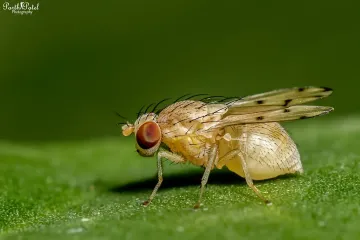
When you find small flies, it is critical to confirm they are truly the Drosophila fruit fly, as eradication methods differ based on the species. The general description for D. melanogaster includes a tan/light body, red eyes, and a small oval shape.
However, another common confusion arises with fungus gnats, especially for those with houseplants. Fungus gnat larvae breed in the moist potting soil of indoor plants and are not attracted to vinegar or fermented material the way Drosophila are. If the small flies are consistently found near windows or directly above soil, they are more likely fungus gnats, requiring a different approach focused on drying out the soil. Identifying the exact micro-location—overripe fruit versus damp soil—will dictate where you need to set your traps or apply corrective sanitation measures.
# Commercial Habitats
The same principles that govern household infestations apply to commercial settings, often magnified by volume and traffic. Restaurants, supermarkets, and pubs are frequently listed as common areas for fruit flies. In these environments, the culprits are often found near leaking pipes associated with beverage dispensers, sticky residues under taps, or poorly cleaned floor tiles where contaminated water may seep and collect. The constant influx of fresh produce in grocery stores provides a perpetual supply of potential egg carriers.
In summary, the fruit fly is found anywhere that offers a temporary sanctuary and a food source derived from fermentation. While the kitchen counter is the most visible location, a thorough understanding of their needs—moisture, warmth, and decaying organics—reveals a hidden network of potential breeding sites ranging from the depths of a seldom-used drain to the unseen shadows beneath a refrigerator. Eliminating the source, not just swatting the adults, is the only way to stop their surprisingly swift population explosion.
Related Questions
#Citations
Fruit flies - where do they come from? : r/insects - Reddit
Where Do Fruit Flies Come From and What Attracts Them? | Orkin
Drosophila melanogaster - Wikipedia
Fruit Flies in the Home - Wisconsin Horticulture
Fruit Flies - UK Entomology
Fruit Flies: How to Get Rid of Them & Prevention Tips
Fruit Fly Facts | All About Fruit Flies | Insect Library - Terro
Where Do Fruit Flies Come From? - Plunkett's Pest Control
Fruit Flies - Cornell CALS