What's the blue tanager's conservation status?
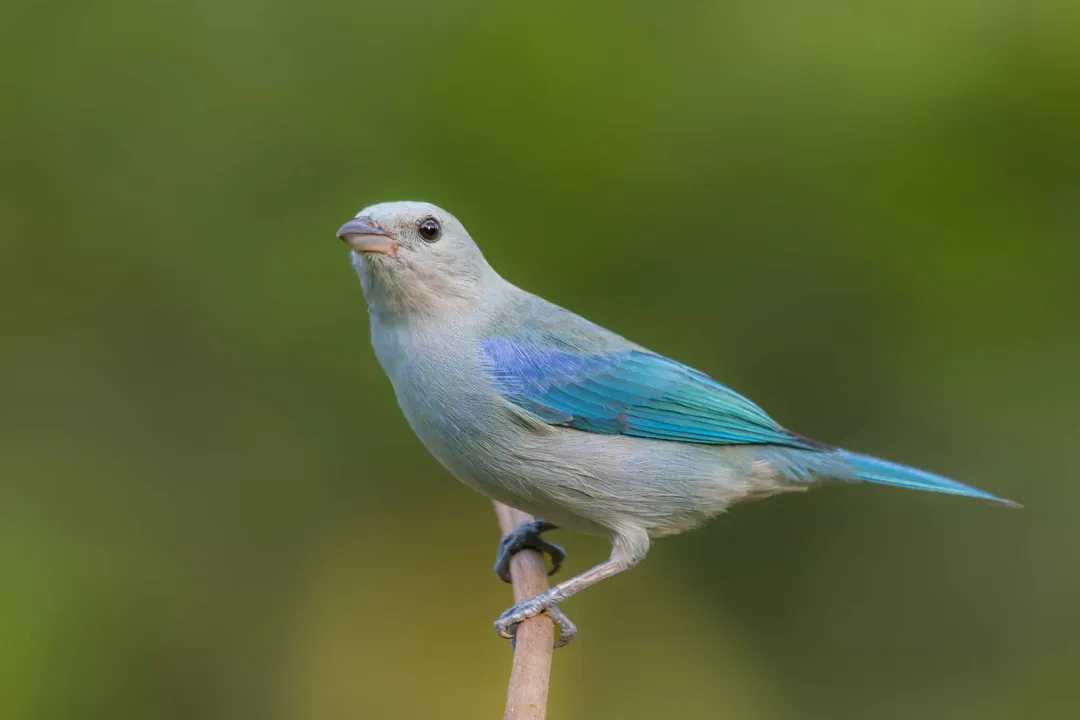
The conservation status of "the blue tanager" requires a nuanced look, as this common moniker applies to several distinct, strikingly colored species within the diverse Thraupidae family. When ornithologists or birdwatchers use this term, they are often referring to the widespread Blue-gray Tanager (Thraupis episcopus), but it can just as easily point to the Blue-backed Tanager (Cyanicterus cyanicterus), the Blue-necked Tanager (Tangara cyanicollis), or the Blue-capped Tanager (Thraupis cyanocephala). Fortunately, a review of their current assessments suggests a generally positive outlook across the group, with all four species currently listed as Least Concern by the International Union for Conservation of Nature (IUCN) [1][2][^3_calacademy][^4_mybirdbuddy].
# Group Status Overview
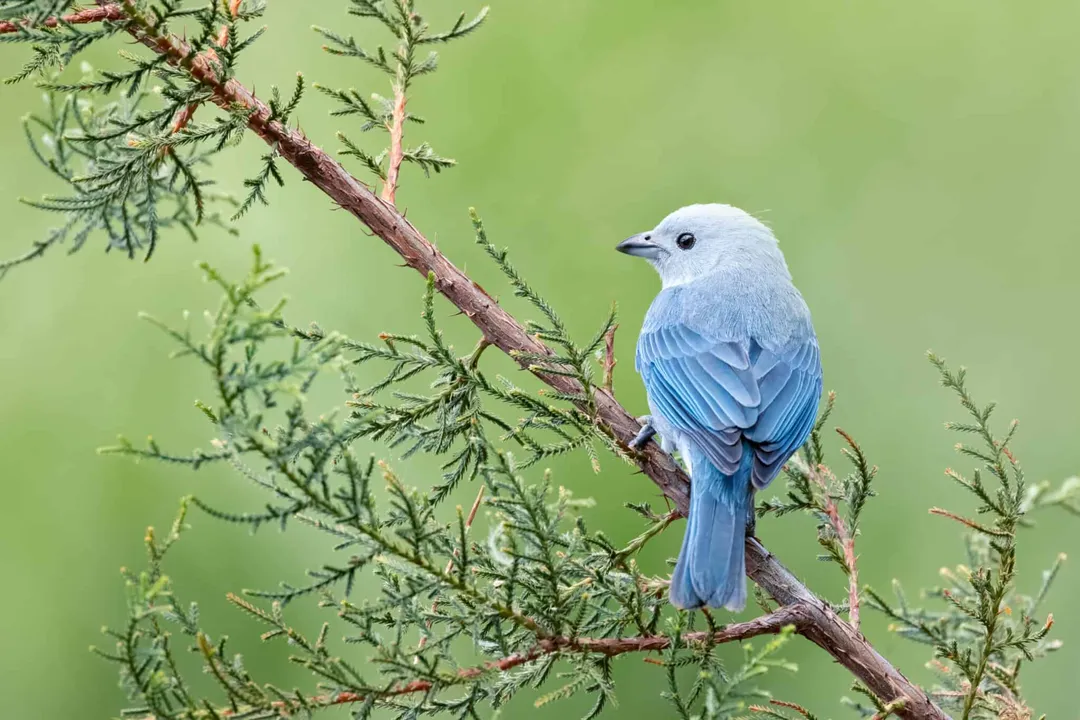
The blanket assessment of "Least Concern" (LC) signifies that, for now, none of these species meets the criteria for being threatened, endangered, or critically endangered globally. [2] This status is generally attributed to species that possess large geographic ranges, stable population sizes, or populations that are even increasing. [2] This is certainly true for the Blue-gray Tanager, whose global population is estimated to be around 50 million mature individuals and is noted for experiencing a significant increase due to its remarkable adaptability. [2]
The Blue-backed Tanager, the sole member of its genus Cyanicterus, also holds the LC designation, inhabiting countries across the northern tier of South America, including Brazil, French Guiana, Guyana, Suriname, and Venezuela, thriving in subtropical or tropical moist lowland forests. [1] Similarly, the Blue-necked Tanager, found along the western coast of South America from Venezuela down to Bolivia with a concentration in Brazil, retains its "least concern" tag based on its wide distribution [^3_calacademy]. Even the higher-elevation specialist, the Blue-capped Tanager, which prefers subtropical or tropical moist montane forests in the Andes, is classified as Least Concern [^4_mybirdbuddy].
# Blue-Gray Adaptability
The conservation success story of the Blue-gray Tanager serves as a compelling case study in avian resilience. This medium-sized songbird, typically measuring 16–18 cm in length, has cemented its place in human-dominated landscapes. [2] Unlike many species that suffer from habitat encroachment, the Blue-gray Tanager actively thrives near human habitation, colonizing cultivated areas, gardens, and parks. [2]
This adaptability is evident in its feeding habits. While its diet centers on soft fruit, nectar, and insects, it readily incorporates cultivated produce like papayas. [2] Furthermore, studies observing birds in the Brazilian Amazon revealed that the species is more common in secondary forest resulting from slash-and-burn agriculture followed by abandonment than it is in primary, undisturbed forest. [2] They eagerly utilize abandoned pasture land for foraging wild fruits. [2] This success in disturbed habitats contrasts sharply with the conservation challenges faced by more specialized species.
However, even for a widespread and increasing population like the Blue-gray Tanager, local threats exist. The primary identified threat noted for this species is parasitic infections, including the presence of Blastocystis subtypes. [2] While their numbers are large, a high localized parasitic load could theoretically impact small subpopulations or cause localized declines, even as the global status remains secure.
# Montane Specialists Facing Pressure
While the Blue-gray Tanager prospers near farms and towns, its Andean cousin, the Blue-capped Tanager (Thraupis cyanocephala), relies on more sensitive, high-altitude ecosystems. Found primarily in subtropical or tropical moist montane forests between 1,500 and 3,500 meters across the Andes, its conservation status, though LC, is intrinsically linked to the health of these cloud forests [^4_mybirdbuddy].
The major stressor for the Blue-capped Tanager is explicit: deforestation and habitat fragmentation, largely driven by agricultural expansion [^4_mybirdbuddy]. This comparison between two LC species offers a clear insight: a species' IUCN rating reflects its global status, not its local security. For the Blue-gray Tanager, human disturbance is an opportunity; for the Blue-capped Tanager, the same activity—agriculture—is a direct threat to its specialized niche. A local forest clearing might devastate a Blue-capped Tanager territory but merely open up feeding grounds for a Blue-gray Tanager pair.
Similarly, the Blue-necked Tanager (Tangara cyanicollis) faces a different form of human impact within its broad western South American range. While currently Least Concern, the source material notes that a steady supply of these birds are taken from their environment for the pet trade [^3_calacademy]. For many vibrant, small, and easily captured birds, the pet trade can rapidly push a species toward decline, regardless of its extensive range. Localized collection efforts can create significant population bottlenecks even if the species is generally abundant across multiple countries.
# Differentiating Blue Tanagers
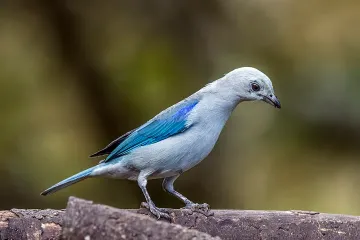
For any birder interested in supporting conservation through accurate observation, differentiating between these "blue" species is crucial, as their habitat needs vary, as noted above. The Blue-gray Tanager is recognized by its light bluish head and underparts contrasted by darker blue upperparts and a variably colored shoulder patch, with 14 recognized subspecies. [2]
In contrast, the Blue-capped Tanager derives its name from its most striking feature: a vibrant blue crown atop its head, set against an olive-green back and bright yellow underparts [^4_mybirdbuddy]. This species is also known for cooperative behaviors within its small flocks [^4_mybirdbuddy].
The Blue-necked Tanager, often confused with the Blue-masked or Golden-hooded tanagers, prefers the drier, more open spaces along the western slopes of the Andes [^3_calacademy]. Meanwhile, the Blue-backed Tanager is distinguished by its solid blue back and is the only member of the Cyanicterus genus. [1] Understanding which blue tanager is present dictates what ecological needs an observer should prioritize in their mind—be it avoiding habitat loss (Blue-capped) or recognizing successful adaptation (Blue-gray).
# Implications for Birding and Local Action
The status of these four species provides a fascinating real-world lesson in conservation biology: Least Concern is not synonymous with invulnerable. For observers in the northern parts of the range, specifically where the adaptable Blue-gray Tanager is found, understanding its diet can lead to simple, unintentional support actions. Since these birds consume insects like bees, worms, and crickets, they function as natural pest controllers in gardens and agricultural areas. [2] Therefore, rather than supporting the use of broad-spectrum insecticides that target their insect prey, choosing organic or targeted pest management methods aligns with supporting this already thriving, yet still susceptible, species. The sheer scale of the Blue-gray population, estimated at 50 million, means small local actions can aggregate into a measurable positive effect on the overall stability of the species. [2]
For those interested in the more specialized species, like the Blue-capped Tanager in the Andean montane zones, the path to conservation is more direct, though perhaps less accessible to the average person. Protecting this bird means supporting organizations working on habitat preservation strategies for cloud forests, promoting sustainable land management, and encouraging the expansion of forest reserves where they reside between 1,500 and 3,500 meters [^4_mybirdbuddy]. Participation in community science, such as logging sightings on platforms like eBird, directly aids scientists in monitoring population trends, especially as these specialized habitats face pressure from deforestation [^4_mybirdbuddy]. Even for species that seem secure, dedicated monitoring provides the necessary data to quickly spot any reversal in fortune, ensuring their LC status remains accurate.
# Longevity and Life Cycles
While conservation status speaks to the species' survival, details about individual lifespans offer context on their ecological role and vulnerability to sudden environmental changes. The Blue-capped Tanager is generally expected to live for about 7 to 10 years in the wild, a duration comparable to related species like the Scarlet Tanager [^4_mybirdbuddy]. In contrast, the Blue-gray Tanager has a known captive lifespan of up to 12 years, though its wild longevity is less certain. [2] These life spans mean that while they are not exceptionally long-lived birds, they are stable enough to recover from minor fluctuations, provided their general habitat needs are met.
In breeding, both the Blue-gray and Blue-capped species show parental commitment. The Blue-gray Tanager's female incubates for about 14 days, with fledglings leaving the nest around 17 days later. [2] The Blue-capped Tanager also exhibits strong parental investment, with both parents feeding chicks, often starting breeding when resources are abundant at the beginning of the rainy season [^4_mybirdbuddy].
The fact that the Blue-gray Tanager's nests are sometimes parasitized by Molothrus cowbirds illustrates a specific ecological interaction that the species must manage without significant impact on its overall numbers. [2] This resilience in the face of brood parasitism is another factor contributing to its robust population numbers.
In summary, the current conservation outlook for the commonly referenced "blue tanagers" is favorable, with multiple species classified as Least Concern [1][2][^3_calacademy][^4_mybirdbuddy]. However, the specific threats—parasites for the adaptable, human-tolerant Blue-gray Tanager versus deforestation for the high-altitude Blue-capped Tanager—underscore that the journey toward true long-term security is highly species-specific and requires continued localized attention and monitoring across their diverse Neotropical ranges [2][^4_mybirdbuddy].
Related Questions
#Citations
Blue-gray tanager - Wikipedia
Blue Tanager (Blue-Grey Tanager) - Thraupis episcopus - A-Z Animals
Blue-Necked Tanager - California Academy of Sciences
Blue-capped Tanager