What does a purebred Russian Blue look like?

The Russian Blue possesses an instantly recognizable elegance, often described as aristocratic and graceful, making it a true gem among purebred cats. [2][3] When you encounter one of these felines, the first elements that command attention are undoubtedly the dazzling coat and the expressive eyes, both defining characteristics of this breed that trace back centuries, perhaps even to the favor of Russian royalty. [2][3] A key aspect of owning or appreciating a purebred specimen is understanding the precise details that distinguish it from similar-looking breeds, ensuring the visual characteristics align with established breed standards. [3][5]
# The Shimmering Coat
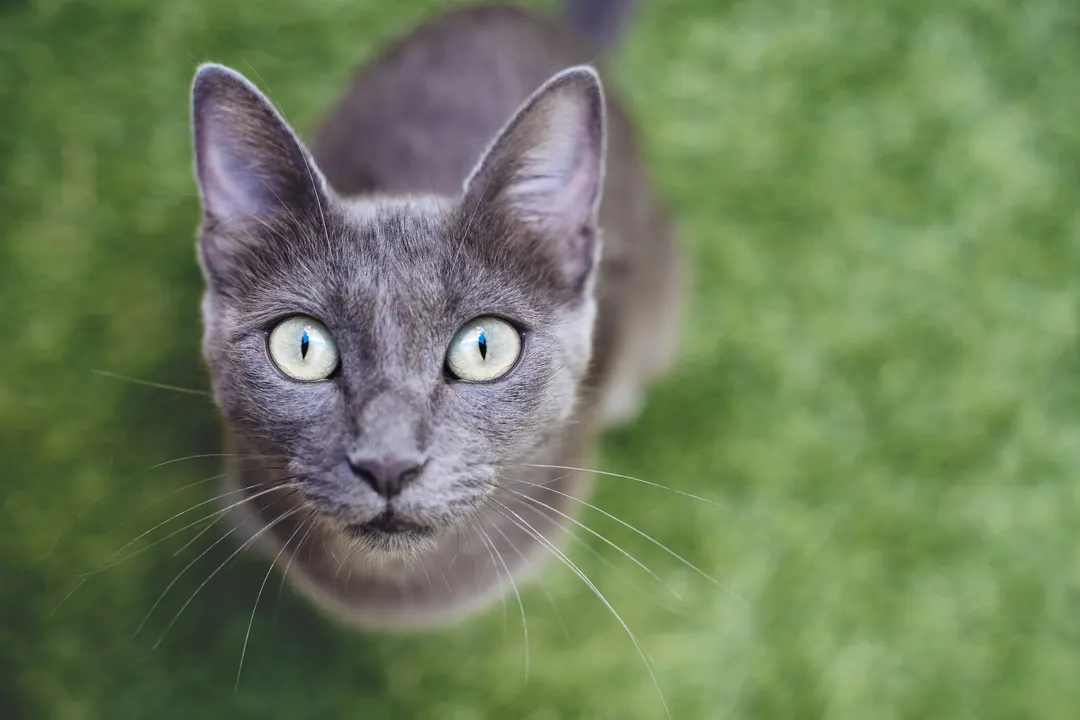
The hallmark feature of the Russian Blue is its luxurious, singular coat color, which is always designated as "blue" in cat fancy terminology, although to the casual observer, it is a beautiful shade of gray. [5] This coat is not merely colored gray; it is a specific, even bright blue shade that must be uniformly distributed across the entire body. [3] What truly sets this coat apart, giving it that ethereal quality, is the tipping—each individual guard hair is distinctly tipped with silver. [1][3][4] This silver frosting reflects light, causing the entire coat to appear to glisten or shimmer when the cat moves, an effect sometimes likened to moire silk. [2][3]
The texture of this dense covering is exceptionally fine and plush, giving it a soft, silky feel to the touch. [3] A purebred standard dictates that the density of the double coat causes it to stand slightly away from the body. [3] An interesting indicator of coat quality, perhaps more noticeable on the show bench or in bright natural light, is that running a finger across the fur will leave temporary impressions, sometimes referred to as "footprints," until the plush hairs settle back into place. [3] While the color should be even, lighter shades of blue are generally preferred in judging circles. [3]
It is worth noting a subtle complexity that even a purebred Russian Blue can exhibit: ghost striping. Because all cats genetically carry tabby patterns, the Russian Blue requires non-agouti genes to suppress these markings and present a solid color. [5] If these non-agouti genes are not fully dominant, faint, ghost-like tabby stripes might become momentarily visible, particularly on the legs or tail when the cat is in bright sunlight. [5] This subtle pattern variation is a biological artifact, but a truly purebred show specimen aims for the complete suppression of these markings, presenting a solid field of blue tipped with silver. [3]
Considering the coat's dense structure and the breed's known low shedding rate, the grooming requirements are quite minimal. [1][4] However, the density that grants this coat its appearance also means that shedding, while light compared to many breeds, does occur seasonally. [4] For owners seeking to maintain that pristine, shimmering look, an occasional, gentle brushing—perhaps with a microfiber cloth or a damp cloth during heavy shedding seasons—is often recommended to manage dead hair and keep skin oils distributed, rather than intense, routine combing which could disrupt the unique texture. [3][4]
# The Emerald Gaze
If the coat is the regal cloak, the eyes are the priceless jewels set within the elegant frame of the face. [2] The eyes of a purebred Russian Blue are famous for being large, wide-set, and a vivid, brilliant green. [1][2][4] This depth of color is highly prized; the intensity of the green typically deepens as the cat matures. [3][4] Kittens are often born with eyes that start as a gold or yellow hue, gradually transitioning to that sought-after emerald shade. [4][5]
The setting of the eyes contributes significantly to the breed’s characteristic expression. They must be wide apart, and the aperture, or visible opening, should be rounded. [3] This combination of large size and wide spacing, along with the way the thick fur frames the socket, creates an almost mesmerizing effect, often described as radiating intelligence. [3][5] When these cats look upon their domain, they appear self-satisfied, which contributes to the breed's enigmatic, slightly upturned look. [2] While some cats may have eye colors bordering on blue or yellow/gold based on genetics or age, the goal for a show-quality Russian Blue is the unmistakable, deep, vivid green. [3]
# Head Shape and Planes
The Russian Blue’s head structure is highly specific and contributes greatly to its overall "aristocratic" bearing. [2] It is described as a modified wedge shape. [3] This means it should not be overly long and tapering, nor should it be short and massive like some other rounder-headed breeds. [3]
A crucial detail for breed experts is the geometry of the head, which is ideally formed by seven distinct angular planes. [3] These planes must flow smoothly together to create a pleasing silhouette. [3] The top of the skull should appear long and flat in profile, descending at a slight angle toward the nose, with absolutely no break or "stop" (a sudden dip in the profile) between the forehead and the bridge of the nose. [3] The length of the top-head section must be greater than the length of the nose itself. [3]
Framing these planes are the wide, high cheekbones, which help emphasize the size and width between the eyes. [3] The muzzle should integrate smoothly into the overall wedge shape, appearing blunt without any noticeable protrusion of the whisker pads—the cat should not look pinched at the mouth. [3] This specific contouring of the muzzle in relation to the cheekbones is what creates the cat's famous, subtle "smile," giving the face an engaging and charming expression. [1][2]
In terms of size relative to the head, the ears are noteworthy. They should be rather large, broad at the base, and set far apart, positioned more on the sides of the head than right on top. [3] The ear leather should be thin, allowing the fine, short hair covering the outside to look sparse enough that the leather shows through, and the tips are expected to be more pointed than rounded. [3]
It's an interesting divergence point between breeding for show and typical companionship. While the standard demands precision—seven defined planes, specific length ratios between the top-head and nose, and a defined wedge—a cat bred purely for companionship might possess a slightly softer interpretation of these angles, resulting in a rounder appearance overall while still retaining the stunning coat and eye color combination. [3][5] This subtle difference often dictates whether the cat excels in the show ring or simply as a beloved household fixture.
# Body Conformation and Size
The Russian Blue is categorized as a medium-sized cat that is built for elegance and agility. [1][4] Its body structure is characterized by fine boning, yet it must simultaneously be firm, muscular, long, and lithe. [3] It should never appear tubular or heavy-set; the overall outline must convey grace in its carriage. [2][3] This lean, muscular quality is vital, contrasting with breeds like the heavier-set Chartreux. [5]
The legs are an extension of this fine-boned elegance: they are long. [3] This length is often accentuated by the cat’s natural posture, as many Russian Blues prefer to sit with their front paws neatly crossed, drawing attention to their fine limbs. [2] The paws themselves are small and slightly rounded. [3] A very specific marker of purity, which owners should verify if they are concerned with pedigree adherence, relates to the toes: a purebred standard requires five toes on the front paws and four on the rear. [3] Any deviation from this count is grounds for disqualification in a formal show setting. [3]
The tail complements the body’s length, described as long and tapering gradually from a base that is only moderately thick. [3]
In terms of overall mass, the Russian Blue is not a large breed. Males typically remain lighter, rarely exceeding 10 pounds, while females usually fall between 5 and 8 pounds. [3] More broadly, the accepted weight range is often cited as 7 to 12 pounds. [4] Given that this breed is known for having a keen appetite and a tendency to put on weight if allowed, keeping the cat lean is essential to maintaining this sleek, muscular build and avoiding potential health complications like diabetes or arthritis. [1][4] If you notice your Russian Blue is becoming too rounded, a direct reduction in measured food portions, alongside increased interactive play, is necessary to restore that elegant, lithe profile. [4]
# Distinguishing From Lookalikes
While the Russian Blue's visual identity is strong, its appearance is sometimes confused with other solid blue breeds, particularly because of historical outcrossing and similar coloration. [5] A purebred Russian Blue is distinctly different from the British Shorthair (which historically was sometimes shown with them). [5] Furthermore, while the Korat also features a blue coat and green eyes, the Korat tends to have a slightly stockier build and a marginally different head shape with shorter, more rounded ear tips compared to the Russian Blue's elongated, angular profile. [5]
Perhaps the most telling physical difference, aside from the coat texture and head shape, is the length of the coat itself. The Russian Blue is a shorthair breed. [1][2] Its close relative, the Nebelung, shares the beautiful blue, silver-tipped coat and green eyes, but the Nebelung is specifically a longhaired cat, making visual differentiation quite straightforward based on coat length alone. [5] For the dedicated enthusiast or breeder, the combination of the specific wedge head, large wide-set eyes, and the plush, double, silver-tipped blue coat—all supported by the correct physical proportions—paints the portrait of the purebred Russian Blue. [3]
Related Questions
#Citations
Russian Blue - The Cat Fanciers' Association
The Russian Blue cat - Cat in the Box LLC
Russian Blue: Cat Breed Profile, Characteristics & Care
Russian Blue - TICA - The International Cat Association
Russian Blue Cat Breed Health and Care - PetMD