What species has the brown tree snake killed?

The arrival of the brown tree snake (Boiga irregularis) on the island of Guam has resulted in one of the most dramatic and well-documented ecological disasters of the modern era. Originating from New Guinea, the Solomon Islands, and parts of Australia, this nocturnal, arboreal predator hitched a ride to Guam likely in military cargo after World War II, finding an environment tragically unprepared for its presence. With no natural predators to keep its population in check on the island, the snake exploded in numbers, leading to a near-total restructuring of the native wildlife community. The immediate and most visible victims of this invasion were the birds.
# Bird Annihilation

The impact on Guam's avian life has been catastrophic. The brown tree snake systemically wiped out the majority of the island's native forest bird species. In total, ten out of the twelve native forest bird species on Guam have been extirpated, meaning they have been eliminated from the island, though some may still exist elsewhere. This massive local extinction event left the forests eerily silent. Species like the Guam Rail, Guam Kingfisher, Guam Broadbill, and the Guam Reed Warbler have all vanished from the island's wild landscape due to predation by this single invasive species.
The sheer efficiency of the snake as a predator in an island setting, where native birds evolved without serpentine threats, cannot be overstated. This is not just a matter of a few birds being eaten; this is the complete removal of entire ecological roles. Imagine a forest suddenly stripped of its singers, its insect controllers, and its seed spreaders all at once. The snake's diet is not highly specialized; it readily consumes birds, bats, lizards, and even small rodents.
# Fauna Losses
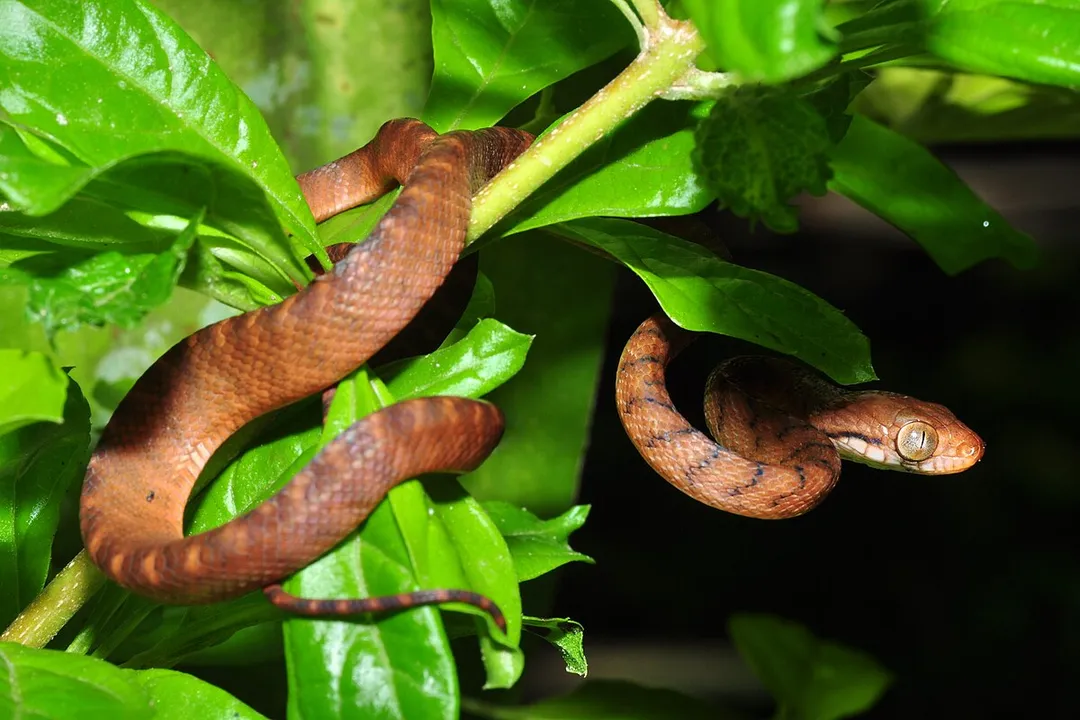
While the birds received the most extensive coverage due to their sheer numbers and the resulting silence, the brown tree snake's appetite extends much further down the food chain. Native lizards, another crucial component of the island's ecosystem, have also suffered significant losses. The snake will consume any small vertebrate it can overpower and swallow.
This propensity for indiscriminately consuming whatever is available, regardless of size or defense mechanism, is part of what makes the species so devastating in naive environments. Anecdotal evidence shared among those who study or work on Guam often notes the snake’s surprising capacity; observers have sometimes seen them regurgitate prey items that were too large to digest fully, suggesting an extreme feeding drive where the snake attempts to consume animals significantly bigger than its head diameter. This suggests that if a slightly larger native mammal or reptile had been present, it would likely have been targeted as well.

# Forest Changes

The eradication of avian life triggered severe, slower-moving ecological consequences that continue to unfold decades later. Birds are not just ornamental; they perform essential services, most notably seed dispersal. Many native tropical trees rely exclusively on birds to eat their fruit and then deposit the seeds far from the parent plant, allowing new generations to grow.
When the bird populations collapsed, this vital process broke down. The consequence is a measurable alteration in the structure of Guam's forests. Tree species that relied on birds for dispersal are struggling to regenerate effectively, leading to changes in forest composition where canopy health is demonstrably declining in certain areas. It is a sobering example of how removing one functional group (predators) can eventually cause a collapse in another (producers) through an indirect trophic cascade. If we view the forest not as individual trees but as a self-sustaining machine, the birds were the oil lubricating the next generation's growth; without it, the machine begins to seize up.
# Predation Mechanics

The reason the brown tree snake achieved such success where other invasive predators might have failed lies in its unique combination of traits. It is arboreal, meaning it lives in trees, perfectly placing it within the nesting and roosting zones of its primary prey—the birds. Furthermore, on Guam, it faces absolutely no natural predators, allowing its population density to skyrocket past any natural checks and balances found in its native habitat.
A key component of the environmental damage is the snake’s dietary flexibility and sheer appetite. While some predators specialize, the brown tree snake appears to operate on a "catch and consume" mandate for anything small enough to manage. This contrasts sharply with island ecosystems, like those in the Pacific, where terrestrial predators were historically rare, and avian and lizard species evolved without the instinctual fear or physical adaptations needed to escape a fast-moving, tree-climbing threat.
# External Risks
The devastation on Guam serves as a stark, ongoing warning for other island chains and ecologically sensitive regions. The very means by which the snake arrived—hitching rides in cargo, shipping containers, and shipping pallets—remains the primary vector for its global spread. Areas like Hawaii, which possess similarly unique and vulnerable native bird and reptile populations, maintain rigorous inspection programs specifically to prevent the introduction of this single species. The threat is so significant that many agencies actively search for and inspect containers, aircraft, and equipment arriving from Guam precisely because of the established threat the snake poses to ecosystems lacking defenses against it.
The sheer scale of the loss on Guam—the near-total disappearance of an entire suite of native birds—is a permanent ecological scar. It underscores a critical lesson for biosecurity efforts everywhere: for certain invasive species, prevention is the only viable management strategy once introduction occurs, as reversing such widespread extirpation is nearly impossible once the invasive population has established itself without checks. The silent canopy of Guam is a constant reminder of what can be lost when a single, well-adapted predator meets a world unprepared for its arrival.
Related Questions
#Citations
Brown tree snake - Wikipedia
Brown Tree Snake | National Invasive Species Information Center
Hawaii Invasive Species Council | Brown Tree Snake
Guam's Forests Are Being Killed – By A Snake - The Revelator
Brown tree snake could mean Guam will lose more than its birds
Invasive Brown Tree Snakes On Guam Killing Birds Too Large To ...
TIL Since the brown treesnake has no natural predators or ... - Reddit
Invasive snake has impacts that cascade through forests on Guam
The Brown Tree Snake on Guam Island, finishes all birds there