What snake is mistaken for a coral snake?
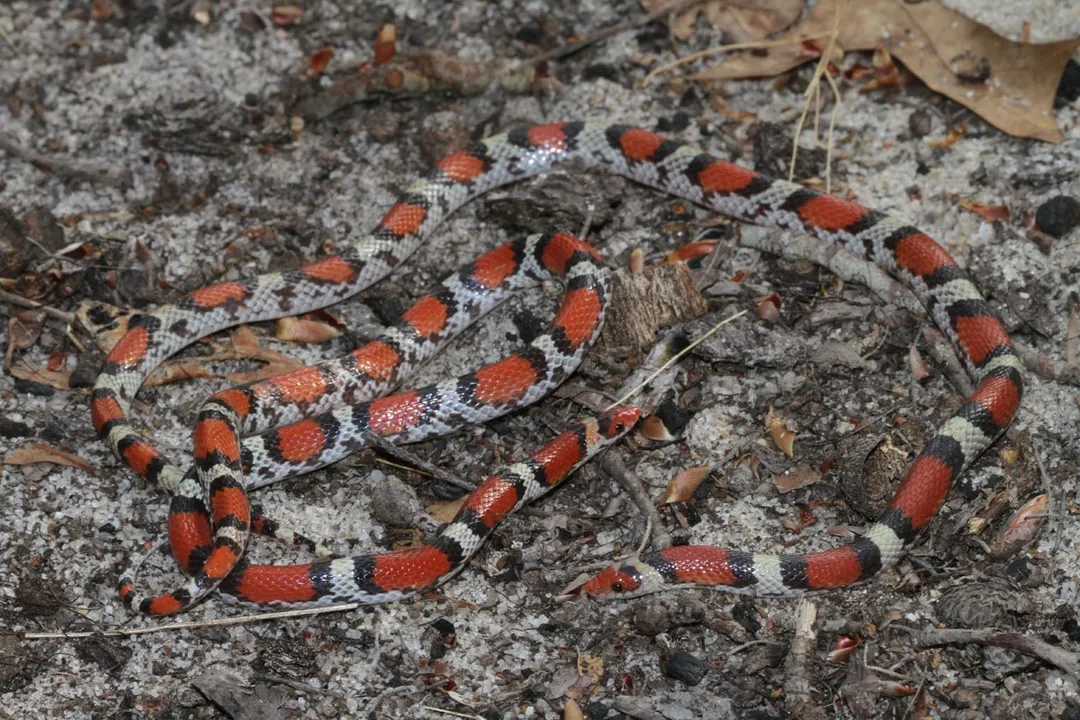
The visual drama of a snake adorned in bright bands of red, yellow, and black often causes immediate alarm, as this coloration is nature's unmistakable warning sign for one of North America’s most venomous snakes: the coral snake. [1][5] Because true coral snakes are relatively secretive, ground-dwelling elapids, their vivid camouflage has been effectively co-opted by several harmless species, leading to frequent and understandable confusion. [1][3] This case of mistaken identity is so common that learning to distinguish between the venomous native coral snake and its harmless mimics is a fundamental skill for anyone living in their shared territories. [8]
# Lookalike Species
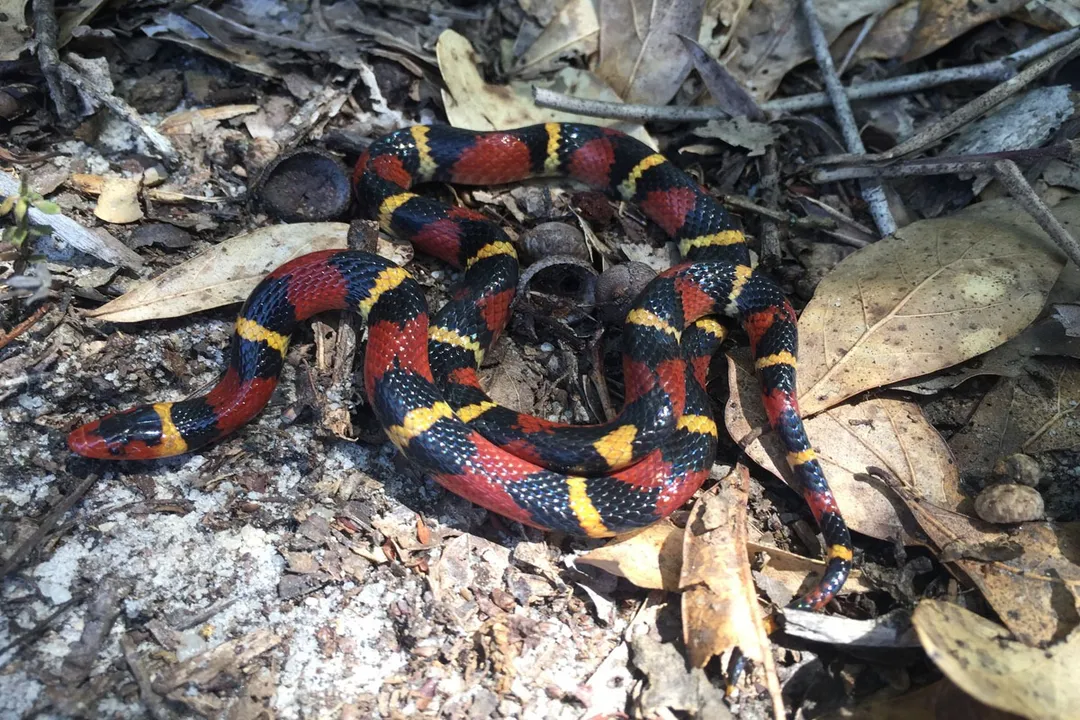
The snakes most frequently mistaken for the venomous coral snake belong primarily to the kingsnake and scarlet snake groups. [1] These non-venomous constrictors have evolved to possess similar tri-color banding patterns, a phenomenon known as Batesian mimicry, where a harmless species evolves to resemble a dangerous one to deter predators. [1][8]
The Scarlet Kingsnake (Lampropeltis elapsoides) is perhaps the most famous doppelgänger, often found across the same southeastern ranges as the Eastern Coral Snake (Micrurus fulvius). [1][5] Similarly, various subspecies of Milk Snakes (Lampropeltis triangulum), particularly the Red Milk Snake, exhibit this tricolored banding. [8] Less commonly encountered, but still a potential lookalike, is the Scarlet Snake (Cemophora coccinea), though its pattern often involves more black than the other mimics. [1]
The confusion stems entirely from the pattern. All these snakes share striking rings of red, yellow/white, and black, making a quick, casual glance insufficient for safety. [1][5]
# Color Coding Mastery

To navigate this dangerous visual overlap, residents and naturalists rely heavily on a classic mnemonic device that focuses on which colors touch one another on the snake’s body. [3][5] This rhyme is the single most quoted method for immediate field identification of the Eastern Coral Snake. [1]
The standard rhyme often goes:
For the venomous Coral Snake, the bands of red are bordered immediately by yellow bands. [1][3] In the lookalikes, such as the Scarlet Kingsnake, the red bands are bordered by black bands. [5][8] The non-venomous mimics are therefore described as having red touching black. [1][8]
It is important to remember the sequence, as reversing the rhyme in your mind can lead to a critical error. The venomous snake has its warning colors, red and yellow, adjacent to each other. [5] The harmless counterpart presents red adjacent to the more muted black band. [8]
While this rhyme is a powerful tool, its application requires focus. In real-time encounters, especially when a snake is partially concealed in leaf litter or moving quickly, observing the precise border of the bands can be challenging. [3] Furthermore, variations exist, making the rhyme most reliable for the Eastern Coral Snake found in the southeastern United States. [1]
# Physical Markers
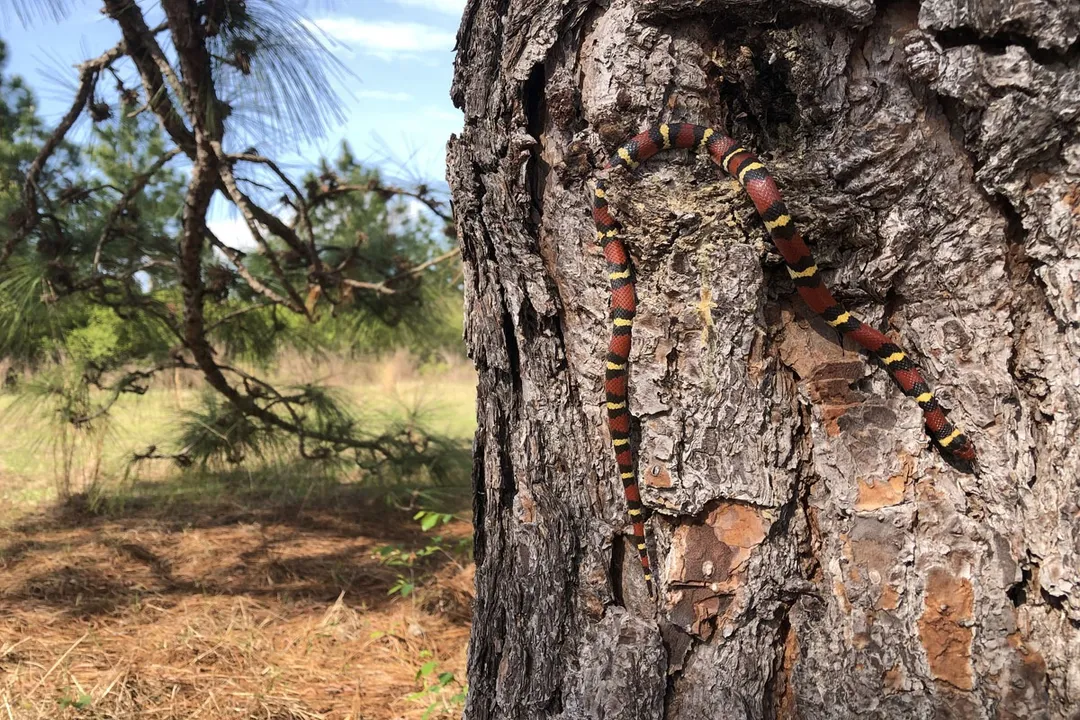
Beyond the critical band colors, other physical characteristics are sometimes cited to differentiate the coral snake from its mimics, though these details often come with caveats regarding their consistency across all species and subspecies. [5]
# Head and Eye Shape
Coral snakes are part of the Elapidae family, distinct from the pit vipers (like rattlesnakes or copperheads) found in the same regions. [3] They possess small, non-hinged jaws and fixed front fangs, differing structurally from vipers. [3] Visually, this sometimes translates to a head that is not markedly wider than the neck, appearing more slender or blunt, unlike the triangular heads often associated with venomous pit vipers. [5] Furthermore, coral snakes are generally reported to have round pupils. [3][5]
However, relying on head shape or pupil size for definitive identification against mimics can be unreliable. Many common mimics, including the kingsnakes, also possess slender heads and round pupils, effectively neutralizing these features as foolproof identifiers when compared side-by-side with a coral snake. [5] Pit viper mimics are generally distinguished easily by their triangular heads and vertical pupils, but the mimicry aimed at coral snakes often involves species that do not share those viper characteristics. [5]
# Scales and Body Proportions
Both the true coral snake and its primary mimics, the kingsnakes, possess smooth, non-keeled scales. [4] This shared feature means that the tactile difference of rough vs. smooth scales—a common differentiator between vipers and many other snakes—is not useful here. [4]
Coral snakes are generally smaller and more slender than the larger kingsnakes they imitate. [1] While a true coral snake averages about 20 to 30 inches in length, they rarely exceed three feet. [1] Kingsnakes are often stouter in build. [5]
# Regional Caveats
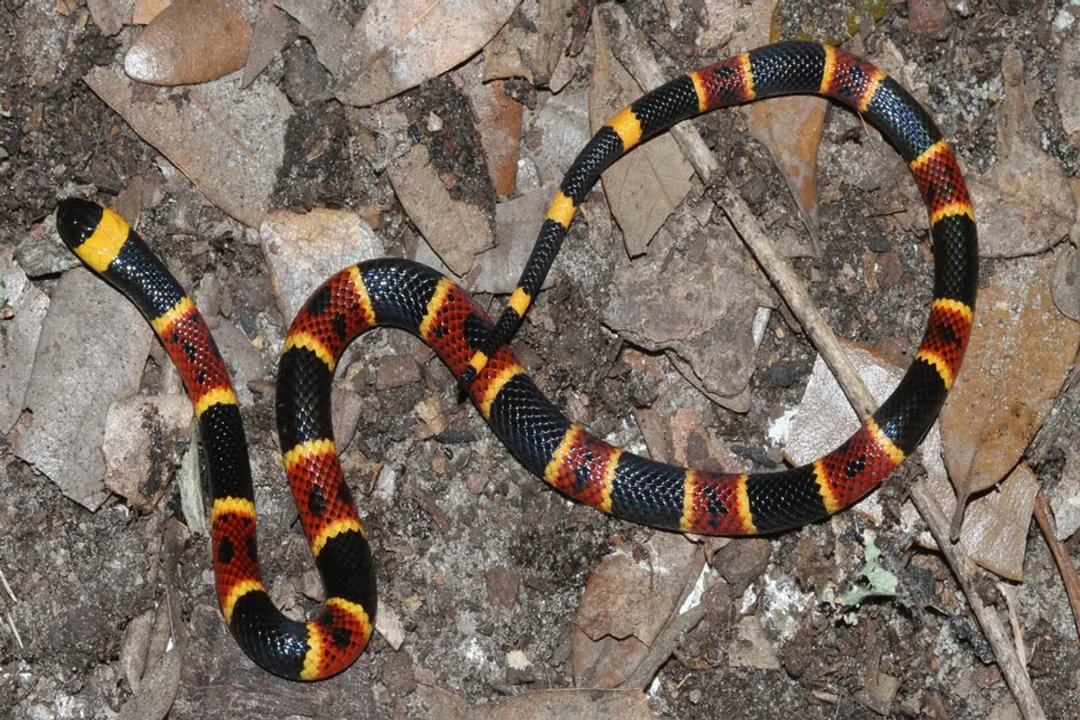
The "red-touches-yellow" rule is a powerful generalization, but one that requires geographic awareness for true expertise. [1] The primary complication arises when considering the various species of North American coral snakes. The rule applies strongly to the Eastern Coral Snake (Micrurus fulvius) prevalent in the Southeast. [1]
However, the Southwest is home to the Sonoran (or Arizona) Coral Snake (Micruroides euryxanthus), which often presents a different banding scenario. [1] In some populations of this species, the yellow bands may be extremely thin or even entirely absent, resulting in a pattern consisting mainly of red bands separated by black bands—a pattern that appears strikingly similar to a non-venomous mimic like a Scarlet Kingsnake. [1] For those residing outside the Eastern US, strict adherence to the simple rhyme risks misidentifying a venomous Southwestern coral snake as a harmless species. This geographic dependence suggests that local wildlife guides, rather than a single national mnemonic, offer the highest level of safety and accuracy for definitive species ID.
# Encounter Strategies
Since the stakes are so high and visual identification can be prone to error, particularly under stress or poor lighting, the wisest approach is to treat any brightly tri-colored, banded snake with extreme caution. [3] A practical step, often recommended by wildlife professionals, is to never attempt to handle, corner, or capture a snake whose identity you cannot confirm with absolute certainty. [3][9] Coral snakes are notoriously shy; they spend the majority of their time hidden under debris, logs, or underground, meaning encounters are rare but should always be treated as potentially dangerous. [1][3] If a snake matching the general description is seen, the best course of action is to slowly back away and allow the animal to move away undisturbed, rather than trying to get close enough to definitively check which colors are touching. [3] Observing the snake from a safe distance, perhaps allowing it to disappear into cover, confirms its secretive nature, which is characteristic of the true coral snake. [1]
#Videos
The Coral Snake and its Look-alikes Learn the Difference in Five ...
Related Questions
#Citations
Coral Snakes and their Mimics - The Orianne Society
Identifying coral snakes and their harmless mimics safely - Facebook
The Coral Snake and its Look-alikes Learn the Difference in Five ...
Coral Snake Mimic ID : r/herpetology - Reddit
Coral Snake Look Alikes - Batesian Mimic Copy Colors
Coral Snake vs. King Snake Identification and Traits | HowStuffWorks
What are some non-venomous snakes that have scales similar to a ...