What is the physical description of a gypsy moth?
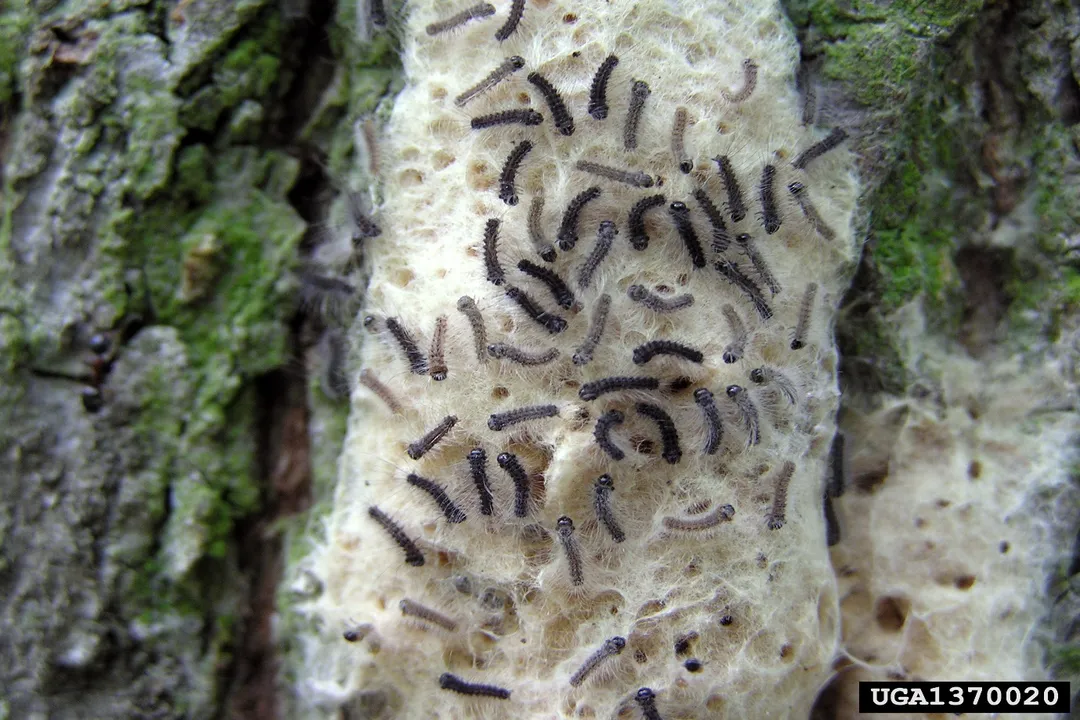
The physical description of the gypsy moth, scientifically known as Lymantria dispar, requires looking closely at its complete metamorphosis, which involves four distinct life stages: egg, larva (caterpillar), pupa, and the final adult moth. The most dramatic visual differences occur between the sexes of the adult insects, a characteristic known as sexual dimorphism.
# Egg Masses

The cycle begins with the egg mass, which is the overwintering stage, remaining dormant from late summer until the following spring. These masses are typically laid on rough bark, though caterpillars, having wandered from their feeding sites, deposit them on nearly any sheltered surface they encounter. Common sites include tree trunks, fences, rocks, outdoor furniture, trailers, and cars. In fact, unusual places like inside old rubber boots or even a beer can have been recorded for deposition in certain areas.
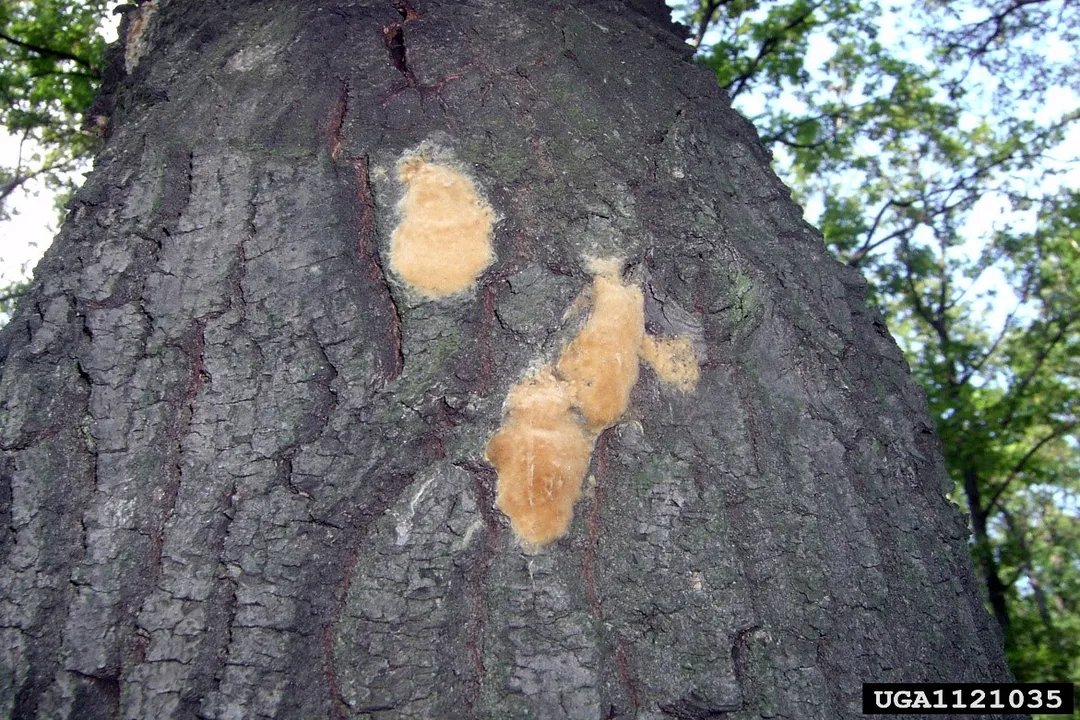
The egg mass itself is a conspicuous feature, appearing as a single plaque that is usually teardrop-shaped. They measure roughly $1.5$ to $2$ inches in length, or about $3$ to long. A defining characteristic is the dense covering of hair that protects the eggs throughout the cold months. This hair is plucked from the female’s body and gives the mass a felt-like, buff tan or yellowish-brown appearance when freshly laid.
It is worth noting that the appearance changes with age; masses laid in a previous year will have faded in color and will feel soft to the touch as the eggs inside have already hatched. If you encounter an egg mass between late spring and August, chances are high it is empty, though destroying any found is advised to prevent secondary hatching or confusion with native species.
# Larval Stage

When the weather warms, usually in April or May, the tiny caterpillars emerge from the egg mass. Upon hatching, the larvae are small, measuring about inch () or long, and are described as dark brown to black and very hairy.
As the caterpillars grow through their several instars—shedding their skin each time—their appearance shifts significantly. They develop a mottled yellow-gray pattern. The most reliable visual key for identifying the gypsy moth larva is the pattern of raised spots running in two rows down its back. There are five pairs of blue spots located toward the head, followed by six pairs of red spots toward the rear. The legs of these larvae are also noted as being dark red. While they possess prominent hairs, they typically do not have the dense, woolly covering or distinct hair tufts—known as tussocks—that characterize some similar species like tussock moth caterpillars. Furthermore, unlike tent caterpillars, gypsy moth larvae do not feed in groups or construct silken tents. An interesting observation specific to this species is the presence of large eyespots on the front of the head, features believed to help deter predators.
# Pupa Transformation
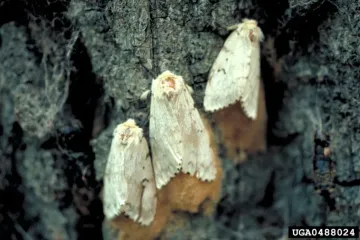
After approximately seven weeks of voracious feeding, the fully grown caterpillar seeks a sheltered area to enter the pupa stage, usually in June or early July. The pupa itself is brown and teardrop-shaped. Unlike many other moths that spin a silken cocoon, the gypsy moth pupa is held in place by only a few threads of brown silk attached to the substrate, often under loose bark. They may also appear dark brown with only sparse orange-yellow hairs. This resting stage is relatively brief, typically lasting between $7$ and $14$ days before the adult moth emerges.
# Adult Moths
The final stage presents the greatest physical divergence between the sexes, which is crucial for accurate identification. The adults emerge for the sole purpose of reproduction; after mating, both sexes die. Males generally emerge a day or two before the females.
# Male Characteristics
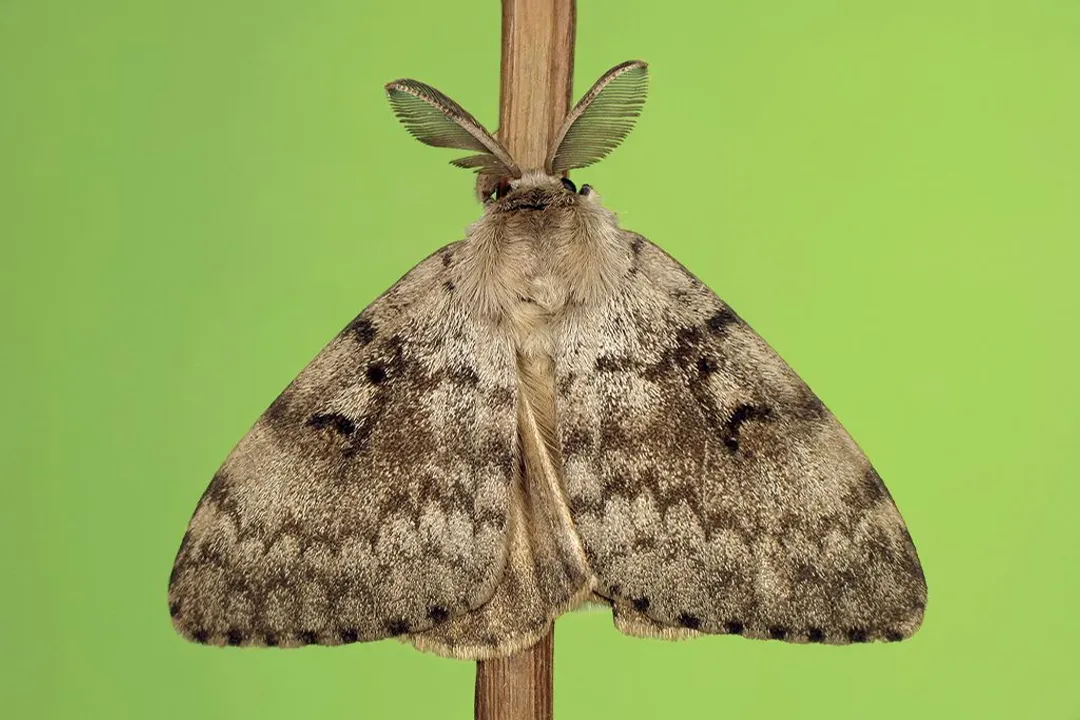
The adult male moth is smaller than his female counterpart. He is generally brownish with darker brown or black wavy markings across his forewings. A distinct feature helping to separate them from other similar species is how they rest: males often hold their wings in a position that gives the insect a roughly triangular shape.
Perhaps the most significant physical feature on the male moth relates to his sensory organs. His antennae are distinctly feathery or comb-like in appearance, which he uses expertly to detect the female’s potent sex pheromone, or disparlure, from a distance. Males are strong fliers and are often observed flying during the day in a characteristic zig-zag pattern as they search for emerging, stationary females.
# Female Characteristics
The female gypsy moth is substantially larger and more heavy-bodied than the male. Her coloration is nearly the opposite of the male's: she is predominantly creamy white with only a few dark spots or markings on her wings. Like the male, she possesses markings, which can include a wavy, indistinct band and an inverted black "U-shape" mark on her forewings.
Her wings, while present, are reduced, rendering her effectively flightless. She remains near her pupation site, relying entirely on emitting a powerful pheromone to draw the males to her for mating. Her antennae are described as being thread-like, lacking the feathery structure of the male. While her size is greater, her overall body length is often cited in the range of $15$ to .
When observing moths near lights or in flight, if you see a white, heavy-bodied insect, you are likely not looking at a female gypsy moth, as she cannot fly to these locations. Distinguishing the female from native white moths often comes down to looking for the subtle dark markings; for instance, native species like the Virginia tiger moth have pure white forewings or different black spot patterns.
This pronounced sexual dimorphism in the adult stage—a small, dark, highly mobile male and a large, pale, sedentary female—is an efficient biological strategy, ensuring the male expends energy searching while the grounded female conserves hers for egg production. The consistency of the male's feathery antennae and the female's flightlessness are excellent field identification markers, regardless of regional variations in adult size that might exist between the subspecies.
| Stage | Size Reference | Primary Color/Texture | Key Physical Feature |
|---|---|---|---|
| Egg Mass | $1.5-2$ inches long, teardrop shape | Buff tan, felt-like, densely hairy covering | Plucked hairs insulate eggs over winter |
| Larva (Mature) | $2-2.5$ inches long | Slate-colored or mottled yellow-gray | Two rows of spots: 5 blue pairs then 6 red pairs |
| Pupa | N/A | Brown | Attached by silk threads, no cocoon formed |
| Adult Male | Smaller than female | Brownish with darker markings | Feathery antennae; rests in a triangular wing shape |
| Adult Female | Larger than male | Creamy white with a few dark markings | Flightless; thread-like antennae |
For those identifying caterpillars, remember that while the blue and red spots are unique, the early instar stages are simply dark and hairy, making positive identification difficult until they reach a larger size where the distinctive spotting becomes apparent. If you see a hairy caterpillar with large eyespots, however, you can be quite confident it is a gypsy moth larva.
Related Questions
#Citations
Invasive Species — Gypsy Moth (Lymantria dispar) Biological ...
Gypsy Moth
Lymantria dispar | INFORMATION
Spongy Moth (Formerly Known as Gypsy Moth)
Gypsy Moth in Colorado - Identification and Insects of ...
spongy moth (formerly gypsy moth) (Lymantria dispar ...
GYPSY MOTH - Cornell Cooperative Extension
Gypsy moth (Lymantria dispar)
Learn to Identify the Gypsy Moth