What is the physical description of the spotted eagle ray?
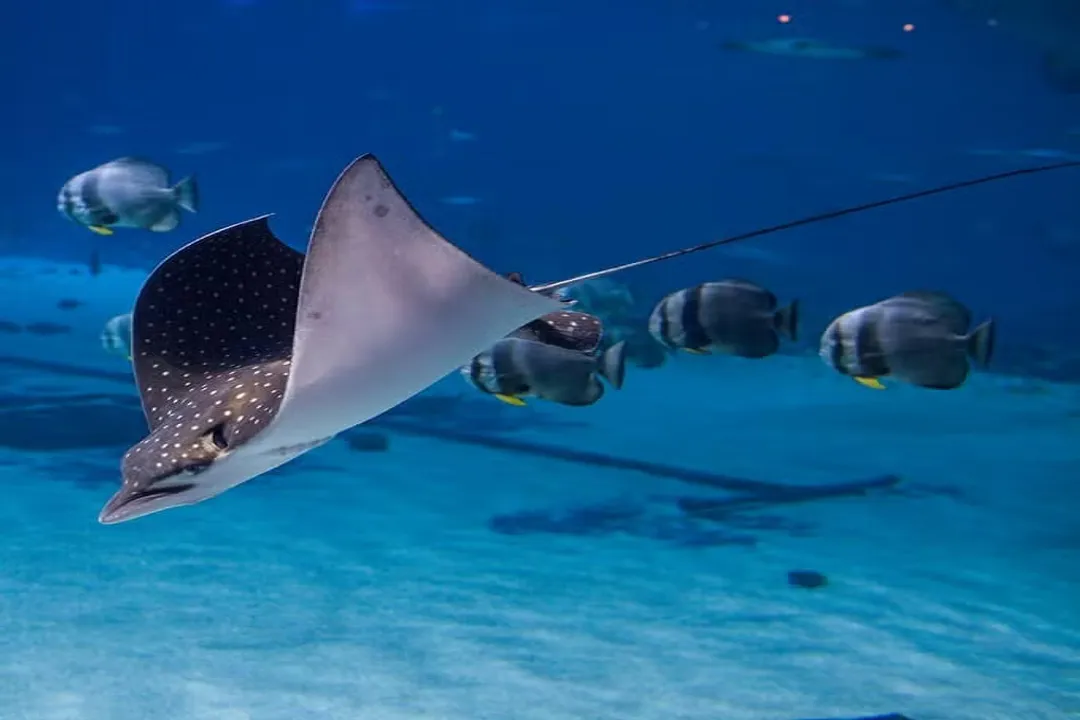
The spotted eagle ray cuts an unmistakable figure in the water, instantly recognizable by its flattened, disk-shaped body and the dramatic motion of its wing-like pectoral fins, which give it the appearance of soaring through the ocean depths. Common names associated with this creature reflect its unique appearance, including the white-spotted eagle ray, bonnet ray, and the descriptive duckbill ray. The specific Hawaiian name for this ray, hihimanu, elegantly translates to mean "magnificent" or "elegant bird," a fitting title for such a graceful animal.
# Disc Profile
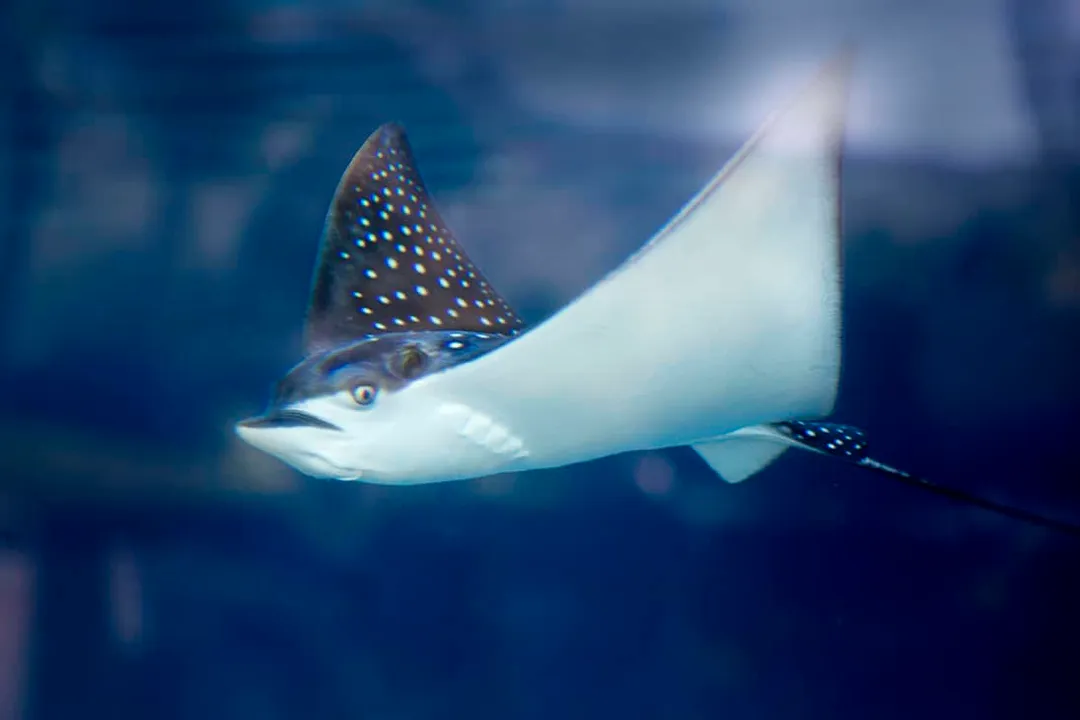
The body, or disc, of the spotted eagle ray is notably flattened and, when viewed closely, quite angular and thick. Its most prominent feature is the striking color contrast between its upper and lower surfaces. The dorsal side is characterized by a dark background—often described as black, dark gray, or deep blue—adorned with numerous bright white spots or rings. Conversely, the ventral surface, or belly, is a brilliant white. An interesting detail noted in observations of the Hawaiian population is that the white underside of each wing can feature a black, geometric maze pattern.
The pectoral fins are extremely pronounced, forming the "wings" responsible for the ray’s signature propulsion. These fins are generally described as broad with tips that can be pointed. In terms of sheer physical scale, these rays are impressive, with maximum recorded wingspans reaching up to 3 meters (9.8 to 10 feet) tip-to-tip. While they are often seen gliding in open water, sometimes near the surface, their physical structure is built for powerful, flapping locomotion.
# Head Features
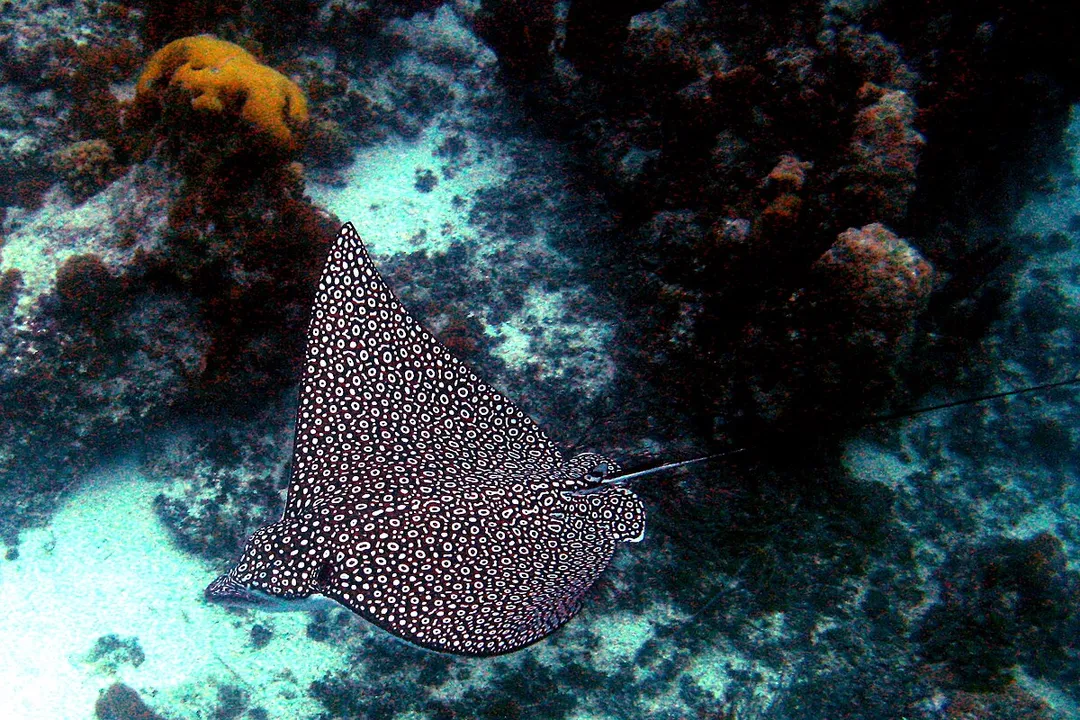
The head region is defined by a most peculiar snout structure. Sources repeatedly emphasize its distinct shape, describing it as similar to a duck's bill, or perhaps more precisely, round and pointed at the tip, resembling a bird's beak. This shovel-shaped snout is not merely ornamental; it is a critical foraging tool used to probe and dig in soft sand sediments on the seafloor to unearth buried prey.
This specialized digging behavior is tied to the ray's sophisticated sensory equipment located beneath the head. The ray utilizes the same ampullae of Lorenzini found in sharks, which function much like a metal detector to locate the faint electrical fields given off by hidden crustaceans and mollusks. Furthermore, a system of canals called the lateral line runs along its body, allowing the ray to sense vibrational changes in the water, effectively allowing it to "feel" its immediate surroundings, including approaching predators.
The mouth itself is specially adapted for its diet of hard-shelled creatures. The jaws house a single row of broad, flat teeth that form upper and lower plates, perfectly engineered for crushing the shells of bivalves and other hard-shelled prey. Adding another layer of refinement to this crushing mechanism, some researchers have noted a row of 6 or 7 small projections, or papillae, located behind the teeth plates in both the upper and lower jaws, which are thought to assist in separating the shell fragments from the edible meat before ingestion.

# Tail Structure
The tail of the spotted eagle ray is a key component of its overall profile, being characterized as long and whip-like. The length of this tail can vary significantly; one measurement suggests it can reach 2.5 to 3 times the width of the disc, while another report suggests a maximum total length, including the tail, of nearly 9 meters (28.8 feet).
A non-negotiable physical characteristic is the presence of venomous spines located near the base of the tail, situated just behind the pelvic fins. The number of these spines is reported to be between one and six. While this tail houses defensive weaponry, an interesting distinction is made regarding true stingrays: in Hawaiian waters, the eagle ray’s barbed spines are located further down the length of the tail compared to the species classified as true stingrays. Despite possessing these spines, the ray is generally considered docile and typically swims away when approached.
# Size Fluctuations and Body Mass
When documenting the size of the spotted eagle ray, the data reveals a significant spread in reported maximum lengths, which can be attributed to how the tail length is incorporated into the measurement. This highlights the importance of using the wingspan when comparing the actual size of the ray’s body disc across different reports.
| Measurement | Low Estimate | High Estimate | Notes |
|---|---|---|---|
| Wingspan (Width) | 2.7 meters (9 feet) | 3.3 meters (10.8 feet) | The most consistent measure of disc size. |
| Length (w/o Tail) | 1.2 meters (4 feet) | 2.4 meters (8 feet) | Average body length before the tail begins. |
| Length (Total) | 4.9 meters (16 feet) | 8.8 meters (28.8 feet) | Total length is highly variable based on tail condition. |
| Maximum Weight | 230 kilograms (507 lbs) | 230 kilograms (507 lbs) | Weight measurements are consistent across sources. |
The consistency in the maximum reported weight, 230 kg (507 lbs), across multiple sources suggests this figure is a well-established biological maximum for the species, regardless of the variations in total length reporting. Young pups, born alive, are relatively small, showing a disc width between 17 and 35 centimeters (6.7 to 13.8 inches) at birth.

# Form Dictates Function
The physical architecture of the spotted eagle ray is an exceptional case study in form perfectly matching specialized function. While many rays are benthic dwellers, rooting around the seafloor, the eagle ray’s body plan emphasizes open-water movement. Its extremely pronounced, wing-like pectoral fins are its primary means of locomotion, allowing it to glide efficiently in the water column. This movement style contrasts with rays that utilize more undulating or flapping motions close to the substrate.
This difference in movement is directly related to its physical feeding strategy. The ray's tapered, duck-like snout is not designed for sifting fine sediment like a flounder; rather, it is built for precision excavation, acting like a shovel to dig out hard-bodied infauna from the sand. This digging, combined with the sophisticated electrical sensing of its ampullae of Lorenzini, allows it to efficiently locate and extract prey that other predators might miss beneath the surface layer. Even subtle physical differences exist between sexes; the males' teeth plates are slightly more pointed than the females', a physical trait that may directly relate to their behavior of biting the female’s wing during the mating embrace. This intimate link between specialized anatomy—from the crushing jaws to the sensory pores—and feeding ecology clearly demonstrates how the ray’s physical description outlines its niche in the marine environment.
Related Questions
#Citations
Spotted eagle ray - Wikipedia
Spotted Eagle Ray | Oceana
Spotted Eagle Ray - Georgia Aquarium
Spotted Eagle Ray | Hawaiian Marine Life - Maui Ocean Center
Spotted Eagle Ray Facts and Information | United Parks & Resorts