What is the description of the Eastern Phoebe?
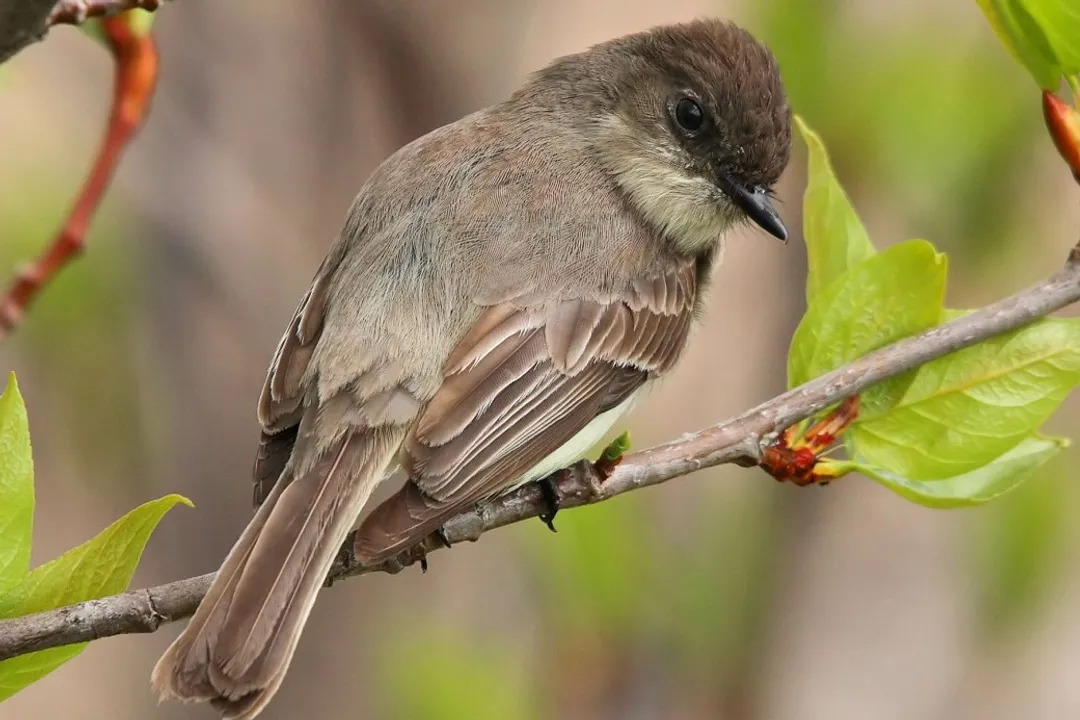
The Eastern Phoebe, a familiar sight across much of eastern North America, is often the first flycatcher to return north in the spring, signaling a distinct shift in the seasons. This small songbird belongs to the Tyrannidae family, commonly known as the tyrant flycatchers, though their demeanor is often less tyrannical than their classification might suggest. Its presence is often first noticed not by its color, which is relatively subdued, but by its characteristic behavior, particularly its constant, jerky tail movements while perched.
# Appearance Profile
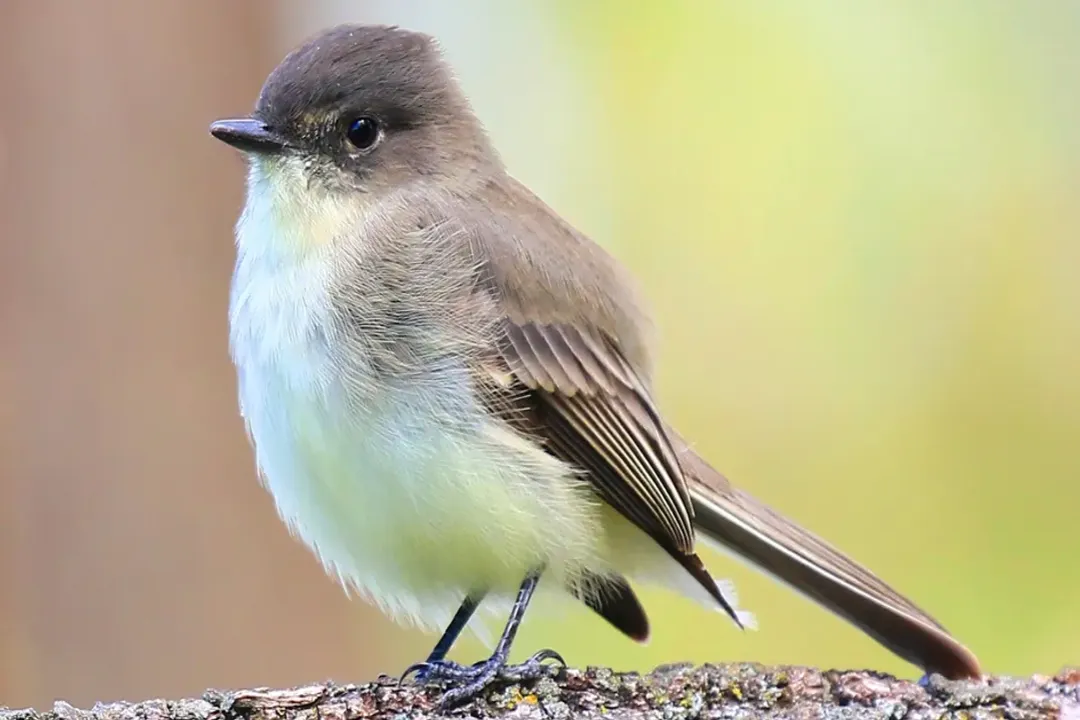
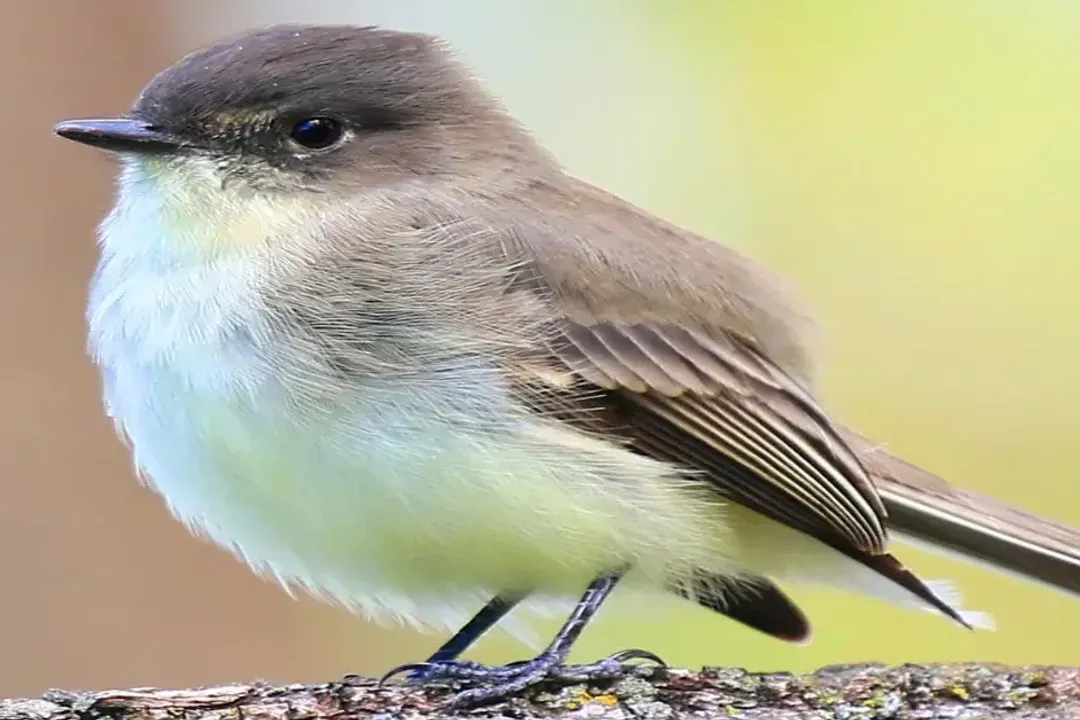
To describe the Eastern Phoebe is to describe subtlety in color punctuated by definite structure. They are small, chunky birds, measuring roughly 5 to 5.5 inches in length, with a relatively short, slightly peaked head and a short bill typical of an insectivore. The overall plumage presents a rather plain, dull appearance. The upperparts, including the head, back, and wings, are generally a dusty, grayish-brown. This brownish-gray coloration tends to be somewhat darker on the head and back compared to the paler breast and belly.
Unlike many other flycatchers, the Eastern Phoebe lacks obvious field marks such as conspicuous wing bars or a distinct eye-ring. This absence of extra adornment is, in itself, a key identification feature when scanning the messy clutter of a mixed species foraging group. The undertail coverts are typically pale, often appearing whitish or buffy. In breeding males, the colors might appear marginally brighter or cleaner, but for the most part, sexing a bird based on plumage alone is challenging; males and females look very similar. Immature birds might exhibit pale buffy feather edges, giving them a slightly scaled look, especially on the breast, but this is a temporary stage.
The legs and feet are noticeably dark, often described as blackish. Their silhouette, when perched, is fairly upright, although they frequently lean forward slightly when actively scanning for prey. When observing them, one should look for a bird that appears uniformly gray-brown above and pale gray or whitish below, without any striking patches of color or bold wing patterns.
# Size and Structure
When comparing the Eastern Phoebe to other common North American flycatchers, its size places it among the smaller members of the group, though it appears stockier than a kingbird, for instance.
| Characteristic | Measurement Range (Inches) | Notes |
|---|---|---|
| Length | 5.0–5.5 | Relatively small body size. |
| Wingspan | 7.9–8.7 | Moderate span for a small flycatcher. |
| Weight | 0.3–0.5 oz | Very light bird. |
This structural uniformity across sexes and ages simplifies identification once one is familiar with the species, shifting the focus away from measuring subtle color variations toward observing posture and action. A consistent observation across many field guides is the Phoebe's lack of a prominent crest, which sets it apart from species like the Eastern Wood-Pewee or Say's Phoebe.
# Distinctive Movements
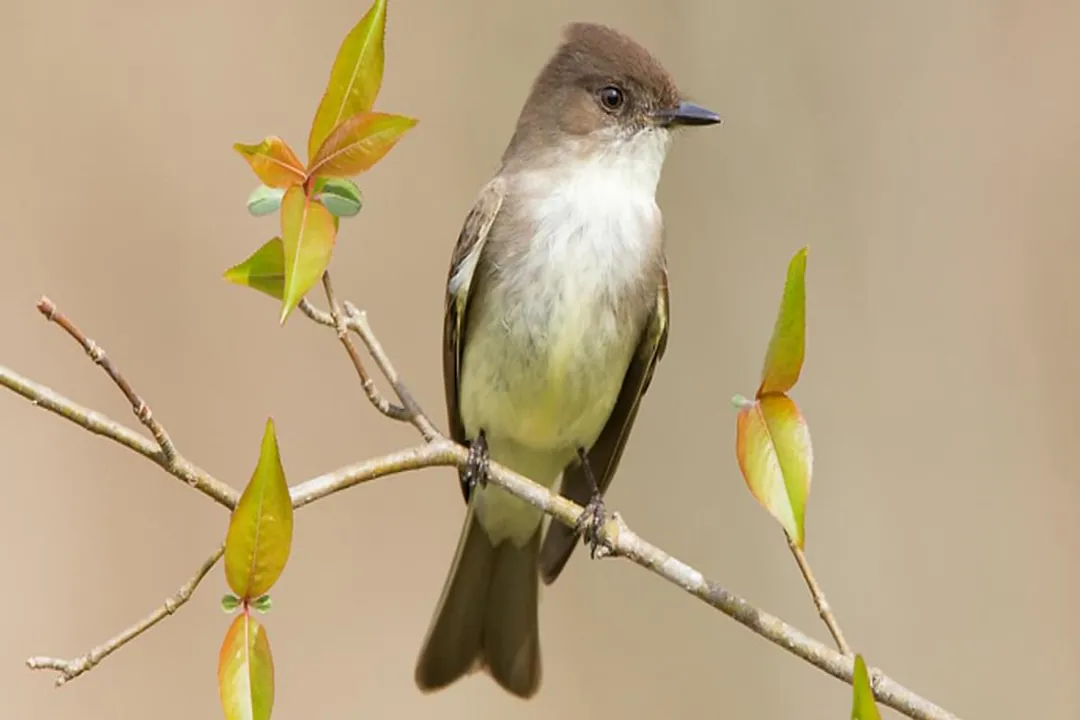
If the plumage is understated, the motion of the Eastern Phoebe is anything but. The species name Phoebe is sometimes thought to derive from the bird’s call, but its behavior is equally distinctive. The most memorable and reliable characteristic of the Eastern Phoebe is its persistent tail-wagging. While perched, often on a low branch, wire, or structure, the bird will frequently flick its tail up and down in a rapid, jerky motion, sometimes accompanied by a slight bob of the body.
This tail movement is not just an occasional habit; it is almost continuous when the bird is settled and not actively foraging or singing. This constant agitation helps in quickly identifying the bird, even at a distance where subtle color details are lost in shadow or haze. While some other flycatchers exhibit tail movements, the Phoebe’s is particularly repetitive and pronounced. This behavior is thought by some observers to help flush out insects hiding underneath leaves or bark, though it may also serve a signaling or territorial function. This active signaling contrasts sharply with the more sedate, slowly drooping tail of a similar-looking species, the Eastern Wood-Pewee, which makes movement analysis critical for accurate field identification.
# Geographical Presence
The Eastern Phoebe is primarily a bird of eastern North America, though its migratory route and wintering grounds extend its range significantly. The breeding range generally covers the eastern half of the continent, reaching from Newfoundland and Labrador west to the eastern edge of the Great Plains, extending south through the central and eastern United States.
As northern populations migrate, they move south for the winter, with most individuals wintering from the southeastern United States down through Mexico and Central America. The migration timing is relatively early; they are noted for arriving on their northern breeding grounds surprisingly early in the spring, sometimes while snow is still present in sheltered areas, which is a testament to their hardiness.
Their habitat preferences show an interesting adaptation to human presence. While naturally drawn to woodlands, especially near water sources like streams, rivers, and wet slopes, they have readily incorporated human-made structures into their life cycle. They are often found near farm buildings, bridges, culverts, and the eaves of porches or sheds. This willingness to nest close to people is a significant part of their description, as many flycatchers prefer deep, undisturbed forests.
When considering where a birder might encounter them throughout the year, understanding the shift in habitat use is key. In the northern parts of their summer range, they stick closely to wooded ravines and riparian corridors. As the season cools, those birds moving south often utilize more open environments—backyards, parks, and the edges of fields—as they pass through or settle for the winter.
# Foraging Habits
As a member of the tyrant flycatcher group, the Eastern Phoebe is an obligate aerial insectivore, meaning its primary food source is flying insects caught directly out of the air. Their foraging technique is characteristic of many flycatchers: the sally-and-return method.
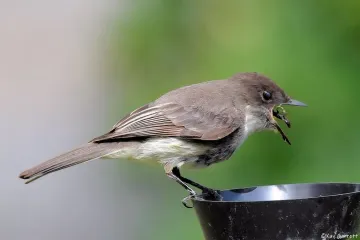
A Phoebe will choose a conspicuous perch, often low to the ground or water, that offers a clear view of open air in front of it. It sits statue-still, exhibiting that telltale tail-wag, until it spots an insect flying by. It then executes a short, quick flight, or "sally," snapping the insect out of the air with a sharp clap of its bill, before returning immediately to the same perch or a nearby one. This method conserves energy while maximizing opportunities to capture small prey like gnats, flies, mosquitoes, and small moths.
One fascinating aspect of their feeding behavior, which speaks to their resourcefulness, is their tendency to hover momentarily in the air, often described as "hover-gleaning," particularly when catching insects disturbed near the ground or off vertical surfaces like bridge pilings. In the non-breeding season, when aerial insects are scarcer, they will supplement their diet with small spiders and occasionally small berries, though insects remain dominant year-round. A notable point of comparison: unlike the Great Crested Flycatcher, which often moves aggressively through the foliage to flush out prey, the Phoebe prefers a more stationary, ambush-style attack from a known lookout post.
# Vocal Language
The vocalizations of the Eastern Phoebe are simple but remarkably consistent, providing a straightforward way to identify them when they are too difficult to see. Their song is a series of short, clear, somewhat plaintive whistles. The primary song consists of repeated, sharp, two-note phrases, often described as "fee-bee" or "fee-buh". The first note is typically higher in pitch than the second. This call is delivered with a slight downward inflection at the end.
It is this simple, often melancholy utterance that gives the bird its common name. They sing frequently during the breeding season, often from prominent perches or near nest sites, serving both as a territorial advertisement and a means for the pair to maintain contact. They also possess various contact and alarm calls, which are generally shorter, sharper chips or hisses, used when disturbed or interacting with mates near the nest. A common alarm is a sharp, rapid pit-pit-pit. If you are in a marshy area or near a stream in early spring and hear a repeated, slightly mournful "fee-bee," you have likely found an Eastern Phoebe claiming its territory.
# Building a Home
The nest construction of the Eastern Phoebe is where their comfort with human architecture becomes most apparent. They are cavity nesters by nature, historically utilizing rock crevices, hollows in trees, or beneath rock ledges near water. Today, however, they overwhelmingly choose sheltered, artificial structures. Common nesting sites include the undersides of bridges, culverts, covered porches, open sheds, and garages. They prefer locations that offer protection from rain and predators.
The nest itself is a compact, cup-shaped structure, typically built by the female. The primary construction materials are mud and moss, which are mixed together and applied to form the base and walls of the cup. This muddy exterior is then lined with finer materials, such as rootlets, soft grasses, and sometimes animal hair, creating a soft bed for the eggs. An interesting detail gathered from long-term observations is that Phoebes frequently reuse or refurbish old nests, often adding a new layer of mud and lining each subsequent year if they return to the same location. This fidelity to a specific physical location, even if it requires yearly maintenance, is quite common for the species.
The female typically lays a clutch of four to six white or buff-white eggs, occasionally speckled lightly with brown. Incubation lasts about 15 to 18 days, and the nestlings remain in the nest for another 17 to 20 days before fledging. Both parents participate in feeding the young, bringing insects back to the nest until the juveniles are proficient enough at catching their own aerial prey.
# Local Adaptation and Observer Experience
The Eastern Phoebe occupies a unique niche among eastern songbirds due to its close, year-round association with human habitation across at least part of its range. For birders in the Southeast, where Phoebes winter, spotting one perched on a fence post overlooking a pasture is an everyday occurrence, contrasting with the experience of their more deep-woods northern relatives. This adaptability—being comfortable near both a roaring waterfall in a wilderness area and the exposed beam of a suburban carport—suggests a behavioral plasticity that has allowed them to maintain stable populations despite significant habitat modification. This reliance on sheltered overhangs means that property owners who leave sheltered spots open can often attract a nesting pair without much effort, provided insects are available nearby.
When trying to nail down an identification among the similarly drab Empidonax flycatchers or other pewees, focusing purely on the slight differences in wing feather edging or bill color is often a frustrating exercise, especially in poor light. What sets the Phoebe apart is the certainty offered by movement. If the bird sits still, it requires careful scrutiny; if it bobs and continuously jerks its tail every few seconds while maintaining an upright posture, the chance it is a Phoebe jumps dramatically, regardless of the shade of gray it presents. It is one of the few species where observed behavior provides a much faster and more reliable identification key than static visual characteristics. Thus, learning the Phoebe is essentially learning how to watch a flycatcher, rather than just how to see one.
# Breeding Cycle Timing
The early arrival of the Eastern Phoebe in the spring is a critical factor influencing its breeding success and species description. Because they arrive early, they often secure the best or most traditional nesting sites before later migrating species arrive to compete for those same sheltered spots under bridges or eaves. This early commitment means they are highly dependent on consistent early spring weather; a sudden, late cold snap can drastically reduce the available flying insect population when the nestlings are newly hatched and require high-volume feeding.
While a typical clutch size is four to five eggs, in areas where conditions are excellent and food is abundant early on, it is not unheard of for a pair to successfully raise two broods within a single breeding season. This second brood is usually initiated shortly after the first set of young has successfully fledged and become independent foragers. The dedication to reusing or repairing a nest foundation from the previous year also saves significant time and energy during the critical early nesting phase, providing a head start on the breeding cycle compared to pairs building a new structure from scratch. The Eastern Phoebe, therefore, is described not just by its appearance but by its eagerness and efficiency in capitalizing on the earliest opportunities of the North American spring.
#Videos
The Eastern Phoebe: Everything You Need to Know - YouTube
Related Questions
#Citations
Eastern Phoebe Overview, All About Birds, Cornell Lab of Ornithology
Eastern phoebe - Wikipedia
10 Fascinating Facts About Eastern Phoebes | Nest Box Live
Eastern Phoebe | Audubon Field Guide
Eastern Phoebe | Bird Gallery - Houston Audubon Society
The Eastern Phoebe: Everything You Need to Know - YouTube
Eastern Phoebe | State of Tennessee, Wildlife Resources Agency
Eastern Phoebes - Mass Audubon
Birds of Brooklyn: Eastern Phoebe