What is the classification of the Atlas moth?
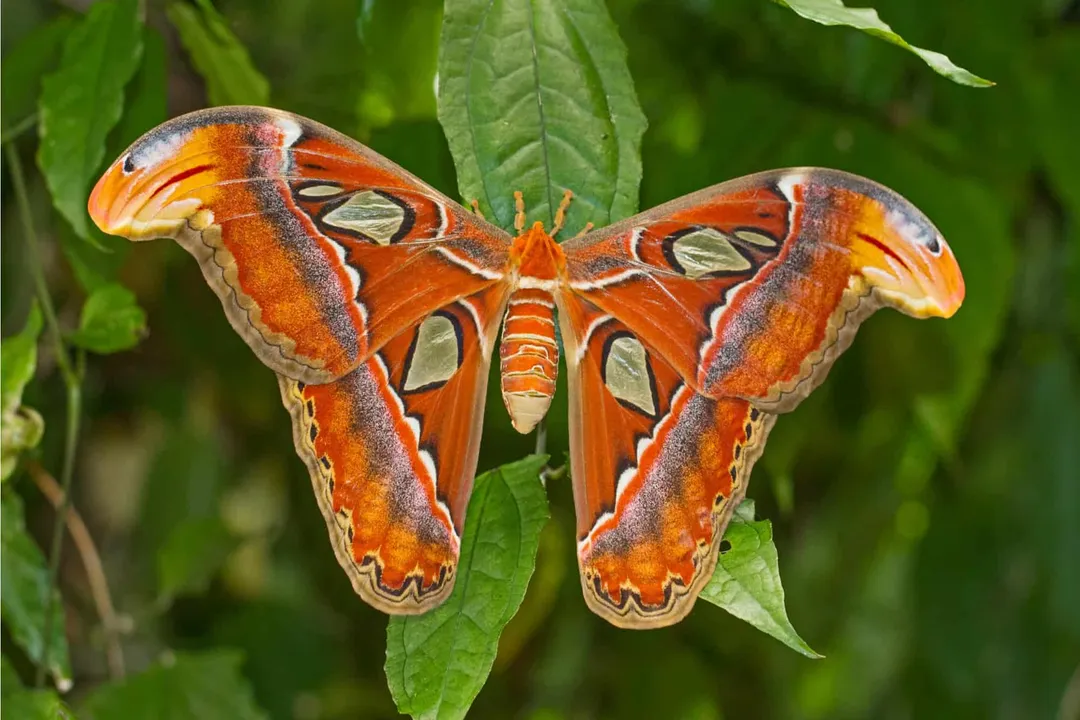
The classification of the Atlas moth, Attacus atlas, is a fascinating exercise in biological organization, mapping this enormous insect onto the established hierarchy that defines all life on Earth. Understanding where this magnificent creature sits within the tree of life explains not only its physical attributes—like its massive wing span—but also its fundamental biology, reproductive strategy, and ecological role. [1][7] This process begins at the broadest level and drills down to the specific species designation that sets it apart from all other organisms. [3]
# The Hierarchy
The Linnaean system, developed by Carl Linnaeus, remains the bedrock for naming and grouping organisms, relying on nested categories from Kingdom down to Species. [6] For the Atlas moth, tracing this path reveals its close relatives and its ancient evolutionary lineage. [3] The scientific name, Attacus atlas, provides the final two pieces of this puzzle: the genus, Attacus, and the species, atlas. [1][6]
# Animal Kingdom
At the highest level, Attacus atlas resides in the Kingdom Animalia. [1][3][6] This places it among multicellular, eukaryotic organisms that are heterotrophic, meaning they obtain energy by consuming other organisms, and typically lack cell walls. [3] The Atlas moth is undoubtedly motile during its larval stage and possesses complex sensory organs as an adult, fitting comfortably within this massive grouping. [1]
# Arthropod Phylum
Moving down, the moth belongs to the Phylum Arthropoda. [1][3][6] This phylum is defined by several key characteristics that the Atlas moth clearly exhibits: a segmented body, a jointed pair of appendages (legs, antennae), and, most notably, a tough, external covering called an exoskeleton. [1][3] Arthropods dominate the animal world in terms of species diversity, and insects form the largest class within this group. [3]
# Insect Class
Within Arthropoda, the Atlas moth falls into the Class Insecta. [1][3][6] This classification requires the organism to possess three distinct body regions—the head, thorax, and abdomen—along with three pairs of jointed legs attached to the thorax. [3] Furthermore, adult insects usually possess one or two pairs of wings, which, in the case of the Atlas moth, are spectacularly large and patterned. [1][7]

# Lepidoptera Order
The order Lepidoptera is the home for all butterflies and moths. [1][3][6] The name itself is descriptive, deriving from the Greek words lepis (scale) and pteron (wing). [3] The defining feature of this order is the presence of microscopic, overlapping scales covering the wings, body, and sometimes the legs. [1][7] These scales are responsible for the insect’s color, pattern, and insulation. [1] The Atlas moth’s wings are renowned for their complex, large-scale patterning, which is entirely generated by these tiny structures. [7]
# Saturniidae Group
Perhaps the most informative step for understanding the Atlas moth’s adult life is its placement in the Family Saturniidae, commonly known as the giant silkworm moths. [1][3][6] This family is famous for housing some of the largest moths globally, including the Atlas moth and the Comet moth. [1][7][8] Moths in the Saturniidae family share several crucial traits beyond their impressive size. A significant biological marker for many Saturniids, including Attacus atlas, is that the adult stage lacks fully developed mouthparts. [1][8] This means the adult moth does not feed; its entire existence after emergence is dedicated solely to reproduction, relying entirely on the energy reserves built up during its long larval (caterpillar) feeding stage. [1][8] This fact, stemming directly from its family classification, dictates the adult lifespan, often lasting only a week or two, making the rapid discovery of a mate an imperative. [9][10]
If you were to look at a chart summarizing the major features of the Saturniidae family compared to their close relatives, the true silk moths (Bombycidae), you would notice the Saturniids often display elaborate eyespots on their wings—features Attacus atlas possesses conspicuously. [1]
| Taxonomic Rank | Group Name | Defining Feature |
|---|---|---|
| Order | Lepidoptera | Scaled wings [1][3] |
| Family | Saturniidae | Giant size, usually lack adult feeding apparatus [1][8] |
| Genus | Attacus | Very large, often with apical wing 'tails' [1] |
| Species | A. atlas | Specific combination of wing pattern and size [1] |
# Attacus Atlas
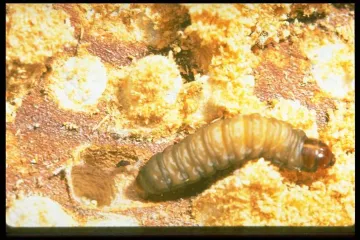
Within the large family Saturniidae, the Atlas moth is categorized under the Genus Attacus. [1][6] Moths within this genus are generally characterized by their immense size, and many species feature wing shapes that have distinct, somewhat elongated corners, sometimes referred to as 'tails'. [1]
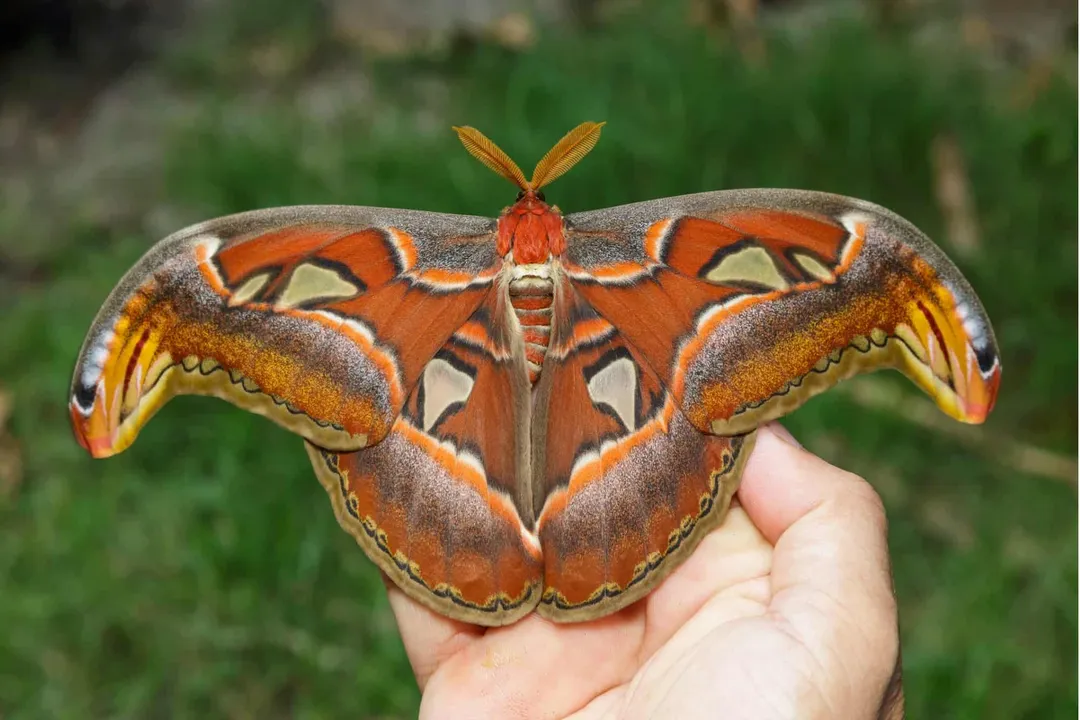
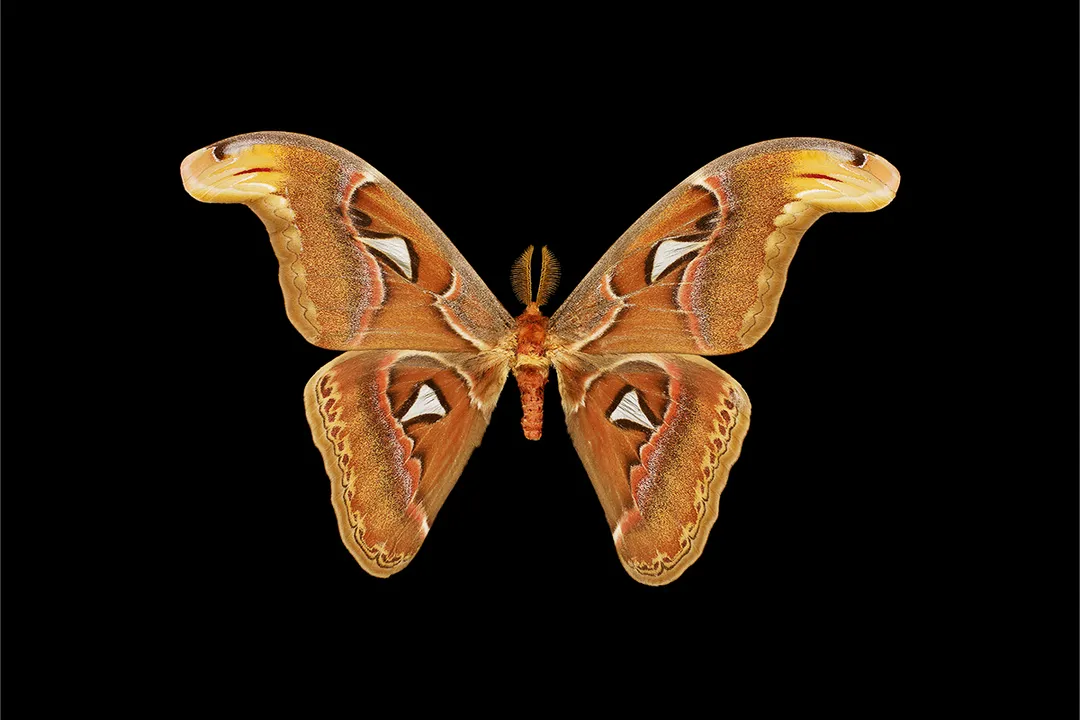
The final designation, Attacus atlas, identifies the species itself. [1][6] This specific combination of features—the massive wingspan, the specific coloration involving shades of red, brown, cream, and black, and the unique triangular, transparent patches on each wing—distinguishes it from any other Attacus member. [1][7][10]
# Contextualizing the Placement
The sheer scale of Attacus atlas is often the first thing people notice, with wingspans regularly exceeding 25 centimeters (10 inches) and sometimes approaching 30 centimeters. [1][7][8] While size is a key feature used by entomologists, placing it firmly in Saturniidae—the giants of the moth world—is more about shared non-visual traits, like the vestigial adult feeding structures mentioned earlier. [8] A fascinating aspect of its placement within the global context is how its classification informs management, particularly where it is not native. Because it is classified as Attacus atlas, a species originating in Southeast Asia and the Indian subcontinent, [1][2] its presence in areas like the continental United States triggers specific regulatory responses. [4] Authorities, such as the USDA's Animal and Plant Health Inspection Service (APHIS), track it specifically because its genus and species designation link it to known biosecurity concerns, necessitating rigorous quarantine protocols if an imported specimen were ever found. [4] This taxonomic identity is the scientific key that unlocks the proper regulatory doors, showing that classification is not merely academic but has real-world implications for agricultural protection. [4]
The larvae, or caterpillars, of Attacus atlas are also well-placed within their family context. They go through five instars (developmental stages), growing substantially before pupating in a cocoon. [1][5] The silk produced by some Saturniids is commercially valuable, though the silk from A. atlas is often considered too coarse for quality textiles, a biological note that differentiates it ecologically and commercially from Bombyx mori, the true silk moth. [8]
The entire classification system, from Animalia down to atlas, demonstrates a progression of specialization. It starts with the most general requirements for animal life and narrows down to the precise morphological and behavioral traits that make this particular moth recognizable and unique among the world's insects. [3][6] Its journey through the phylum, class, and order illustrates deep evolutionary history, while its placement in the Saturniidae family highlights a shared, dramatic life strategy centered around massive larval growth followed by a brief, reproductive adult phase. [8][9]
Related Questions
#Citations
Attacus atlas - Wikipedia
atlas moth (Attacus atlas (Linnaeus)) - Invasive.Org
Attacus atlas | INFORMATION - Animal Diversity Web
Taxon: Attacus atlas - USDA
Atlas Moth Insect Facts - Attacus atlas - A-Z Animals
Atlas Moth (Attacus atlas) - iNaturalist
Atlas Moth - California Academy of Sciences
Atlas Moth: World's Largest Moth - bug under glass
Attacus atlas, the giant Atlas moth available now - TimeToBreed
Atlas Moth Facts For Kids | AstroSafe Search - DIY.ORG