What is special about the Atlas moth?
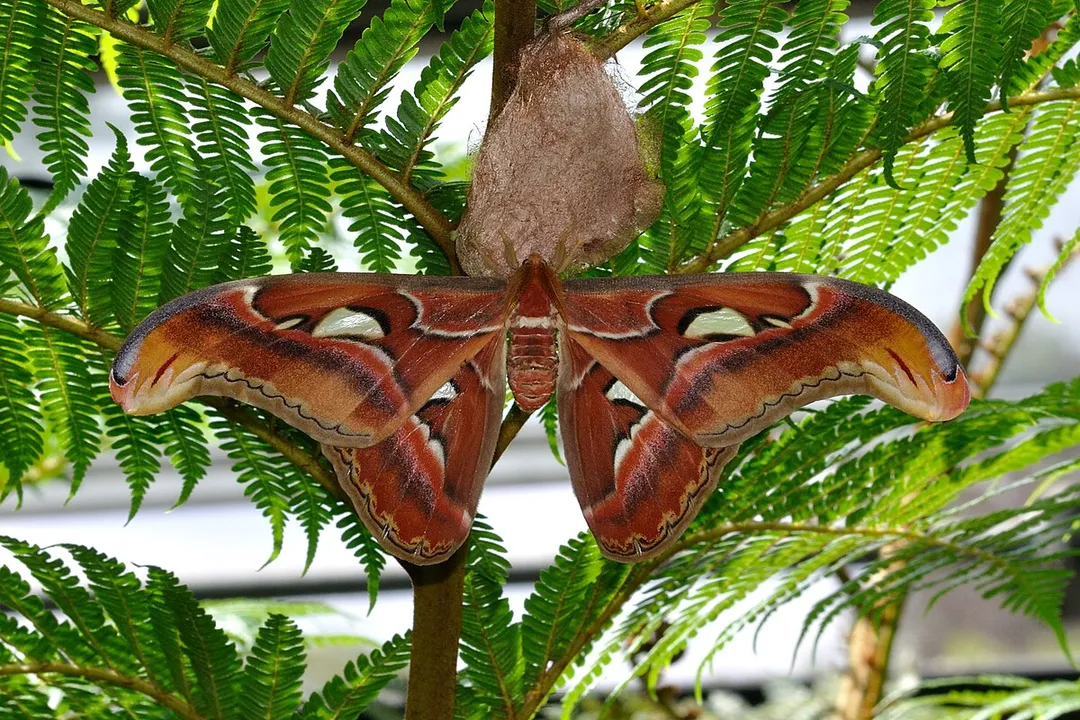
The Atlas moth, Attacus atlas, is an insect that defies the common perception of moths as drab, nighttime fliers. This spectacular creature, a resident of Asia’s tropical and subtropical forests, commands attention not just for its beauty but for its sheer, almost unbelievable scale. It is one of the largest lepidopterans known, and when one considers its immense wingspan or the surface area covered by those wings, it truly earns its name, which is often attributed to the Greek Titan condemned to hold up the sky.
# Colossal Wingspan

When discussing the Atlas moth, size is the first and most staggering feature to address. This species is renowned for holding the title of the largest moth in the world when measured by the total surface area of its wings. While its wingspan—the distance from one wingtip to the other—can reach an imposing maximum of about 12 inches (or 24 cm), it is narrowly surpassed in this specific measurement by a few relatives, such as the White Witch moth (Thysania agrippina). However, in terms of overall wing expanse, the Atlas moth reigns supreme, boasting a wing surface area that can hit 62 square inches, or approximately 160 square centimeters.
This grand architecture necessitates an extreme energy strategy. To put that size into perspective for a general reader, a wingspan of 12 inches is nearly the length of a standard US ruler. The insect’s body, while substantial, appears almost secondary to the immense, patterned structures it uses for display and survival.
# Naming the Giant
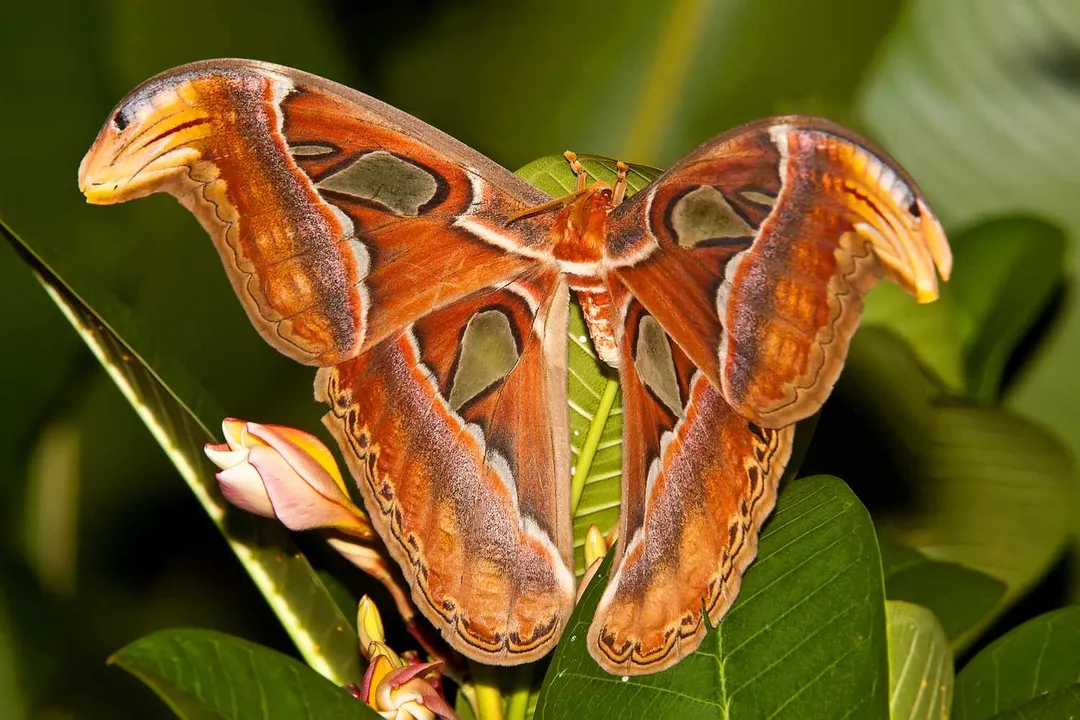
The designation Attacus atlas comes with several layers of meaning, each relating to a different aspect of the moth’s imposing presence. The most immediate association is its titanic size, leading to the mythological connection with the Titan Atlas. However, looking closely at the wings reveals intricate, bold lines and patterns that resemble geological formations on a map, another source for the "Atlas" designation.
In a fascinating example of cultural nomenclature, the Cantonese name for the moth translates directly to “snake’s head moth”. This name is not arbitrary; it points directly to one of the moth's most effective survival tools, located at the extremities of its forewings.
# Defensive Deception
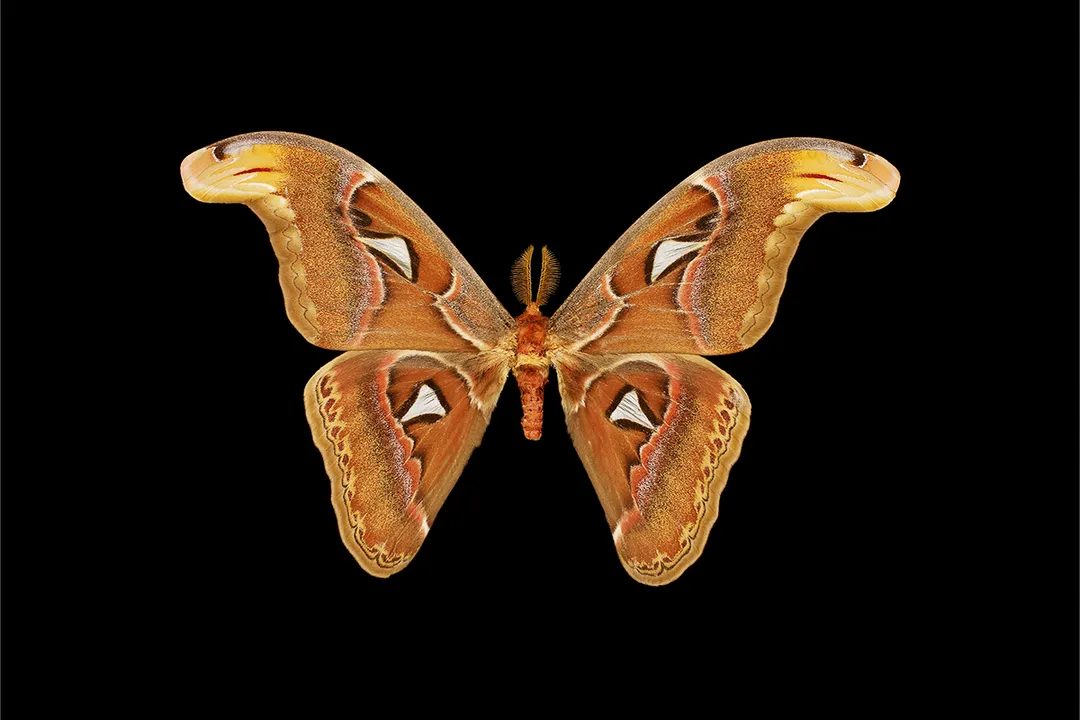
Life as a massive, soft-bodied insect in a region populated by visual hunters like birds and lizards demands clever defense mechanisms. The Atlas moth has evolved two primary strategies centered on visual trickery, both of which rely on its enormous wings.
The first, and most famous, is the snake mimicry. The outer tips of the forewings are distinctly shaped and colored to look remarkably like the head of a cobra, a predator that shares territory with the moth. When threatened while resting, the moth can subtly shift these wings to imitate the movement of a striking snake, a convincing ruse that often causes would-be attackers to hesitate or flee.
If the serpentine bluff fails, the moth has a backup plan: large, translucent, scale-less areas known as eyespots. These spots serve a dual purpose. They can startle an attacker with a sudden flash of perceived "eyes," or, more critically, they can act as a sacrificial target. A predator striking at a conspicuous eyespot on a wing will inflict damage that the moth might survive, whereas a strike to the actual head or central body would likely be fatal. It is a high-stakes game where mere inches and visual misdirection separate existence from extinction.
# The Energy Trade-Off
Perhaps the most singular characteristic of the adult Atlas moth is its utter inability to sustain itself. Upon emerging from the pupa, the magnificent adult moth is effectively living on borrowed time and stored energy. It completely lacks fully formed mouthparts, possessing only a vestigial proboscis that cannot feed. This mandates a fasting existence, relying entirely on the fat reserves accumulated during its voracious larval phase.
This physiological constraint results in an incredibly compressed adult life, usually lasting only one to two weeks, with some accounts suggesting as short as five to seven days. Given this severe time limit, the moth’s entire adult existence is dedicated to one mission: finding a mate and reproducing. To manage this energy budget, they are highly conservative with movement, resting motionless during the day and restricting flight to the cooler, darker hours of the night. The female releases potent pheromones, allowing males to track her from kilometers away using their highly sensitive, feathery antennae. Once mating occurs—a process that can even take up to 24 hours—the female lays her eggs, often numbering 150 or more, and the cycle ends with the death of both parents.
This extreme life strategy—gaining enough stored mass in the larval stage to power a few days of intense reproductive effort without ever consuming another calorie—is a fascinating evolutionary gamble. It entirely bypasses the risks associated with feeding (like exposure to predators while eating) in favor of maximizing the time available for the single most important biological imperative: passing on genes. For an insect of this size, the energy demands are enormous, forcing this radical, all-or-nothing approach to adulthood.

# Larval Life and Defense
The adult’s brief, focused existence is entirely predicated on the success of the caterpillar stage. Atlas moth larvae are prodigious eaters, consuming the foliage of host plants such as citrus, cinnamon, guava, and various evergreen trees. This ravenous feeding continues for roughly two weeks until the caterpillar reaches a length nearing 4.5 inches. This period is crucial for building up the necessary fat reserves to fuel the entire non-feeding adult phase.
The caterpillar itself is far from defenseless. It sports a striking, threatening appearance: a bluish-green body covered in spiny protuberances and coated with a waxy white film. More actively, the larva can deploy a chemical deterrent. When faced with threats like ants or lizards, it can expel a secretion that carries a powerful, foul odor. This irritant spray is effective even at distances of nearly 12 to 20 inches, capable of deterring predators before physical contact is necessary.
# The Fagara Treasure
Before the adult moth emerges, the caterpillar undertakes the creation of its protective shell: the cocoon. This structure is spun from a durable silk fiber known as fagara. Depending on the caterpillar's diet, the silk typically presents in shades of tan or brown. The pupal stage within lasts about four weeks before the magnificent adult breaks free.
The fagara silk has a tangible relationship with the local human populations in parts of Asia. Unlike the fine, continuous strands of the domestic silkworm (Bombyx mori), Atlas moth silk is secreted in broken strands, making it traditionally less desirable for fine textiles like traditional commercial silk. Nonetheless, its robustness is recognized. In Taiwan, for instance, communities sustainably collect the empty cocoons, which are durable enough to be repurposed into novelty items, most famously small coin purses, sometimes with minimal alteration like the addition of a zipper.
Current research is looking into the material science of fagara itself, investigating whether its inherent properties can overcome the production challenges. Studies have suggested that the fibers of the Atlas moth silk exhibit a cell density and growth rate significantly higher—around 80% greater—than those of commercial silk fibers, indicating genuine potential as a high-quality alternative material for specialized uses.
The contrast between the use of the vacated cocoon and the capturing of the living adult moth presents an interesting ecological consideration for admirers. Harvesting the finished, empty silk product represents a form of sustainable, post-life resource collection, similar to gathering shed antlers. Conversely, removing the living adult moth—whose entire existence is a frantic, fragile race to mate—destroys the continuation of the species for a mere display item. True appreciation of this creature’s unique life cycle aligns better with observing its natural, brief splendor than collecting its remains while it is actively fulfilling its sole purpose.
The Atlas moth, therefore, is special not just because it is one of the largest insects on Earth, but because its entire life is a finely tuned mechanism balancing immense size with terminal efficiency. From its cobra-head disguise designed for survival, to its fat-fueled, mouthless existence focused purely on procreation, Attacus atlas is a genuine spectacle of evolutionary specialization in the Asian forests.
Related Questions
#Citations
8 Amazing Facts About the Atlas Moth
Attacus atlas - Wikipedia
Atlas Moth - California Academy of Sciences
[PDF] Atlas Moth - Journey Homeschool Academy
5 Awesome Facts About the Atlas Moth - Mental Floss