What is the classification of the red-eyed tree frog?

The identity of the red-eyed tree frog, scientifically designated as Agalychnis callidryas, begins with its formal placement within the vast hierarchy of life. To understand this species is to trace its lineage from the broadest categories down to its unique niche. This creature, often serving as the unofficial poster child for neotropical rainforests, holds a classification that reflects its identity as a vibrant, tree-dwelling amphibian. [4]
# Hierarchical Placement
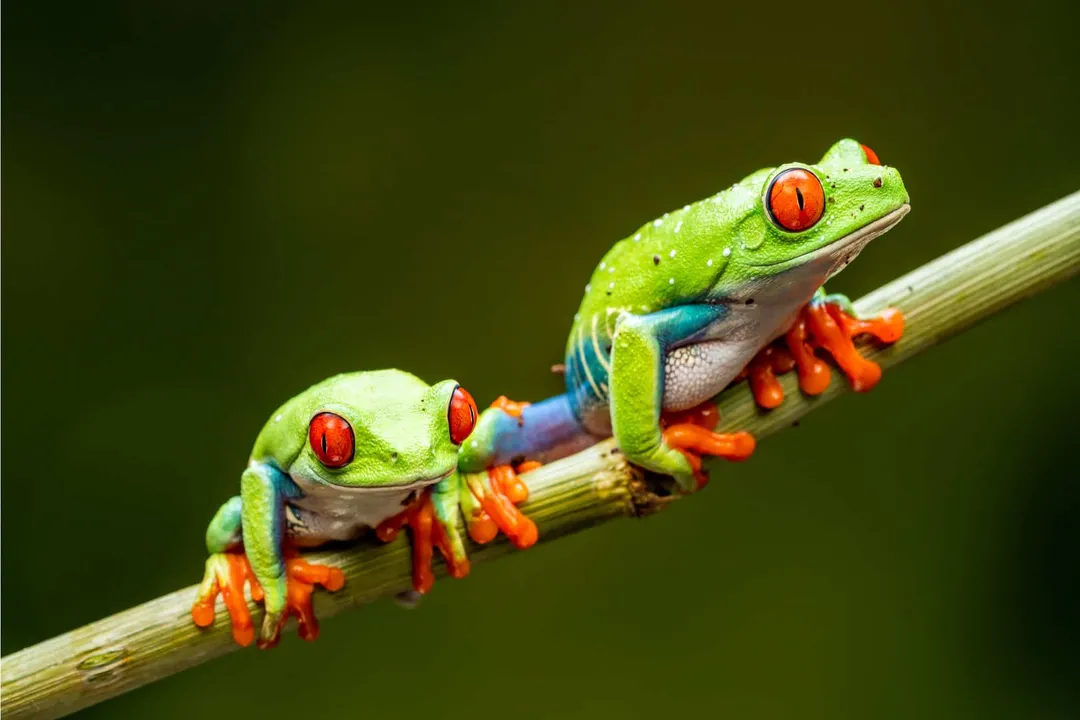
The most fundamental classification starts with the broadest grouping. Agalychnis callidryas belongs to the Kingdom Animalia, [1][2][3][5] placing it among multicellular, eukaryotic organisms that ingest their food. Following this, it is assigned to the Phylum Chordata, [1][2][3][5] a group characterized by having, at some point in their development, a notochord, a dorsal hollow nerve cord, pharyngeal slits, and a post-anal tail. [8] Within Chordata, it falls under the Subphylum Vertebrata, [8] meaning it possesses a backbone or vertebral column.
The next major step in the classification places the frog in the Class Amphibia. [1][2][3][5] This places the red-eyed tree frog among the creatures capable of living both on land and in water, though their lifecycle is intrinsically linked to moisture for reproduction. [4] The defining characteristic of this class is also linked to their need for high environmental humidity, often between 80 and 100 percent, which they require to keep their skin from losing water. [3][4]
The Order is Anura, which simply groups all frogs and toads together—those amphibians characterized by lacking tails in their adult form and possessing powerful hind limbs adapted for jumping (saltatorial locomotion). [1][2][3][5]
# Family and Genus Context

Moving into the finer divisions, the classification reveals more specific evolutionary relationships. The family placement shows slight variations across sources, which is common in taxonomy as scientific understanding evolves, but generally points toward the tree frog lineage. Many sources place A. callidryas within the Family Hylidae, often referred to as the New World Tree Frogs. [2][3][4][5][7] However, other references place it specifically in the Family Phyllomedusidae, or more precisely, within the Subfamily Phyllomedusinae when classified under Hylidae. [4][7] This subfamily grouping is highly relevant because it contains the leaf-breeding frogs, a reproductive strategy central to the life history of A. callidryas. [3][7] The classification suggests that while they share key arboreal traits with other Hylids, like adhesive toe discs for clinging to leaves, [2][5] their reproductive mode ties them closely to the Phyllomedusine lineage. [7]
The frog belongs to the Genus Agalychnis. [1][2][3][4][5][7] This genus contains other tree frogs, and this grouping is defined by specific traits, such as the presence of a red hue in the iris and the golden reticulated palpebral membrane. [7] The name itself offers insight into the animal's appearance: Agalychnis is derived from the Greek words aga ("plenty of") and lychnos ("shining"), perfectly describing its abundance of brilliant, vivid colors. [1]
Finally, the Species name is callidryas. [1][2][3][4][5][7] This epithet, derived from the Greek kallos (beautiful) and dryas (tree nymph), names the frog the "beautiful wood nymph". [1] It is noteworthy that while the scientific name acknowledges its striking beauty, the common perception of its bright colors often mistakenly suggests toxicity, a classic case where nomenclature describes aesthetic quality rather than chemical defense. [4] The species name was first formally assigned by Cope in 1862. [4][8] The species currently has no recognized subspecies. [1]
# Coloration Paradox
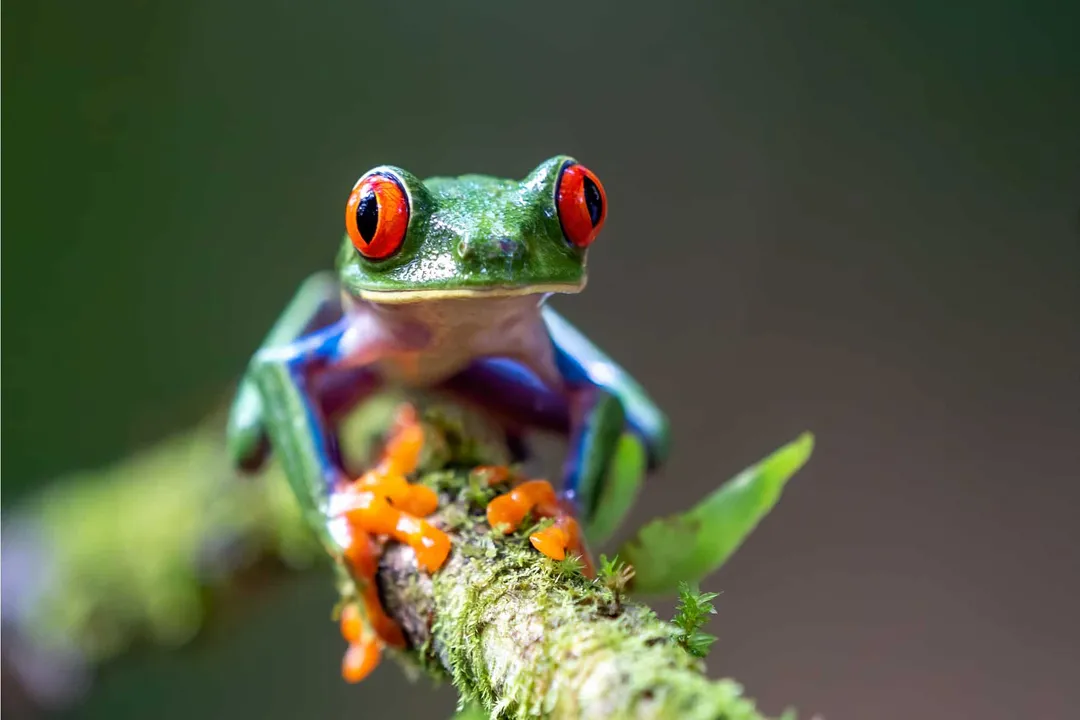
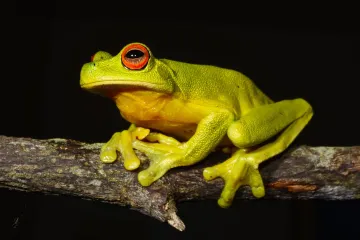
The classification of A. callidryas as a member of the genus Agalychnis places it alongside other conspicuously colored frogs, but its specific defense mechanism highlights a unique evolutionary angle within this group. While many brightly colored amphibians utilize aposematism (warning coloration) to advertise true toxicity, the red-eyed tree frog employs flash coloration. [4] This means the startling red eyes, bright blue and yellow flank stripes, and orange feet are largely hidden when the frog is sleeping against a green leaf. [4][5]
The primary daytime defense is cryptic camouflage—the vibrant green dorsal surface blends into the foliage. [3][4] When disturbed, the sudden opening of its massive red eyes momentarily startles a predator, a behavior known as deimatic display. [6] This momentary paralysis gives the frog a critical second to jump away. [4][6] It is crucial to state clearly: despite its spectacular appearance, A. callidryas is not poisonous or venomous to humans upon touch. [1][4] This contrast between high visibility (flash display) and primary concealment (cryptic camouflage) demonstrates an effective dual strategy, relying on surprise rather than chemical deterrence. [4]
An interesting point of study, related to its visual appearance and classification, involves nutrients. Research indicates that the intake of carotenoids is vital for the wild population, not just for development and fecundity, but specifically to maintain that red eye coloration and skin pigmentation; captive populations often suffer degradation due to inadequate diet. [7] This dependency on external dietary pigments for their defining feature underscores a physiological link to their forest environment that goes deeper than mere habitat preference.
# Distribution and Habitat Classification
The geographic distribution of Agalychnis callidryas anchors its ecological classification as a neotropical species, found in the rainforests stretching from southern Mexico down through Central America and into parts of northern South America, specifically reaching northern Colombia. [3][4][7] This range spans countries like Belize, Costa Rica, Honduras, and Panama. [2][4][7]
Ecologically, the species is strictly arboreal, meaning it spends the vast majority of its life in the trees, rarely descending to the ground as an adult. [2][5] They thrive in humid, tropical rainforests, inhabiting both lowland and premontane slopes, usually up to about 1,250 meters in elevation. [3][4][7] Their existence is intrinsically tied to the availability of water sources, such as ponds, streams, and rivers, because their offspring require water for the aquatic larval stage. [2][3][6] They often shelter on the underside of large, broad leaves during the day, folding their limbs tightly against their bodies to maximize their camouflaged profile. [5][7]
# Life Cycle Adaptations and Reproductive Classification
The reproductive classification of A. callidryas is fascinating and directly influences its taxonomic grouping within leaf-breeding hylids. The species engages in seasonal breeding, timing its activity to coincide with the rainy season, typically between October and March in many regions. [3][4][7] They are iteroparous, meaning they can reproduce in more than one clutch across multiple seasons. [3]
Mating involves the male attracting the female through loud croaking calls and physically shaking the branch—the first evidence that tree-dwelling vertebrates utilize substrate vibrations for communication. [4][7] Competition among males is intense, often leading to wrestling, with the successful male grasping the female in amplexus (a position where the male clasps the female from behind). [2][3][5]
A critical step preceding egg-laying is female hydration. The pair descends to the water so the female can fill her bladder; the jelly mass surrounding the eggs requires significant fluid to form properly and keep the clutch viable. [1][2][7] Following fertilization (which can involve multiple males, confirming polygyny or polyandry depending on how the observation is framed, though one source calls the system polygynandrous), [3][4][7] the female lays her clutch of approximately 40 eggs on the underside of a leaf hanging directly over water. [1][2][3][6] They do not engage in post-fertilization parental care, as the parents depart after the eggs are laid and fertilized. [3]
The most remarkable aspect linking taxonomy to behavior is phenotypic plasticity in hatching. [1][4][7]
- Undisturbed Hatching: Normally, eggs hatch asynchronously between six and ten days post-oviposition, typically after nightfall. [4][7] This delay allows the tadpoles to develop further, maximizing their size and reducing their vulnerability to aquatic predators like shrimp and fish. [7]
- Threatened Hatching: If the embryos sense danger—such as the vibrations from an approaching snake, the presence of predatory wasps, or chemical cues from encroaching fungus—they can initiate a rapid, synchronous, and early hatch. [1][4][7] This behavior is highly specialized; the embryos assess the temporal pattern of vibrations, distinguishing between a predator attack and a non-lethal disturbance like heavy rain. [7]
This strategy forces the newly hatched, nearly helpless tadpole to drop from the leaf into the water below. [7] If the egg falls on dry ground, the tadpole has been shown to survive for up to 20 hours on land while attempting to reach water, showcasing adaptations against desiccation—a factor studied in relation to its nitrogen metabolism and urea production compared to other amphibian lineages. [3][7]
# Defining Features and Status
The physical characteristics that make A. callidryas so recognizable also play a role in its classification and survival. Adults range in size, with females being notably larger, reaching up to 3 inches (7.5 cm), while males are often around 2 inches (5 cm). [4][6][7] Beyond the red eyes, their smooth, leaf-green dorsal skin is complemented by blue and yellow lateral stripes, turquoise upper legs, and bright orange feet. [1][3][5] They possess specialized, moderately large toe discs that function as suction cups, aiding their arboreal existence. [1][2][5]
A detail often overlooked, but critical to their classification as arboreal species, is their specialized limb use. Sources suggest their long limbs make them better climbers than swimmers. [2] Furthermore, they possess a third eyelid, the nictitating membrane, which protects the eye without obstructing vision, allowing them to remain aware even when resting with their eyes closed. [1][2][7]
From a conservation perspective, the red-eyed tree frog is classified by the IUCN Red List as Least Concern (LC), and it is listed under CITES Appendix II. [1][4][7] While the species itself is relatively plentiful and tolerant of some habitat modification, such as selective logging, its essential rainforest habitat faces constant pressure from deforestation, disease (like ranavirus), and capture for the international pet trade. [6] The fact that amphibians, including this species, show effects of pollution earlier than many other vertebrates grants them significant ecological importance as sensitive indicator species for environmental health. [2][6]
To summarize the key classifications, a comparative view helps solidify its identity:
| Taxonomic Rank | Classification | Key Trait Association |
|---|---|---|
| Kingdom | Animalia | Multicellular, heterotrophic |
| Class | Amphibia | Requires moisture; ectothermic |
| Order | Anura | Tail-less adult; jumping locomotion |
| Family/Subfamily | Hylidae / Phyllomedusinae | New World Tree Frogs; Leaf-breeding strategy |
| Genus | Agalychnis | "Shining plenty"; arboreal habits |
| Species | A. callidryas | "Beautiful wood nymph"; distinctive red eyes |
Ultimately, the classification of Agalychnis callidryas is a story of adaptation. It sits firmly within the tree frog lineage due to its adhesive digits and arboreal life, but its reproductive specialization—laying non-amniotic eggs on leaves over water, coupled with its sophisticated vibration-sensing embryos—confirms its specific placement in the Phyllomedusinae subfamily. This system allows us to appreciate how a creature described scientifically as a "beautiful wood nymph" has evolved such complex, high-stakes methods to survive the threats within its dazzling, yet precarious, humid world. [1][7]
Related Questions
#Citations
Agalychnis callidryas - Wikipedia
Red-eyed tree frog - The Dallas World Aquarium
Agalychnis callidryas (Rana-de árbol ojos rojos) | INFORMATION
The Red-Eyed Tree Frog - Lamar University
Agalychnis callidryas - AmphibiaWeb
Red-Eyed Tree Frog | Rainforest Alliance
Agalychnis callidryas - NCBI
Red-Eyed Tree Frog - Agalychnis callidryas - A-Z Animals
Red-eyed Tree Frog (Agalychnis callidryas) - World Land Trust