Was Amargasaurus a titanosaur?
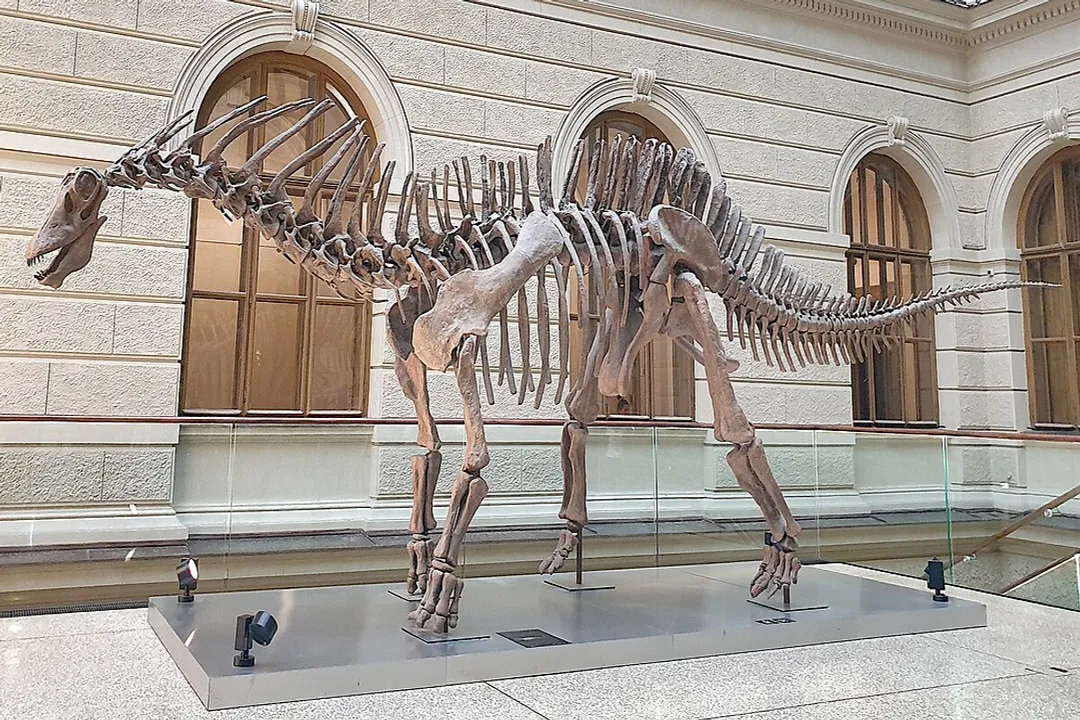
The sight of Amargasaurus cazaui immediately sparks debate, not just about its bizarre neck ornamentation, but about where this creature fits within the vast, long-necked world of the dinosaurs. This distinct sauropod, instantly recognizable by the twin rows of elongated spines running down its neck and back, is often casually grouped with other massive herbivores. For many enthusiasts, the default category for any large sauropod from the Cretaceous period tends to be Titanosauria. However, a closer look at the anatomical evidence and its placement within the dinosaur family tree reveals a more nuanced, and ultimately definitive, answer: Amargasaurus was not a titanosaur. [2][9] It represents a different, highly specialized lineage within the larger sauropod group.
# Sauropod Diversity
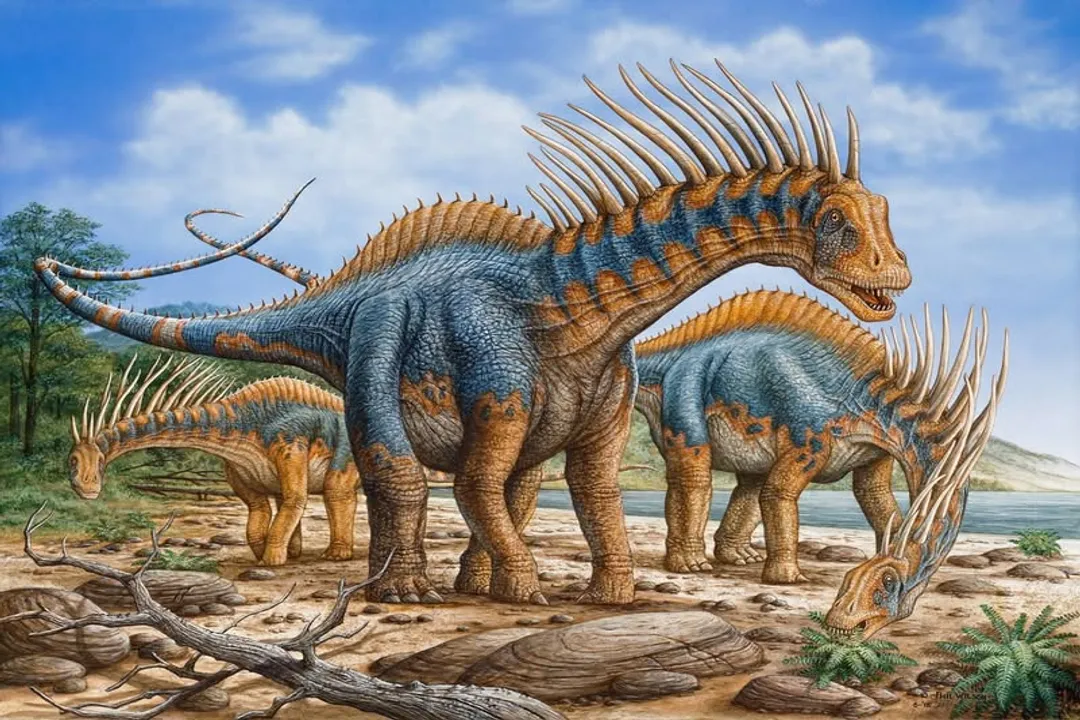
To understand why Amargasaurus falls outside the titanosaurs, one must first appreciate the branching complexity of the sauropods—the dinosaurs characterized by their immense size, long necks, and pillar-like legs. Sauropoda is generally divided into several major clades, two of the most prominent being Diplodocoidea and Titanosauria. [2]
Titanosaurs form one of the most successful and diverse groups of sauropods, flourishing across the globe during the Cretaceous period. [7] They are famous for producing some of the largest land animals ever known, such as Argentinosaurus and Patagotitan. Titanosaurs are generally characterized by robust builds, broad torsos, and distinct vertebral structures, particularly in the tail and hips. [2]
Amargasaurus, on the other hand, belongs firmly within the clade Diplodocoidea. [2][9] This group includes the more slender, whip-tailed sauropods like Diplodocus and Apatosaurus. More specifically, Amargasaurus is nested within the family Dicraeosauridae. [2] This family is known for its shorter necks relative to their Diplodocid cousins and, most notably, for possessing the characteristic tall neural spines that Amargasaurus took to an extreme. [2] The difference is fundamental: Titanosauria and Diplodocoidea are generally considered sister groups, meaning they split off from a common ancestor earlier in sauropod evolution, making a titanosaur classification for Amargasaurus impossible based on current cladistics. [2]
# Spine Structure
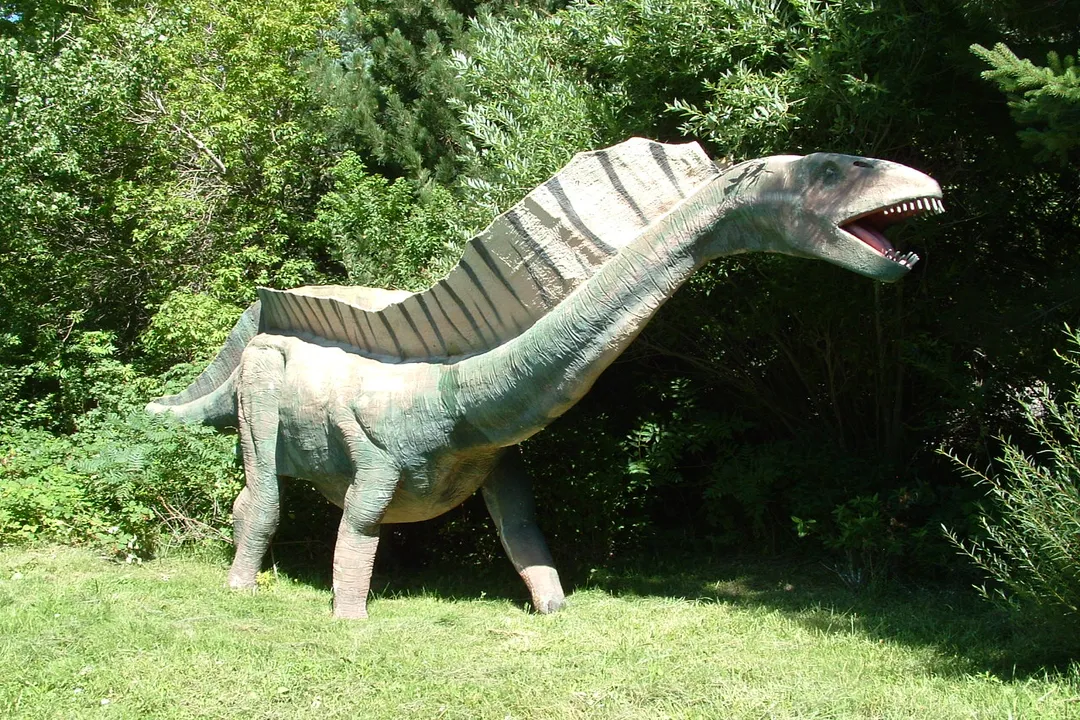
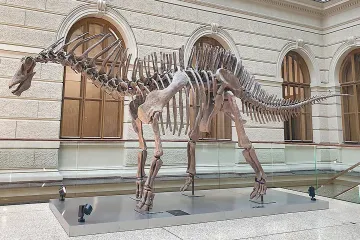
The most striking feature of Amargasaurus is, without question, its array of tall neural spines extending from the vertebrae of its neck and anterior back. [9][8] These spines, particularly those over the neck, could reach heights of over 60 centimeters, sometimes exceeding the length of the vertebral body itself. [2] This morphology is the key piece of evidence separating it from its titanosaurs relatives.
In the context of its own family, the Dicraeosauridae, having tall spines is a shared trait, but Amargasaurus represents an evolutionary exaggeration of this feature. [2] The spines are bifurcated, or dicraeosaurid, meaning they split into two branches toward the top, a feature shared with other members of its immediate family like Dicraeosaurus. [2]
Titanosaurs, in stark contrast, have vertebrae that are generally more specialized for weight-bearing and flexibility, often featuring internal pneumatic cavities (air sacs) to lighten the massive structure, but they lack the towering, bifurcated neural spines seen in Amargasaurus. [2] While some primitive titanosaurs might have had slightly elevated spines, nothing approaches the extreme elongation seen in this specialized South American sauropod. [2] Think of it this way: if sauropods were a modern group of large vehicles, Titanosaurs would be heavy-duty tractor-trailers built for sheer capacity, whereas Amargasaurus would be a highly specialized, perhaps armored, utility vehicle built for a very specific, niche job, defined entirely by those prominent structural spikes. [8]
# Discovery Context
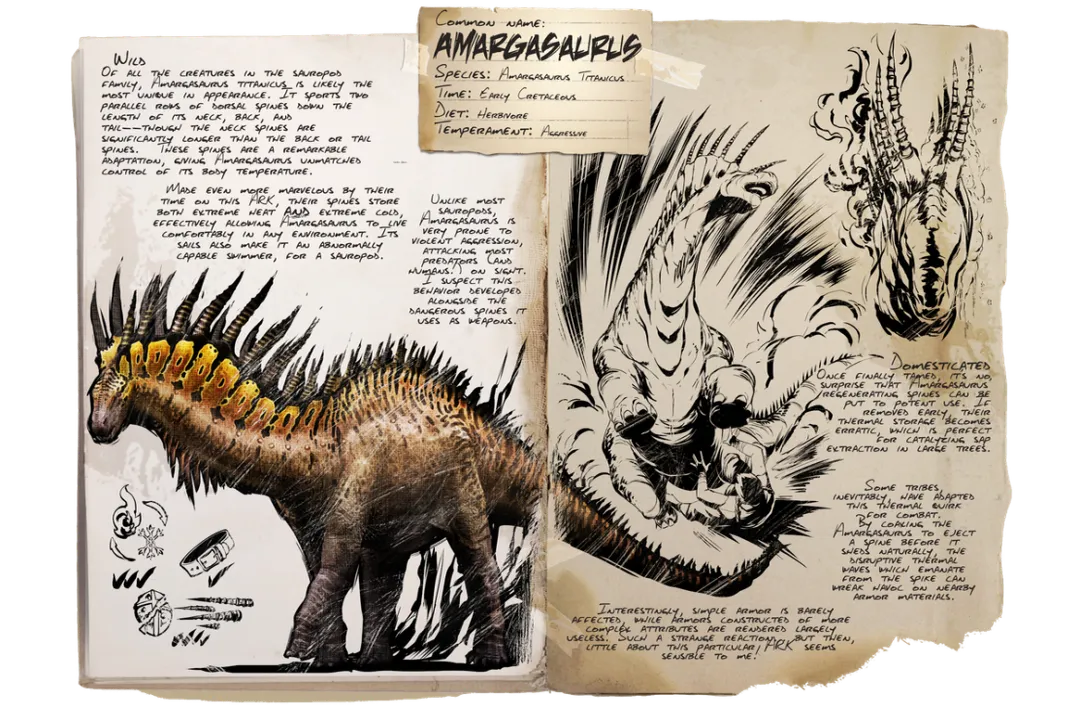
The fossils of Amargasaurus were unearthed in the famed Amarga Formation of the Neuquén Province in Argentina. [9][2] This geological layer dates to the Early Cretaceous period, specifically the Barremian to Aptian stages, roughly 129 to 122 million years ago. [2] This time frame is significant because, while titanosaurs were certainly present and beginning their long reign in South America during the Early Cretaceous, Amargasaurus fossil evidence firmly places it alongside other sauropods known from the same geological setting that are clearly not titanosaurs, such as early rebbachisaurids. [2]
While titanosaurs eventually became the dominant large herbivores globally, the specific environment that produced Amargasaurus also contained evidence of other, more primitive diplodocoid forms. [2] This suggests that early in the Cretaceous, the supercontinent Gondwana hosted a mixed assemblage of sauropod groups before the titanosaurs achieved complete dominance later in the period. [2] Amargasaurus's existence helps paleontologists map out the diversification and distribution of Diplodocoidea outside of their better-known Late Jurassic North American strongholds.
# Size Comparison
The term "Titanosaur" often conjures images of truly gigantic animals, and while the group contains many giants, Amargasaurus was notably modest by comparison. [2] While exact estimates vary based on the reconstruction methods used, Amargasaurus is generally reconstructed as measuring around 9 to 10 meters in length. [9][2] This places it firmly in the mid-to-small range for a sauropod, especially when considering that many titanosaurs easily surpassed 25 or 30 meters. [7]
If we place the known skeletal material into a simple comparison matrix, the divergence becomes clearer:
| Feature | Amargasaurus | Representative Titanosaur (e.g., Argentinosaurus) |
|---|---|---|
| Estimated Length | meters [2][9] | $> 30$ meters (some estimates) [7] |
| Taxonomic Group | Dicraeosauridae (Diplodocoidea) [2] | Titanosauria (Sauropoda) [7] |
| Vertebral Spines | Extremely tall, bifurcated [2][8] | Generally low, robust for support [2] |
| Geographic Origin | Amarga Formation, Argentina [9] | Widespread, but massive forms often Gondwanan [7] |
It is fascinating to consider that in the same ancient environment, creatures ranging from the slender, spike-necked Amargasaurus to potentially massive titanosaurs coexisted, occupying different ecological niches, perhaps browsing on different vegetation heights or consuming different quantities of food to sustain their mass. [9] This level of niche partitioning among large herbivores is a testament to the specialization that occurred in Gondwanan ecosystems. [2]
# Distinguishing Features
Beyond the spines, other skeletal characteristics confirm Amargasaurus's placement outside Titanosauria. Diplodocoids, including Dicraeosaurids, generally have vertebrae that are relatively narrow side-to-side (pleurocoels) compared to the wide, robust centra of most titanosaurs. [2] Furthermore, the structure of the pectoral girdle and the limbs often shows subtle but consistent differences that paleontologists use in cladistic analysis to separate the major sauropod clades. [2]
The sheer distinction in the spine morphology is so profound that it serves as an immediate taxonomic marker. Imagine trying to classify a modern deer versus a moose; both are cervids, but the antlers of the moose are a defining feature that places it clearly outside the lineage that produced the smaller, spike-antlered species. Similarly, the extreme neural spines of Amargasaurus anchor it firmly to the Dicraeosaurid branch of Diplodocoidea. [2] While we may not know the exact function of those spines—whether for display, defense, or thermoregulation (as a sail-like structure for heating or cooling)—their presence dictates its family assignment. [8] If the spines were primarily for heat exchange, the sheer surface area would suggest a need to rapidly regulate body temperature, perhaps indicating that Amargasaurus, despite being a sauropod, experienced environmental temperature swings that its larger, more insulated titanosaur cousins did not face to the same degree.
Therefore, every piece of anatomical evidence, from the shape of its individual vertebrae to its overall body plan, points away from the Titanosauria group. Amargasaurus stands as a magnificent example of specialized evolution within the Diplodocoidea, perfectly adapted to its Early Cretaceous world, but evolutionarily distinct from the broad-shouldered titanosaurs that would later dominate the Cretaceous landscape. [2][9] It is a Diplodocoid cousin that took an evolutionary path marked by dramatic, towering sails along its spine, a feature entirely absent in the Titanosaur lineage. [2]
#Videos
A new huge titanosaur, Amargasaurus sails, and Hans Sues
Related Questions
#Citations
Amargasaurus | Jurassic World Evolution Wiki - Fandom
Amargasaurus - Wikipedia
So I'm curious, what dinosaur do you find the most fascinating? Mine ...
Amargasaurus : r/Dinosaurs - Reddit
Amargasaurus - ARK Official Community Wiki
A new huge titanosaur, Amargasaurus sails, and Hans Sues
Titanosaurus | Jurassic Park Wiki - Fandom
Amargasaurus | Research Starters - EBSCO
Amargasaurus - Dinosaur Park