What is classified as the gorilla group?
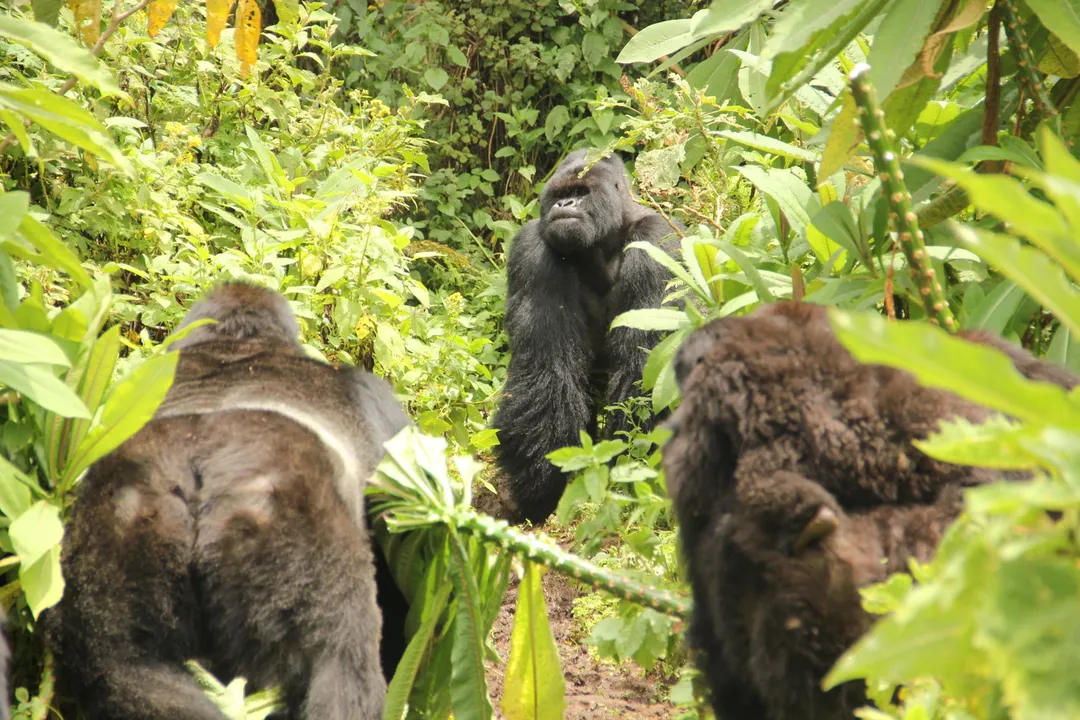
The social world of gorillas is organized around distinct family units, which researchers often refer to as a troop, band, or sometimes simply a family. [6][8] These terms describe the fundamental social classification of these great apes, who live primarily in the tropical forests of equatorial Africa. [9] While gorillas are known for their immense size and strength, their social organization is nuanced, varying significantly depending on the subspecies and the local environment. [1] Understanding what defines a "gorilla group" means looking beyond a simple headcount and examining the roles, movement, and continuity of its members. [1][4]
# Group Terminology
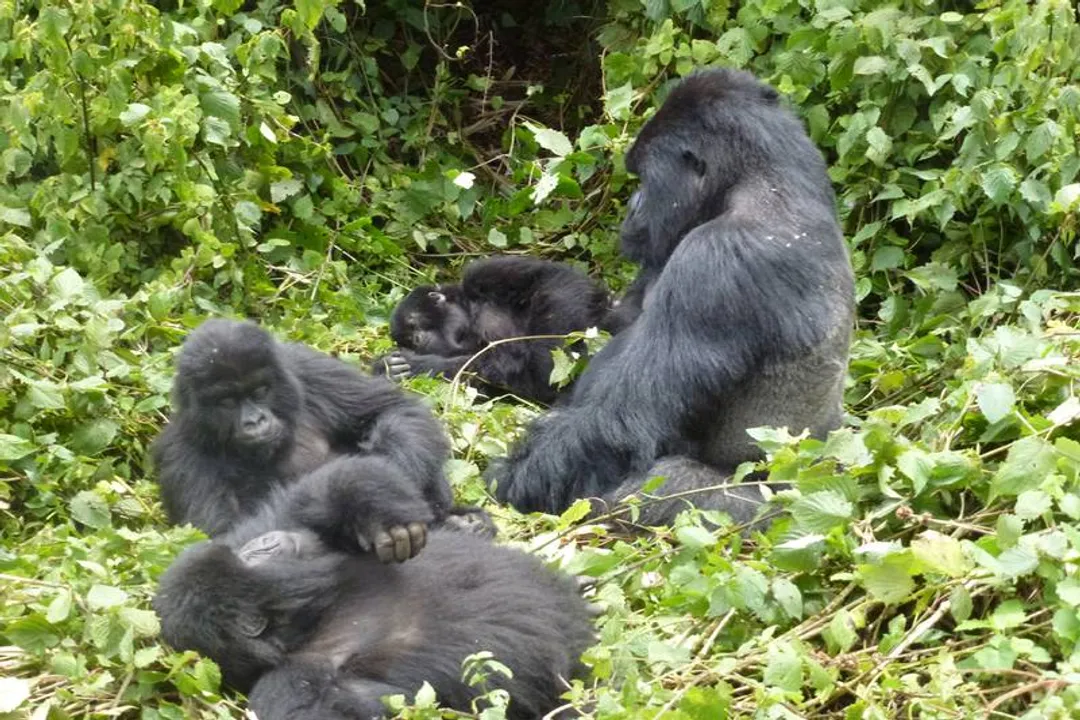
The most widely accepted names for a collective of gorillas are troop or band. [6][7] These groups are centers of social life, and their activities—feeding, traveling, and resting—are highly synchronized across the group members. [7] The composition is generally defined by a dominant leader and his accompanying females and offspring, giving rise to the common description of the group as a family unit. [5][6]
# Typical Structure
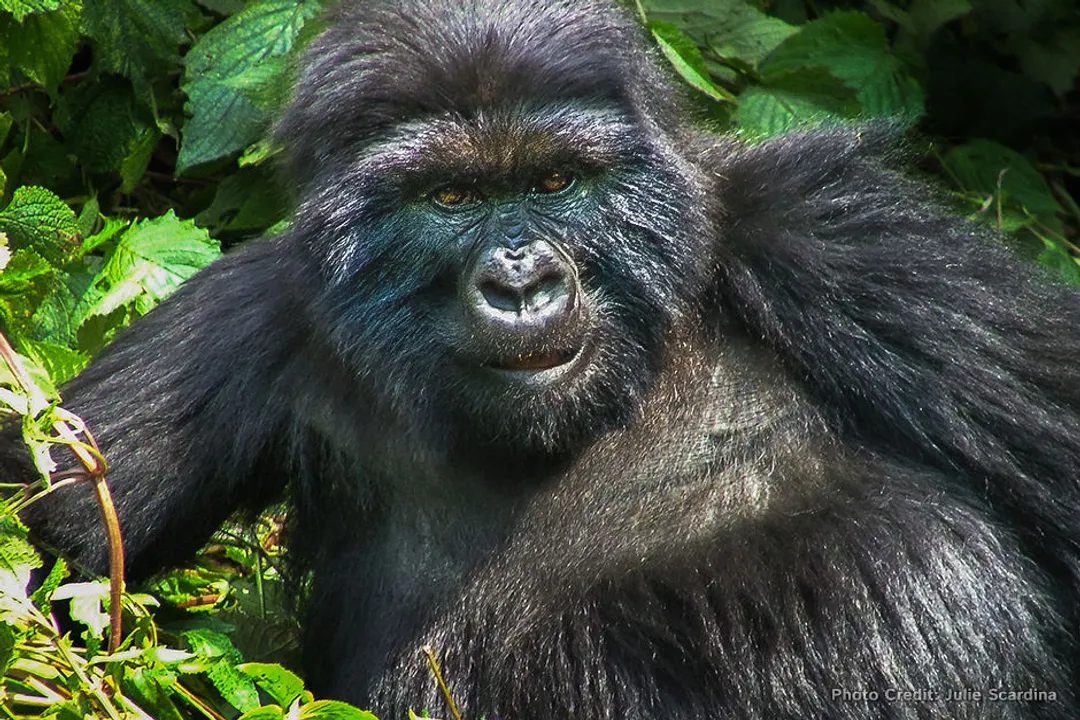
In the most common configuration across various subspecies, the core of the group is the single, mature adult male, the silverback. [5][7] He presides over a harem typically comprising several adult females—often three to six—and their dependent young. [5][7] In addition to the females and offspring, younger males who have not yet developed their silver saddle marking, known as blackbacks, may also be present. [7]
Group size is remarkably flexible. While the average size often settles around ten to twelve individuals, observed groups range widely, sometimes featuring as few as two individuals, or stretching to a massive sixty-five members. [1][4][9] The environment plays a strong role in determining this size. For example, Western lowland gorillas, who rely heavily on fruit found in small, scattered patches, tend not to form very large groups. [1] Conversely, Eastern gorillas, particularly Mountain gorillas living in high-altitude forests rich with abundant, distributed terrestrial vegetation, can sustain much larger aggregations. [1][4]
# Subspecies Differences
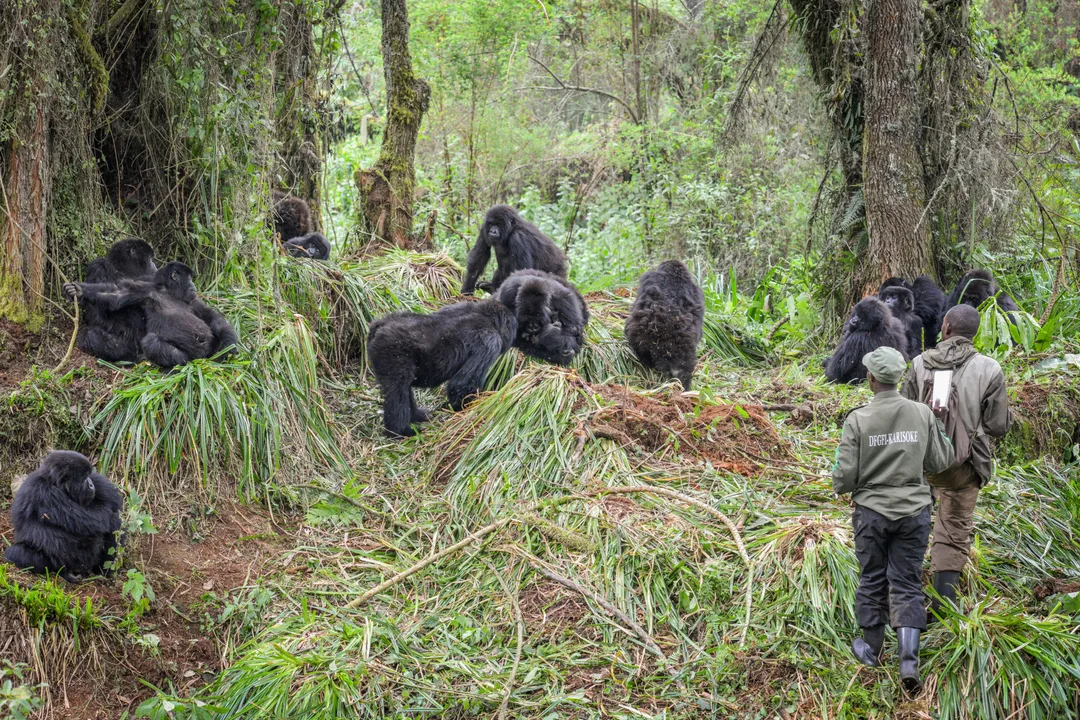
The social architecture shifts notably between the species. Western lowland gorillas typically maintain smaller breeding groups, rarely surpassing about ten adult females. [1] Eastern gorilla groups, which include Mountain gorillas and Grauer's gorillas, exhibit greater variability and can often support larger numbers. [1]
The presence of multiple adult males is a key differentiator. While a single dominant silverback leads most groups, larger Eastern gorilla groups frequently include more than one silverback, especially among Mountain gorillas, where groups can host up to eight. [1][4] These multi-male setups are less common in Grauer's gorillas. [1] For observers or researchers tracking these animals, noting the subspecies is vital context for understanding group size; for instance, a 20-individual Western lowland group is exceptionally large, whereas a 20-individual Mountain gorilla group is fairly standard, reflecting their differing dietary bases and resulting social flexibility. [1][9] This variation in social structure is a critical focus for understanding gorilla social evolution. [1]
# Bachelor Societies
Not all male gorillas live within breeding units. Young males reaching maturity, or even older solitary silverbacks, may form or join an all-male bachelor group. [3][4][7] These groups consist solely of males and are generally less stable than breeding troops, with their membership changing more frequently. [1] For the younger males, known as blackbacks before they attain silver status, joining such a group offers a place to learn necessary leadership skills, such as determining travel routes and resting spots, before they attempt to establish their own harem. [1][4]

# Leadership Roles
The silverback is the undisputed center of the troop, bearing the weight of leadership and security. [5][7] His responsibilities are extensive: he makes nearly all group decisions, directs movement toward feeding sites, and is tasked with the protection of every member. [7] His dominance is enforced through formidable displays like chest-beating, charging, and throwing vegetation, though researchers observe that the vast majority of charges are bluffs intended to intimidate rivals or intruders. [1][7]
While he typically holds exclusive breeding rights to the troop's females, [6][7] this is not always absolute. In multi-male groups, subordinate silverbacks may sire a small percentage of offspring, sometimes through stealth, or because the dominant male tolerates them in exchange for added protection against external threats. [1][5] The silverback's strength and physical presence, such as a prominent crest, often correlate with the number of females he maintains in his group, as females evaluate potential mates during group encounters. [1]
# Female Life
Gorilla social life revolves around the bond between the silverback and his females. [7] Females have remarkable autonomy regarding group membership. They typically emigrate from their birth group upon reaching sexual maturity (around age eight) to avoid inbreeding, often joining a solitary male or an existing troop. [1][5][7] Moreover, females are not locked into their second group; secondary transfers are common throughout their lives, potentially resulting in offspring fathered by several different males. [4][5]
Within a group, females establish a hierarchy. Status can be influenced by age, how long they have been with the group, or, crucially, their current reproductive state. [4][5] The female caring for the youngest, most vulnerable infant usually commands the highest rank because her offspring requires the silverback’s most direct protection. [5] This competition for male attention means that non-related females often display aggression toward one another, while those who are maternally related tend to exhibit friendlier associations. [7]

# Group Lifespan
The longevity of a gorilla group is tied directly to the survival of its dominant male and the resource landscape of its habitat. [1] In Western lowland gorilla groups, which tend to be structured around a single breeding male, the group generally disbands if the silverback dies, as the females and offspring disperse to join other males or solitary silverbacks. [1][3]
However, in many Mountain gorilla groups, particularly those containing multiple males (often the leader's sons), the group remains cohesive when the dominant silverback dies. [1] A subordinate silverback, often a relative, steps up, allowing the group to "perpetuate" its lineage and stability over decades. [1][4] The difference in food availability seems to drive this divergence: consistent, abundant forage in the high-altitude Eastern habitats allows a large group to persist under a new leader, whereas the fruit-dependent Western groups might fragment if resources are insufficient to support a continued large unit without the primary decision-maker. [1] Observing these group dynamics provides crucial data that informs conservation strategies aimed at anticipating demographic impacts from threats like disease. [1]
When two groups meet, the silverbacks engage in intense displays, often serving as a way for the leader to "seduce" females from the neighboring group to transfer, a choice made entirely by the females themselves. [1] For a young male gorilla in a multi-male group, the decision to disperse or stay and queue for dominance is a finely balanced survival calculation; staying might offer protection, but if too many subordinate males are present, mating chances drop significantly, making dispersal the only viable path to reproduction. [1]
Related Questions
#Citations
5TF: 5 Things About Gorilla Social Groups
Social Structure - Dutch Gorilla Foundation
Gorilla Group Social Structure - National Zoo
Gorilla groups usually feature one dominant silverback. More rarely ...
All About the Gorilla - Behavior | United Parks & Resorts
What is a group of gorillas called? - Great Adventures Safaris
What Is a Group of Gorillas Called? Troop, Band, or Family Explained
Gorilla Group Formation and Dynamics
Gorilla - Wikipedia