What family is the tree-kangaroo in?
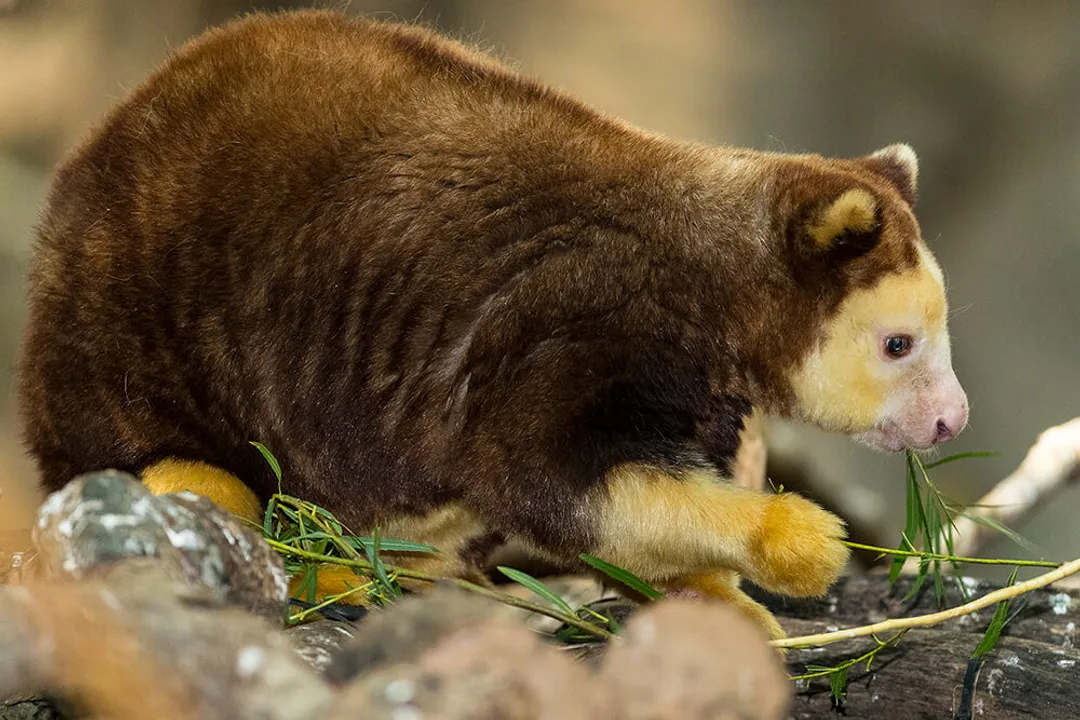
The arboreal marsupials known as tree-kangaroos fall squarely within the Family Macropodidae. This placement immediately establishes their close relationship with the more familiar ground-dwelling kangaroos and wallabies. While this shared family designation, which translates literally to "big foot," might suggest uniformity, the tree-kangaroo genus, Dendrolagus, represents a remarkable divergence from the hopping plains dwellers. They are, in fact, the only macropods that have successfully adapted to a life spent almost entirely in the canopy of tropical rainforests across New Guinea, northeastern Australia, and some Indonesian islands. This adaptation to an entirely different niche—the dense, three-dimensional world of the treetops—is what makes understanding their broader family classification so interesting; it’s a tale of divergence from a common ancestor that was itself likely arboreal.
# Family Placement
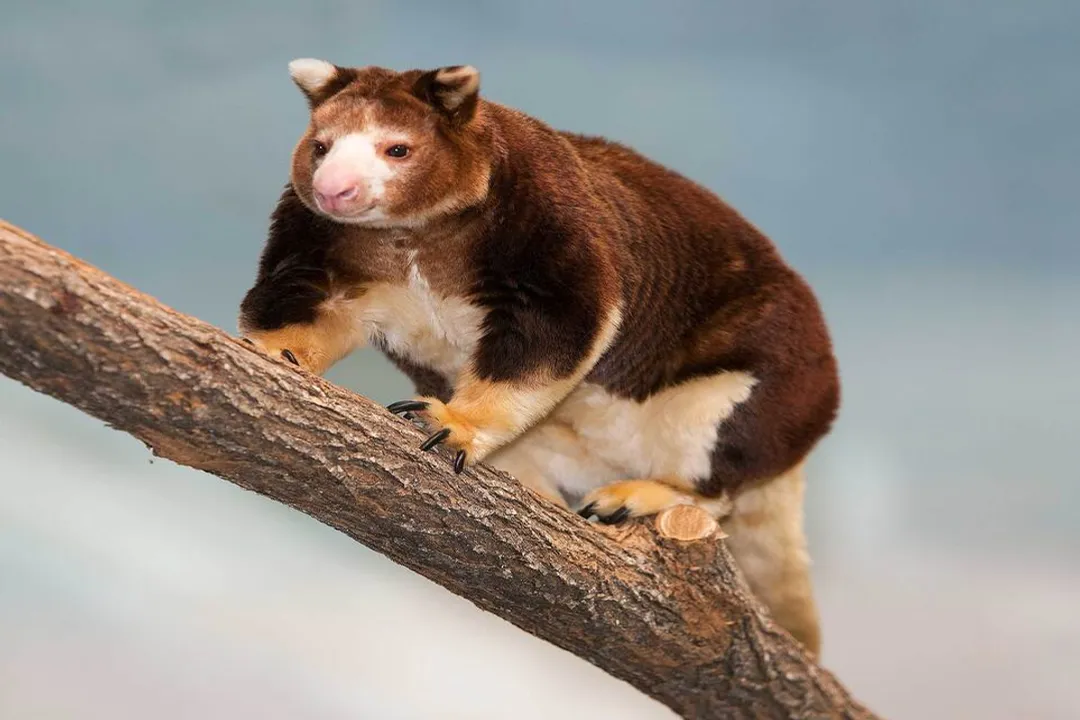
To place the tree-kangaroo precisely, we look up the taxonomic hierarchy. Tree-kangaroos are classified in the Order Diprotodontia, a large group of Australian marsupials characterized by having only two prominent incisor teeth protruding from the front of their lower jaw—the name itself meaning "two forward teeth". This order encompasses a wide range of seemingly disparate creatures, including possums, wombats, and koalas, alongside the macropods. Within this order sits the Family Macropodidae, which unites the tree-kangaroos with their terrestrial cousins.
The defining characteristic that separates the tree-kangaroos from the rest of the Macropodidae is their lifestyle: Dendrolagus is the only genus in the family that is truly arboreal. While the general macropod traits include strong hindlimbs and long tails, the selective pressures of living high above the forest floor have dramatically reshaped the tree-kangaroo body plan. Unlike their ground-based relatives who rely on powerful bipedal hopping for speed across open ground, tree-kangaroos have evolved specialized anatomy for climbing, gripping, and balancing among branches. This divergence within the same family highlights the incredible plasticity of mammalian evolution when isolated in unique environments.
# Canopy Mechanics
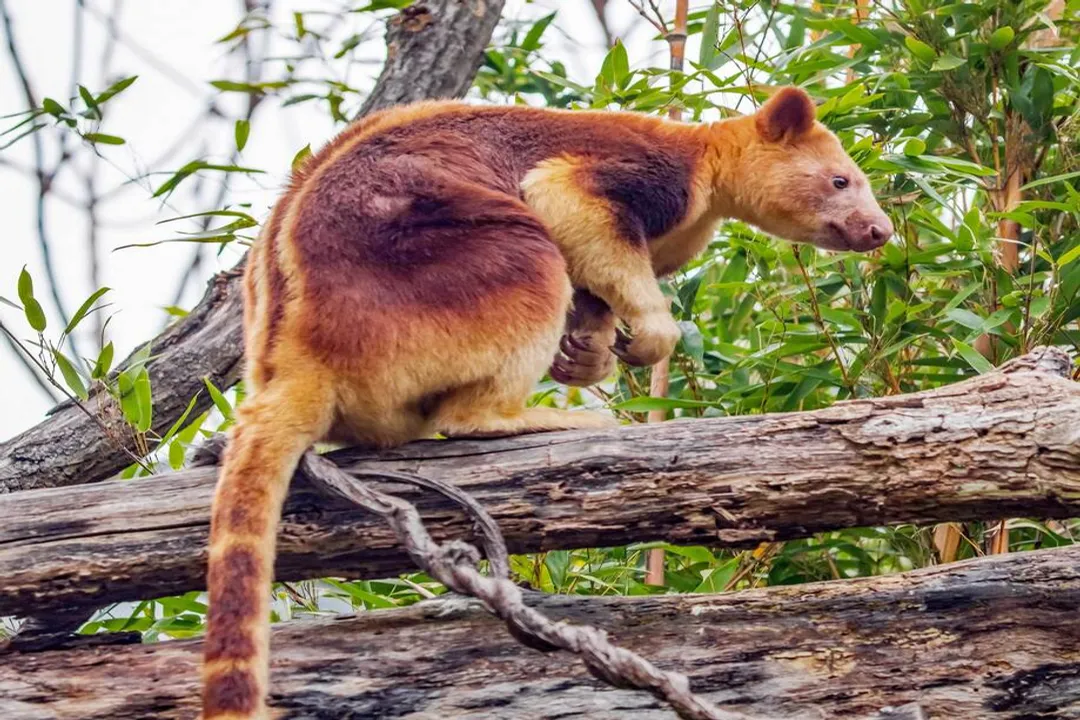
The physical distinctions between a tree-kangaroo and a ground kangaroo are striking indicators of this evolutionary separation, even though they share the same family lineage. Terrestrial kangaroos possess disproportionately large hind legs suited for their bounding locomotion. Tree-kangaroos, conversely, have forelimbs that are longer and stronger, nearly matching the length of their hind legs. This modification shifts their balance and locomotion mechanics significantly for climbing.
Consider the specialized gripping surfaces. While terrestrial kangaroos use their feet for propulsion, tree-kangaroos sport longer, broader hind feet equipped with long, curved claws designed to hook into bark. Furthermore, both their forepaws and hind feet have rough-textured pads and spongy soles, providing enhanced grip. An astonishing feature is their dexterity; they can grasp stems between two fingers and possess wrists flexible enough to bend sharply. This ability to move their forepaws with such complexity is rare among non-primates, shared only by species like the brown rat and the northern quoll. In a fascinating contrast to terrestrial forms, tree-kangaroos can also move their hind legs independently, allowing them to walk or maneuver in ways terrestrial kangaroos cannot.
The tail is another major differentiator. For ground kangaroos, the long tail acts as a crucial fifth appendage during balancing acts on the ground. For the tree-dwelling members of Macropodidae, the tail remains long but has evolved to serve primarily as a counterbalance in the canopy, aiding stability on narrow branches. A final, perhaps less obvious, adaptation concerns thermoregulation. Tree-kangaroos, like other kangaroos, do not sweat to cool down; instead, they lick their forearms to utilize evaporative cooling. However, specific species, like Matschie's tree-kangaroo, have an added feature: fur on their neck and back grows in the reverse angle of the rest of their coat, which helps shed water when they crouch during rain, a necessary feature for an animal that spends so much time exposed in damp cloud forests.
# Ancestral Origins
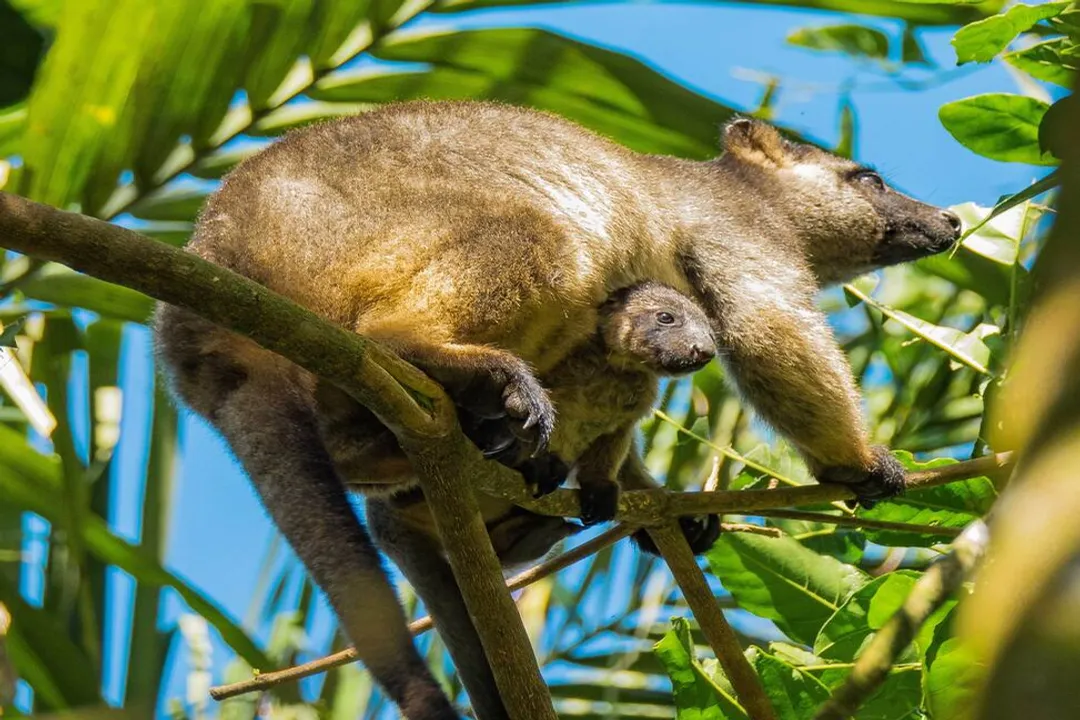
The story of how a "big foot" animal returned to the trees is tied to the geological and climatic history of the Australian and New Guinean continents. The evolutionary trajectory suggests that all macropodids originated from an ancestor that lived in trees, possibly an arboreal possum-like creature, about 50 million years ago. Evidence of this distant past remains in the Musky rat-kangaroo, considered the most primitive kangaroo, which retains a "thumb-like" toe reminiscent of a possum's foot.
As the climate shifted and dried during the late Eocene, rainforests retreated, forcing pademelon-like ancestors into rockier, drier environments, potentially leading to the evolution of rock-wallabies (Petrogale spp.). These rock-wallabies, being generalists, eventually encountered introduced Malesian rainforest types in Australia and adapted to spend more time climbing. One species, the Proserpine rock-wallaby, shows an equal preference for both trees and rocky outcrops, suggesting a stage on the path to full arboreality. A critical step was the evolution of the now-extinct genus Bohra from these semi-arboreal rock-wallabies during the Late Miocene. When global cooling caused further rainforest contractions during the Pleistocene, populations of Bohra became isolated in fragments, leading to the specialization seen today in the genus Dendrolagus. The ancestor of the modern tree-kangaroo is thought to have emerged around 7.5 million years ago, radiating into the present species over the last 7 million years. Thus, the tree-kangaroo's return to the canopy represents a fascinating case of evolutionary reversion within its own family lineage.
# Species Distribution
The genus Dendrolagus currently comprises about 14 recognized species, distributed across the rainforests of Papua New Guinea, far northeastern Queensland (Australia), and surrounding islands. These species exhibit noticeable differences in size, coloration, and slight adaptations based on their specific regional habitats, ranging from lowlands to montane cloud forests up to 11,000 feet in elevation.
A key division in the genus separates the Australian species from the majority found in New Guinea and Indonesia. The two Australian species, Lumholtz's tree-kangaroo (D. lumholtzi) and Bennett's tree-kangaroo (D. bennettianus), are considered more basal or primitive within the genus, partly due to their comparatively long feet.
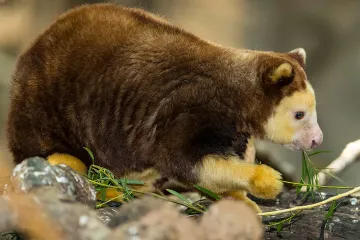
In contrast, New Guinea hosts the majority of species, including the striking Matschie's tree-kangaroo (D. matschiei), known for its reddish-mahogany back and yellow limbs, endemic to the Huon Peninsula. Goodfellow's tree-kangaroo (D. goodfellowi) is recognized by its double pale stripes down its back.
For instance, while Matschie's tree-kangaroos are found in mid-montane to upper-montane cloud forests, Goodfellow's occupies dense tropical forests from sea level up to nearly 10,000 feet. It's noteworthy that while the Australian species have relatively well-studied habitat use in Queensland, many of the New Guinean species are elusive, leading to the tragic situation where some, like the Wondiwoi tree-kangaroo, have been feared extinct until recently rediscovered. The variations within Macropodidae, seen across these geographical boundaries, offer a live comparative study in adaptation; if one were to map the average maximum elevation tolerance for each species, you would likely find a clear trend, with the higher-altitude specialists having evolved more compact bodies and denser fur to cope with cooler mountain conditions, though the sources suggest that some species, like Bennett's, utilize lowland coastal areas as well.
# Canopy Lifestyle
Tree-kangaroos exhibit significant behavioral differences from their ground cousins, largely dictated by their habitat. They are generally described as solitary animals. In the wild, social interactions are minimal, typically occurring only for mating. Home ranges, particularly for females, are small—averaging around 4.5 acres for Matschie's—and often overlap with those of one or more males. While Lumholtz's social structure is sometimes described as loose reproductive units or "harems" consisting of a resident male and several females, actual close contact is rare outside of courtship and mating.
Their movement is slow and clumsy on the ground, akin to a human walking pace, but they are bold and agile in the trees, using a hop-climb motion assisted by their powerful hind legs. Furthermore, they are expert leapers, capable of descending from heights of 59 feet or more without injury.
Dietary habits further distinguish them. Tree-kangaroos are primarily folivorous (leaf-eaters). They browse on leaves from various forest trees, supplemented by fruits, orchids, and bark. They are classified as foregut fermenters, a digestive strategy that allows them to process large quantities of low-nutrient leaves, similar to cows or deer, an unusual trait among arboreal marsupials. They avoid eucalyptus foliage, which is indigestible to them, unlike possums and koalas who are hindgut fermenters. In captivity or occasionally in the wild, some species may supplement this with small amounts of animal protein like bird eggs.
Regarding activity, while historically thought to be strictly nocturnal, recent research on Lumholtz's tree-kangaroo suggests their pattern is actually cathemeral, meaning they are intermittently active throughout the 24-hour period, taking short sleeping bouts of up to an hour in the branches. Tree-kangaroos are known to spend a significant portion of their day resting—Matschie's spend about 60% of the time sleeping, curled up in a tree. This conserved energy expenditure makes sense given their low-nutrient, leaf-heavy diet.
# Reproduction Notes
As marsupials within Macropodidae, tree-kangaroos share the fundamental reproductive characteristic of giving birth to an extremely underdeveloped young, called a joey, which then completes development in the mother's pouch. However, in terms of reproductive timing, tree-kangaroos are somewhat unique among marsupials.
Gestation periods are relatively short but distinct across species—for instance, Matschie's tree-kangaroo has a gestation of about 40 to 45 days, noted as the longest among known marsupials at the time of that data collection, though Goodfellow's is cited with 21 to 38 days. After birth, the tiny joey, sometimes only an inch long, crawls unaided to the pouch. It latches onto a teat and remains inside for a prolonged period, often 8 to 10 months. Even after emerging, the joey will continue to return to nurse for another month or two, resulting in a total period of maternal dependence that is among the longest for marsupials. For Matschie's, weaning occurs around one year after birth, after which the young disperse to establish their own solitary ranges. Sexual maturity is reached between two and four and a half years, depending on the sex.

# Threats and Preservation
Despite their remarkable adaptations and belonging to a well-known family, all tree-kangaroo species are considered threatened. The two primary drivers of population decline are habitat destruction and hunting.
Tree-kangaroos inhabit fragile tropical rainforests, which are frequently targeted for logging, agriculture (such as coffee, rice, and wheat production), and infrastructure development. As trees are cleared, the animals lose both shelter and their primary food sources, simultaneously becoming more exposed to predators like feral dogs. Research on Lumholtz's tree-kangaroo in Australia indicated that vehicle strikes and dog attacks were significant causes of death for the surviving populations. In New Guinea, hunting for meat remains a substantial threat, with the successful hunt of a tree-kangaroo sometimes viewed as a significant achievement by local hunters.
Conservation initiatives are attempting to stabilize populations. The IUCN Red List classifies species across the spectrum, from Near Threatened to Critically Endangered. For example, Matschie's tree-kangaroo is listed as Endangered, with estimates suggesting fewer than 2,500 adults remain in the wild. Zoological institutions participate in Species Survival Plans (SSPs) to maintain genetically diverse captive populations. A crucial on-the-ground effort involves partnering with local communities to protect land, such as the YUS conservation area in Papua New Guinea, which secures habitat for Matschie's tree-kangaroos and other endemic wildlife. The fate of these specialized members of the Macropodidae family truly hinges on preserving the integrity of the remaining tropical canopy.
Related Questions
#Citations
Tree-kangaroo - Wikipedia
Tree Kangaroos: Facts, Habitat, Threats, & Conservation | IFAW
Matschie's tree kangaroo - The Dallas World Aquarium
Matschie's Tree Kangaroo | San Diego Zoo Animals & Plants
Tree Kangaroos - Info you never knew you needed - Stan C. Smith
Kangaroos in the Trees | San Diego Zoo Wildlife Alliance
Dendrolagus goodfellowi (Goodfellow's tree kangaroo)
Tree-kangaroo overview