Is a tree-kangaroo a macropod?

The title that answers the central inquiry is simple: yes, the tree-kangaroo is definitively a macropod. [1] These fascinating marsupials, belonging to the genus Dendrolagus, are classified within the family Macropodidae, the very group that encompasses kangaroos, wallabies, and their relatives. [1][3] While the terrestrial, hopping giants of the Australian outback dominate the public imagination when the word "kangaroo" is mentioned, tree-kangaroos represent a remarkable evolutionary divergence, being the only true arboreal members of this expansive family. [1][2] This fact immediately sets them apart as a unique case study in mammalian adaptation, particularly within the Australian and New Guinean fauna. [2]
# Classification Confirmation
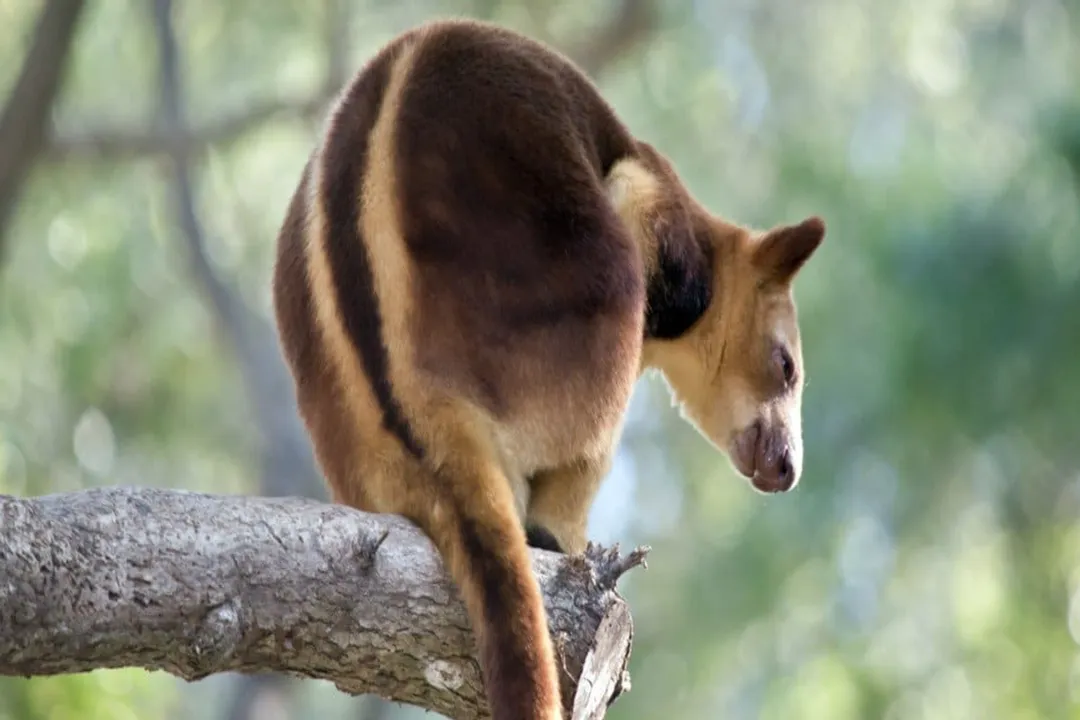
To confirm their membership in the macropod family, we can examine their shared characteristics, many of which root them firmly in this grouping, despite their radically different lifestyle. [1] Like all macropods, tree-kangaroos are marsupials, meaning the females possess a pouch where the undeveloped young, or joey, completes its early growth. [1] Their physical structure confirms this lineage, even where it has been heavily modified for climbing. They retain the powerful hind legs characteristic of their ground-dwelling cousins, and when they do move quickly on solid ground, they still employ a hopping gait. [1][3] Furthermore, the structure of their feet shows clear kinship; their second and third toes are fused together up to the tips, where they possess separate nails—a common macropod trait. [1]
The scientific classification places them specifically within the subfamily Macropodinae, alongside other kangaroos and wallabies. [3] Their genus, Dendrolagus, is derived from Greek roots meaning "tree hare" (dendro for tree and lagus for hare), which, although descriptive of their arboreal nature, fails to capture their true genetic heritage as kangaroos. [1] The existence of the primitive musky rat-kangaroo is often cited as supporting evidence for the shared ancestry of all macropodids stemming from an older, possum-like ancestor. [1] Tree-kangaroos, therefore, are not simply like kangaroos; they are kangaroos, specialized for a life spent high above the forest floor.
# Arboreal Toolkit
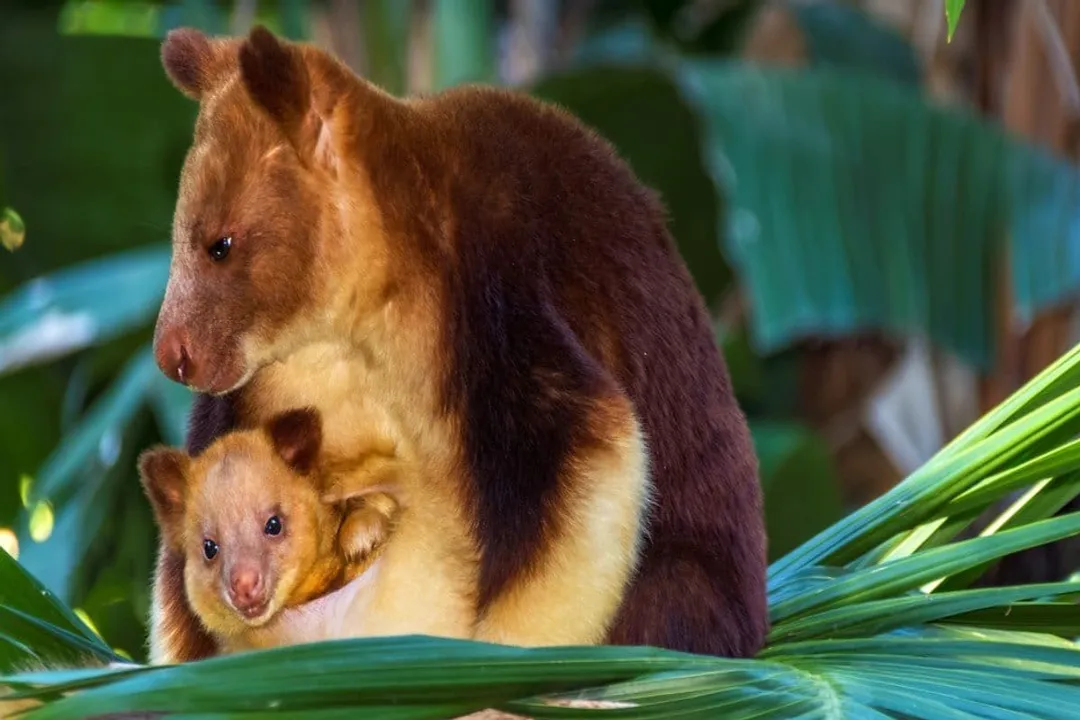
The adaptations that allow tree-kangaroos to thrive in the canopy, distinguishing them from their terrestrial counterparts, are numerous and highly specialized. [1][2] If you were to place a Red Kangaroo next to a Bennett's tree-kangaroo, the differences in limb proportion would be the most striking contrast. [3] Terrestrial kangaroos evolved shorter forelimbs relative to their massive hindquarters, optimized for bipedal hopping across open plains. [2] Tree-kangaroos, conversely, have developed shorter legs and significantly stronger forelimbs to aid in gripping and hauling themselves up vertical trunks. [2][3] In fact, their forelimbs and hindlimbs are closer to equal in length compared to their ground-dwelling relatives. [3]
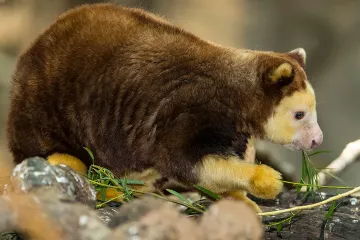
Perhaps the most visually obvious difference is the tail. Where a land kangaroo’s tail is a thick, muscular appendage primarily used as a propulsive counterbalance during hopping, the tree-kangaroo boasts a much longer and thicker tail that is often longer than its body. [1] This arboreal tail is not pointed but is often bushy and cylindrical, acting as a crucial stabilizer while navigating narrow branches or preparing for a leap. [1]
Another essential aspect of their toolkit involves their paws and claws. [1] To secure purchase on bark, they have evolved longer, more curved nails than those found on ground kangaroos. [1] Furthermore, their paws and the soles of their feet are equipped with sponge-like pads that provide superior grip, something unnecessary for animals that primarily rely on powerful thrusting motions on the ground. [1][3]
As a fascinating piece of physiological comparison, tree-kangaroos exhibit a behavior similar to that of some ground-dwelling relatives to manage heat: they do not sweat. [3] To cool down during hot or humid conditions, they engage in behavioral thermoregulation by licking their forearms, allowing the moisture to evaporate and cool their bodies. [1][3] This reliance on behavioral cooling, shared with species that inhabit dry environments, is a curious feature retained in the moist rainforest setting. [3]
# Locomotion Modes
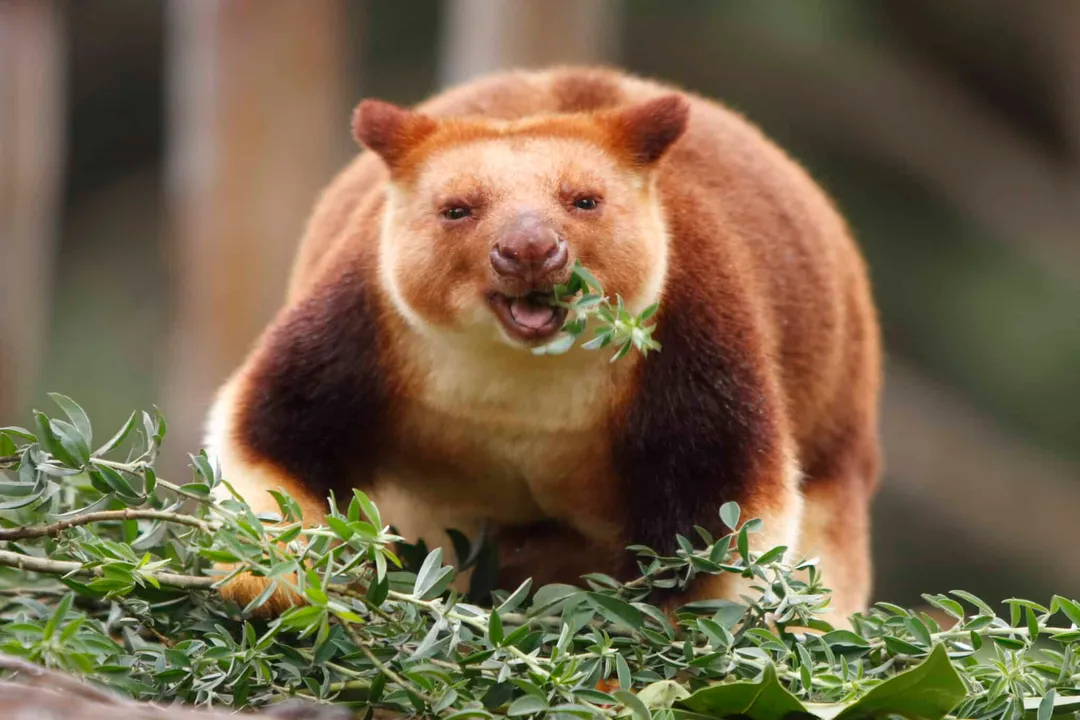
The contrast in movement between these two ecological niches—the ground and the canopy—is stark. [3] On the forest floor, tree-kangaroos are described as slow and somewhat clumsy, moving at roughly the pace of a human walk, with an awkward hop that requires them to lean their body far forward to compensate for their heavy, balancing tail. [3] Their powerful hind legs, while adapted for powerful vertical thrusts in the trees, make for inefficient, short-distance terrestrial travel. [3]
In the trees, however, they are described as bold and agile. [3] Their climbing technique involves using their forelimbs to grip a trunk, wrapping them around the bark, and then using their strong hind legs to hop upward, allowing the forelimbs to slide up the trunk as they ascend. [3] This specialized propulsion allows them to exploit a habitat inaccessible to their cousins. They are also noted as expert leapers. [1] Recorded downward jumps of 9 meters (about 30 feet) between trees have been documented, and they possess the extraordinary ability to drop from heights of 18 meters (nearly 60 feet) or more and land without injury. [1][3] This capacity to survive significant falls is a critical feature for an animal whose life depends on maneuvering through a complex, three-dimensional arboreal environment. [1]
# Habitat Span
The geographical range of the tree-kangaroo genus Dendrolagus is split between two major landmasses: New Guinea and the far northeastern tip of Queensland, Australia. [1][2][3] They exclusively inhabit tropical rainforests, ranging from lowland environments up into mountainous regions. [1][2] The environment they occupy is one of dense foliage and high altitude variation. [2]
In Australia, only two species are found: Lumholtz's tree-kangaroo (D. lumholtzi) and Bennett's tree-kangaroo (D. bennettianus), both restricted to the northern reaches of Queensland, with Lumholtz's dwelling north of the Daintree River. [3] Many species, particularly those in New Guinea and surrounding islands like the Schouten and Raja Ampat Islands, inhabit higher elevations. [2][3] For instance, Matschie's tree-kangaroo (D. matschiei) is known to live between 3,300 and 9,800 feet above sea level. [1] The fact that some species are adapted to montane rainforests while others, like the Lowlands tree-kangaroo (D. spadix), stick to lower elevations demonstrates significant niche partitioning even within the same genus across the region. [1][3]
The general appearance across species is unified by thick, often beautifully colored and patterned fur, which, unfortunately, makes them attractive targets for poachers. [1] Their heads are relatively small compared to their overall stocky build. [1]
# Evolutionary Tale
Understanding why a kangaroo evolved to live in a tree requires looking back millions of years into the deep evolutionary past of the marsupials of Australia and New Guinea. [2][3] The general consensus among scientists suggests that the entire macropodid family originated from an ancestor that resembled a tree-dwelling possum. [1][3] Following this initial stage, the continent experienced a significant drying period during the late Eocene era, causing rainforests to contract. [3] This environmental pressure forced ancestral pademelon-like creatures—relatives of modern, ground-dwelling macropods—to adapt to drier, rockier habitats, potentially leading to the evolution of rock-wallabies. [1][3]
The lineage leading to the tree-kangaroo appears to have involved a partial reversal of this trend. [2] As global cooling during the Pleistocene epoch led to further contractions of rainforests into isolated fragments, some populations of these ancestors—possibly an extinct genus called Bohra that was semi-arboreal—became geographically separated. [3] This isolation forced these groups to specialize further, adapting specifically to a canopy-dwelling lifestyle within these fragmented rainforest refuges. [3] This means that tree-kangaroos are not merely a recent offshoot that decided to climb; they represent a return to an earlier, more arboreal way of life that their distant ancestors inhabited before the entire group specialized for terrestrial hopping. [2] This phenomenon of evolving back into a former ecological niche is a compelling example of how environmental shifts can drive convergent—or in this case, recurrent—evolutionary paths across different lines of descent. [3]
# Species Diversity
The genus Dendrolagus is complex, with scientists generally recognizing about 14 to 15 distinct species, though taxonomic debates continue regarding the exact status of some populations. [1][3] The discovery of new species is relatively recent, with the golden-mantled tree-kangaroo (D. pulcherrimus) only described in 1990 in Papua New Guinea. [2]
Some of the recognized species include:
- Lumholtz's tree-kangaroo (D. lumholtzi): The smallest species, found in Australia. [1]
- Bennett's tree-kangaroo (D. bennettianus): The other Australian species. [3]
- Matschie's tree-kangaroo (D. matschiei): Famous for its unique, water-shedding fur whorl. [1]
- Tenkile (D. scottae): Found in Papua New Guinea and critically endangered. [1]
- Wondiwoi tree-kangaroo (D. mayri): Thought extinct until rediscovered in 2018 and remains critically endangered. [1][3]
- Dingiso (D. mbaiso): A unique species revered by the Moni people, which spends less time in the trees than others. [1]
Taxonomic uncertainty exists; for example, Seri's tree-kangaroo (D. stellarum) has been classified both as a distinct species and as a subspecies of Doria's tree-kangaroo (D. dorianus), often based on subtle morphological differences that warrant further investigation. [3] The existence of these distinct, isolated populations across the rugged geography of New Guinea suggests that habitat fragmentation continues to drive speciation, even today. [3]
# Survival Crisis
Despite their specialized adaptations and fascinating biology, nearly all tree-kangaroo species face severe threats, pushing many populations into vulnerable or endangered categories. [2][3] The most significant dangers they face are twofold: habitat loss and human hunting. [3]
Habitat destruction is widespread across their range. In New Guinea, this is driven by logging and the expansion of agriculture for crops like coffee, rice, and wheat. [3] In Australia, while hunting is a factor, roadkill from vehicles and attacks by domestic dogs are also noted causes of death for the Australian species. [3] Because their lifestyle keeps them high in the canopy, habitat destruction essentially removes their entire living space, forcing them into smaller, disconnected patches of forest. [2][3]
Hunting pressure is a critical issue, particularly in New Guinea, where locals rely on them for meat and their prized fur. [1][2] The Tenkile (D. scottae), for instance, is a staple food source for some communities, and overhunting, combined with logging, has brought it to the brink of extinction. [1] The fact that the golden-mantled tree-kangaroo is estimated to have been extirpated from 99% of its historical range shows the devastating effect these combined pressures have had. [2]
This regional difference in primary threat drivers provides an interesting analytical contrast. In the densely populated, developing regions of New Guinea, the issue is primarily direct subsistence hunting and large-scale commercial logging clearing vast tracts of primary forest. [2] In contrast, the more fragmented, generally smaller habitats in northeastern Australia often result in increased human-wildlife conflict, evidenced by vehicle strikes and dog predation as the forest fragments push animals closer to human settlements. [3] Effective conservation, therefore, cannot be a one-size-fits-all plan; it requires local initiatives addressing subsistence reliance in some areas and managing agricultural encroachment and domestic animal impact in others. [2]
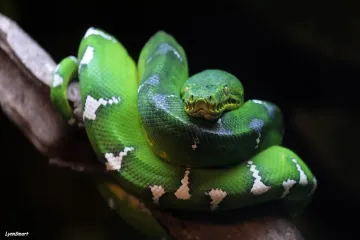
Reproductively, tree-kangaroos are slow to recover from population losses. Females reach sexual maturity relatively late, and the time a joey spends developing is among the longest for any marsupial. The young remain in the pouch for an average of 246 to 275 days, with weaning occurring several months later. [1][3] This low reproductive rate means that even small annual losses due to human activity or natural predation (like that from the amethystine python) can cause population numbers to decline rapidly without any chance for quick rebound. [1][3] Given these compounding factors, the continuation of conservation programs aimed at reducing illegal logging and managing land use is vital for the persistence of the Dendrolagus genus. [2]
# Behavior Patterns
Tree-kangaroos generally lead solitary lives, with the main exception being the bond between a mother and her dependent joey. [1][3] Adult males and females typically only interact briefly for mating purposes. [1] In some observed cases, a male's territory might overlap with several females, which led some early observers to suspect harem-keeping, but this has not been borne out, as the males usually disperse after breeding. [1] Males will, however, defend their defined territory against other males. [1]
Their schedule is remarkably relaxed. These animals are known to spend a significant portion of their day—around 60 percent—simply sleeping. [1] Their foraging sessions, usually focused on browsing leaves, occur every four hours or so and last about 15 to 20 minutes. [1] Their diet is primarily herbivorous, consisting of leaves and fruit found in the canopy, supplemented by flowers, moss, tree sap, and bark. [1][3] Interestingly, some populations, or individuals in captivity, exhibit omnivorous tendencies, consuming insects, bird eggs, and even small birds or snakes. [1][3] This dietary flexibility, incorporating protein, might be a secondary adaptation, especially when the toxic concentration in leaves varies due to drought conditions. [1]
The female’s birthing process is cautious; she will isolate herself, sit down, and place her tail between her legs before giving birth to the minuscule, fetus-like joey. [1] This neonate then makes the long climb to the pouch to latch onto a teat, remaining hidden for over five months before emerging tentatively. [1] The strong mother-joey bond is often the most significant social unit observed in the wild. [1]
The classification confirmation is clear: the tree-kangaroo is a macropod—a specialized, canopy-dwelling branch of the kangaroo family tree, clinging to existence in the shrinking rainforests where its ancestors first learned to climb. [2][3] Their specialized features make them perfectly suited for their arboreal niche, but those same features and their slow reproductive cycle make them extremely vulnerable to modern environmental pressures. [2][3]
Related Questions
#Citations
Tree-kangaroo - Wikipedia
Tree Kangaroo - Backyard Buddies
Tree Kangaroo - A-Z Animals