What is unique about bobolink plumage?
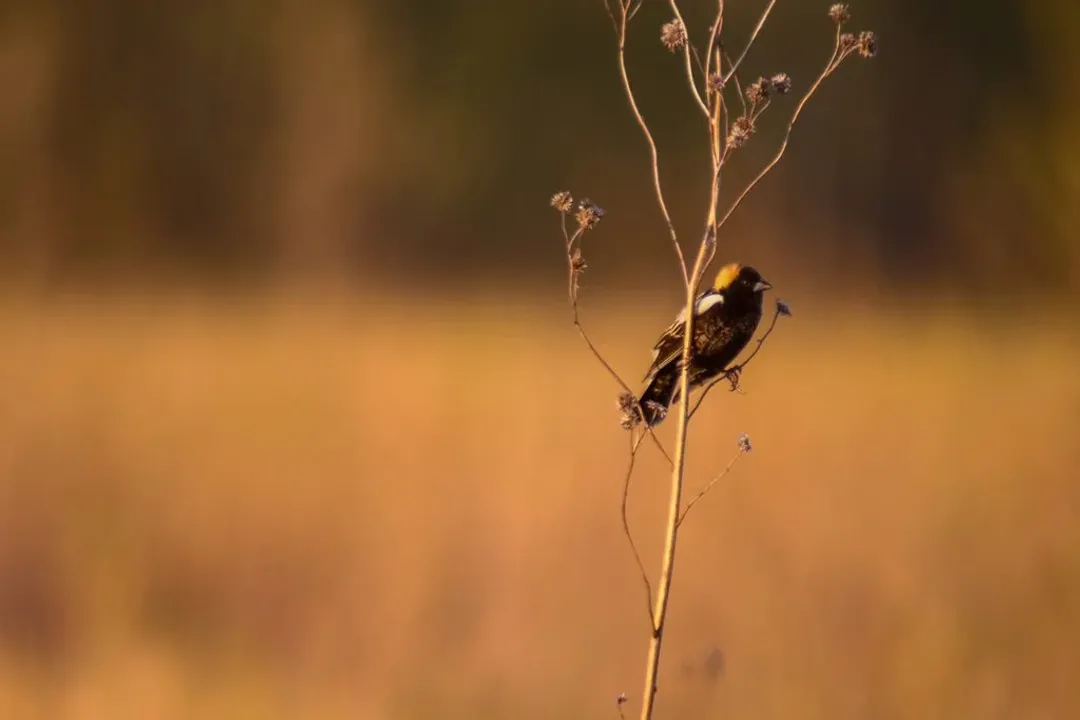
The transformation of the Bobolink across the seasons is one of the most dramatic shifts found among North American songbirds, making its plumage a standout feature in ornithological study. The casual observer encountering a field of these birds during summer breeding months would see something utterly unlike the drab, streaky individuals seen later in the year or the females holding down nests. This radical difference, particularly in the male, is what truly sets the Dolichonyx oryzivorus apart.[1][3][5]
# Breeding Male Striking Looks
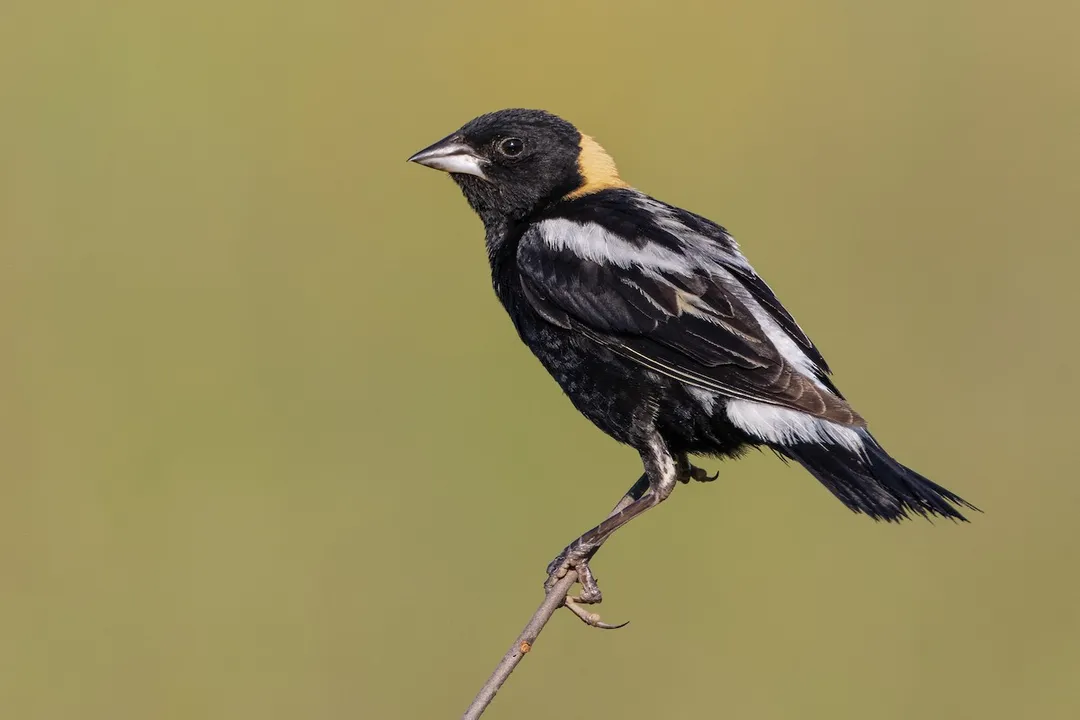
The breeding male Bobolink is immediately recognizable due to its bold, almost chaotic pattern, which seems almost tailor-made for standing out in grassy meadows. When in full breeding attire, the bird presents a striking contrast between light and dark sections. The underside, from the breast down to the undertail coverts, is a deep, solid black. [1][3] This stark black contrasts sharply with the upper parts.
The back, wings, and tail are generally a mix of buffy-yellow or yellowish-brown, heavily streaked with black, offering a kind of camouflage when viewed from above against the dried stalks of hayfields or marshes. [1] However, the true identifying marks for a birdwatcher focusing on the male are the patches of white. There is a noticeable, almost pure white patch on the scapulars—the feathers covering the shoulder area—and sometimes white mixed into the rump feathers. [1][5] Furthermore, the crown of the head often appears a rich, creamy yellow or buffy gold, creating a distinct "crowned" look that is often described as resembling a buttercup flower, especially when viewed in good light. [2][5]
It's worth considering the sheer energy expenditure this bright, high-contrast display requires. In an evolutionary sense, this conspicuous plumage functions to attract mates and signal fitness within the often dense, uniform backdrop of grassland breeding habitats. [4] The male must successfully navigate the dual demands of being flashy enough to secure a female while still avoiding aerial predators like hawks, a trade-off perfectly illustrated by the stark division between its dark belly and streaked upper surface. [1]
# Female Appearance
In stark contrast to the flamboyant male, the female Bobolink maintains a much more subdued appearance year-round, resembling a rather large sparrow. [1][5] Her plumage is characterized by being streaky brown and buff across the back, breast, and head. [3] This muted coloring is crucial, as the female is solely responsible for incubating the eggs and caring for the young in the nest, situations where bright colors would invite disaster. [4]
While she lacks the male's solid black belly and bright yellow crown, keen observation reveals a hint of the male's coloration. Females often show some pale streaking on the breast, and crucially, they may exhibit subtle white patches on the wings or edges of the feathers, though these are far less pronounced than the male's snowy scapulars. [1][5] For the novice birder trying to distinguish a female Bobolink from a Meadowlark or a particularly large Savannah Sparrow in a mixed field, remembering that any visible white patterning on the wing of a streaky brown bird in this habitat should raise the suspicion of a Bobolink, even if it is a female or a young bird. [5]

# Seasonal Plumage Changes
What is truly unique about the Bobolink is not just the difference between the sexes, but the dramatic transition the male undergoes. After the breeding season concludes, often around mid-to-late summer, the male Bobolink undergoes a complete molt. [1] This process involves replacing all their flight and body feathers, resulting in the shedding of that conspicuous breeding attire.
Once molted, the male looks nearly identical to the female and the first-year birds. [1][3] This non-breeding or winter plumage is characterized by the same streaky brown and buff coloration mentioned earlier. [1] They migrate south looking drab and inconspicuous, carrying this camouflage across the Gulf of Mexico and into their wintering grounds in South America. [3] The entire cycle—from flashy advertisement to near-invisibility—is completed within the span of a single year.
This near-total plumage reversal is less common among North American passerines than a partial molt, where only some feathers are replaced. For the Bobolink, the functional necessity of attracting a mate in the breeding grounds demands high visibility, while the survival imperative during migration demands minimal visibility. The species solves this dilemma by essentially wearing two entirely different outfits depending on the time of year. [1]
# Structural Features
Beyond color and pattern, a few structural elements contribute to the overall look. The Bobolink has a relatively short, thick bill, typical of a seed-eating bird, though they consume insects heavily during the breeding season. [2] They are also quite plump, giving them a slightly stocky silhouette, especially on the ground. [2]
# Plumage Comparison Table
To better illustrate the radical differences in their appearance across the life cycle, this table summarizes the key visual distinctions:
| Feature | Breeding Male | Female / Non-Breeding Male |
|---|---|---|
| Underparts | Solid Black | Streaky Brown/Buff |
| Crown | Yellowish/Buffy Gold | Streaky Brown |
| Shoulder/Scapulars | Distinct White Patch | Minimal or Absent White |
| Overall Appearance | High-contrast, bold pattern | Cryptic, sparrow-like |
| Timing | Summer (Breeding Season) | Winter, Migration, Nesting |
| Molt | Pre-breeding molt shows this look | Molts into this look |
| [1][3][5] |
# Field Identification Nuances
When identifying a Bobolink in the field, especially outside the peak summer months, the plumage uniqueness relies on subtle clues rather than the male's bold markings. While the female and the winter-plumaged male are easily confused with other grassland sparrows, the presence of that potential for white on the wing is key. [5]
If you see a bird that looks generally like a large, yellowish-tinged sparrow foraging low in a hayfield during the late summer or early fall, pay attention to its flight pattern and any white flashing. Unlike many sparrows that exhibit plain wing bars formed by feather edging, the Bobolink often shows larger, more defined patches of white when the bird spreads its wings briefly, remnants of the breeding plumage or an intermediate molt stage. [1] Mastering the identification of the drab plumage requires shifting focus from the bold black and yellow of the male to seeking out the slight white accents that hint at the underlying species identity, an essential skill for tracking their sometimes-late migration passage through unexpected areas. [5]
The uniqueness of the Bobolink plumage, therefore, lies not just in the visual spectacle of the breeding male, but in the profound sexual dichromatism that governs the species, coupled with the complete seasonal reversal undertaken by the male, allowing this bird to effectively hide in plain sight for half the year.[1][3]
Related Questions
#Citations
Bobolink | Audubon Field Guide
Fun Bobolink Facts - Birdorable
Plumages, Molts, and Structure - Bobolink - Dolichonyx oryzivorus
Why Bobolinks?
Bobolink - Southern Wisconsin Bird Alliance
Dolichonyx oryzivorus (bobolink) - Animal Diversity Web
The Bobolink - Northern Virginia Bird Alliance
Bobolink - NYSDEC
Bobolink - Conserve Wildlife Foundation of NJ