What are the facts about the common krait?

The common krait, scientifically known as Bungarus caeruleus, holds a significant, if unwelcome, position in the snake populations across South Asia, often cited as one of the "Big Four" venomous snakes responsible for the most human fatalities in the region. Despite its reputation, this snake possesses a surprisingly subdued appearance when compared to the ostentatious markings of many other venomous species. It is a creature that thrives under the cover of darkness, presenting one of the most significant risks during the quiet hours of the night when most people are completely unaware of its presence. Understanding this snake requires looking past initial impressions and delving into its specialized biology and highly potent venom.
# Physical Description

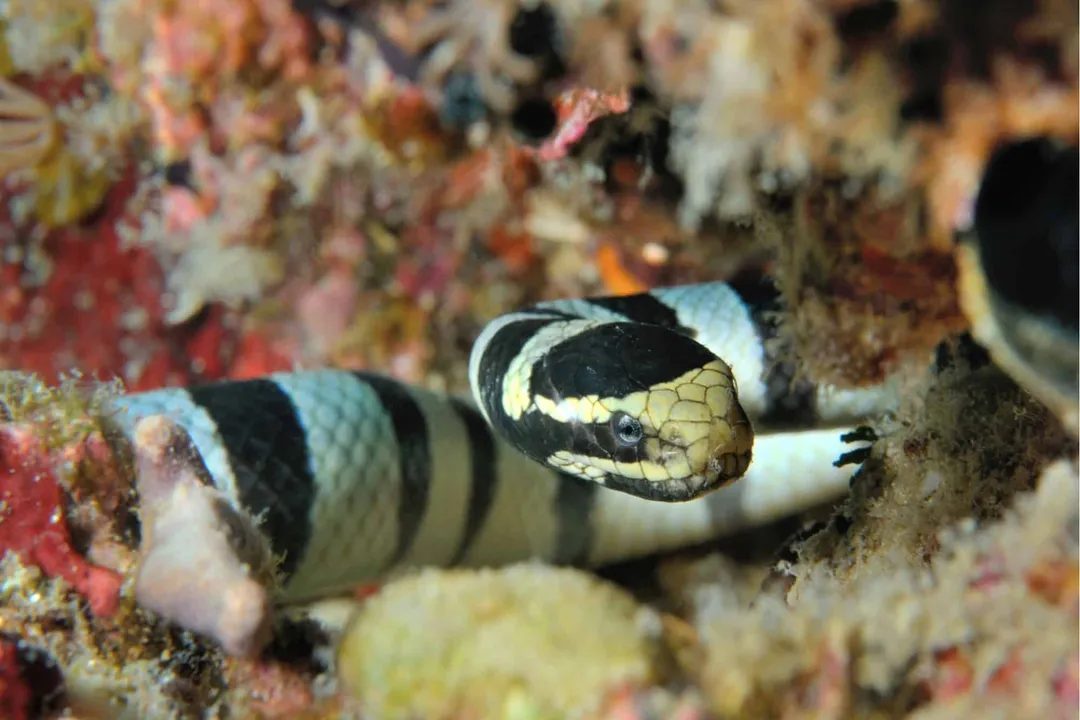
The adult common krait typically reaches lengths between 3 and 5 feet, though specimens nearing 6 feet have been recorded. The most definitive feature of this snake is its coloration and pattern. The dorsal side, or back, is generally a glossy black or bluish-black hue. Running along this dark background are distinct, narrow, white or pale yellowish crossbands. While these bands are usually present, their clarity and spacing can vary significantly; in some individuals, especially older ones, the bands may be faint, broken, or entirely absent, leading to a uniformly dark appearance.
Ventrally, the underside is typically white or pale in color. The head is relatively small and elongated compared to the body, which is smooth and rather slender. A fascinating observation, often missed by the casual observer focused only on size, is how this snake’s visual presentation contrasts sharply with its clinical danger. Its relatively small size and nocturnal habits mean that during the day, it is often mistaken for a non-venomous snake, which contributes to unfortunate human interactions when people underestimate the risk it poses. The specific taxonomic classification places it within the Elapidae family, the same group that includes cobras and mambas.
# Habitat Niche

The common krait exhibits considerable adaptability concerning its environment, thriving across a wide geographical range that spans the Indian subcontinent and parts of Southeast Asia. They are not restricted to dense, primary forests. Instead, they frequently inhabit areas where human settlements overlap with their natural territory, such as agricultural lands, scrub forests, and even within or immediately around human dwellings.
They show a preference for seeking refuge in cool, dark, and often damp places during daylight hours. This might include termite mounds, rock crevices, piles of debris, or beneath stored materials. This tendency to shelter near human activity is a critical factor in understanding bite statistics. Unlike snakes that retreat to deep wilderness when disturbed, the krait’s preference for proximity to human structures means encounters are common, particularly when these structures offer good hiding spots or when the snake is hunting at night.
# Nocturnal Rhythms

The behavior of the common krait is heavily dictated by its strictly nocturnal nature. As dusk settles, this snake becomes active and quite agile, moving out to hunt. This activity pattern is fundamental to safety protocols: encounters with this species are overwhelmingly likely to occur between sunset and sunrise.
During the night, their diet consists mainly of other reptiles, particularly other snakes, but they also consume lizards, rodents, and frogs. This predatory specialization on other snakes, including venomous ones, gives them a unique, if niche, role in local ecosystems. When they are moving and hunting at night, they are alert and can cover ground surprisingly quickly. Conversely, during the day, they are generally docile and reluctant to bite unless directly provoked or physically stepped upon while sheltering.
When considering safety around these snakes, one must appreciate the difference between their daytime lethargy and nighttime vigilance. While a sleeping krait inside a shed might be easy to avoid if detected, a krait actively hunting under the cover of darkness requires much more awareness from anyone walking outdoors or near ground level after dark.
# Venom Chemistry
The common krait’s danger does not stem from the volume of venom injected—which is relatively small compared to some other snakes—but rather from the extreme potency and specific composition of its toxic cocktail. The venom is predominantly neurotoxic.
The primary active agents are a group of toxins known as alpha-neurotoxins. These molecules are highly effective at targeting the nervous system. They function by blocking the transmission of signals from nerve cells to muscle cells at the neuromuscular junction. Specifically, they act as competitive antagonists at the nicotinic acetylcholine receptors (nAChRs).
This disruption leads to a paralytic effect. In the context of a bite, this paralysis progresses systematically. Initial symptoms might be subtle or delayed, which is a significant clinical concern. However, once the effects manifest, they rapidly lead to muscle weakness, drooping eyelids (ptosis), difficulty speaking, and eventually, respiratory failure, as the muscles required for breathing become paralyzed. While the venom also contains some less potent components, like cardiotoxins and phospholipase A2 enzymes, the life-threatening component remains the post-synaptic neurotoxin activity.
It is worth noting that while many highly venomous snakes inject large quantities of venom, the krait demonstrates that efficiency trumps volume. A bite from a krait, even a small one, delivers a concentrated dose of highly targeted neurotoxins, meaning that even a small envenomation can quickly become a medical emergency requiring immediate, specialized antivenom administration. This inherent toxicity places it in a league with some of the world's most medically significant snakes.
# Bite Symptoms Timeline
The clinical progression following a common krait bite is often insidious, contributing to poor initial treatment decisions. Often, the initial pain at the bite site is minimal, or non-existent, which can lead victims to dismiss the bite as trivial or attribute symptoms to something else. This lack of immediate, severe local pain is a major distinguishing factor compared to, say, vipers, and is something individuals in endemic areas must be educated about from a young age.
Systemic symptoms, driven by the neurotoxins, typically manifest several hours after the bite—sometimes up to 12 hours later, although this can vary. The first noticeable signs are often related to cranial nerve involvement: blurred vision, facial drooping, difficulty swallowing, and profound lethargy. As the paralysis descends through the body, weakness becomes generalized. The most dangerous stage is reached when respiratory distress sets in, signaling impending respiratory arrest. Because the initial signs are easily missed, prompt identification of the snake or recognition of even mild neurological changes is crucial for survival.
# Ecological Role and Diet
As mentioned, the common krait is a dedicated carnivore with a specialized preference for other snakes, making it a significant predator within its food web. This cannibalistic or ophiophagous tendency is an interesting area of study, suggesting a local mechanism for regulating snake populations, although its direct impact is often overshadowed by its danger to humans. Beyond snakes, their diet includes rodents, lizards, and frogs. This reliance on small, often hidden prey reinforces their need to hunt under the cover of darkness, leading them into close contact with sleeping humans or those moving quietly at night.
# Comparative Context
The common krait is not alone in its genus; there are several other krait species, and the threat they pose has recently received renewed scientific attention. The identification of new species within the Bungarus genus highlights the complexity of this group, which includes highly dangerous snakes like the Banded Krait (Bungarus fasciatus). While the common krait (B. caeruleus) is well-known for its high toxicity and prevalence in populated areas, the sheer variety of neurotoxic kraits means vigilance is required across their ranges.
For the general public living where these snakes occur, a key takeaway is recognizing that all kraits should be treated with extreme caution due to their potent neurotoxic venom, even if visual identification is difficult. Furthermore, the habitat overlap, where they share space with domestic animals and humans near agricultural areas, means that deterrence and safe housing practices are the most effective preventative measures against these secretive nocturnal hunters.
Related Questions
#Citations
9 Crazy Common Krait Facts - Fact Animal
Common Krait (Bungarus caeruleus) - iNaturalist
Common Krait - Facts, Diet, Habitat & Pictures on Animalia.bio
Common Krait - an overview | ScienceDirect Topics
Krait - A-Z Animals
Common Krait Facts for Kids
The Common Krait is a completely nocturnal snake and is very ...
Meet 4 Deadly-Venomous 'Krait' Snakes—One Is Brand New To ...
Common Krait • LITFL • Toxinology Library