How do you identify a spongy moth?
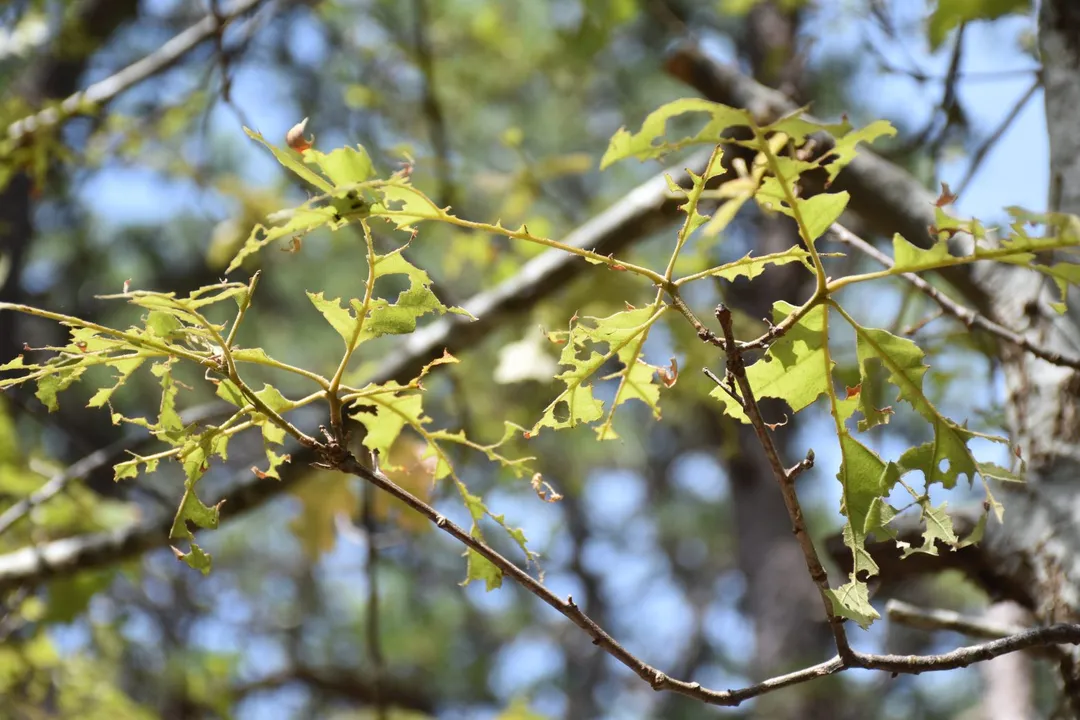
Identifying the spongy moth, formerly known as the gypsy moth, is a vital skill for homeowners and land managers alike, primarily because of the significant defoliation this invasive species can cause to broadleaf trees. [1][9] Because the moth passes through four distinct life stages—egg, larva (caterpillar), pupa, and adult—the visual markers change dramatically throughout the season, requiring observers to be familiar with each appearance. [4]
# Egg Masses
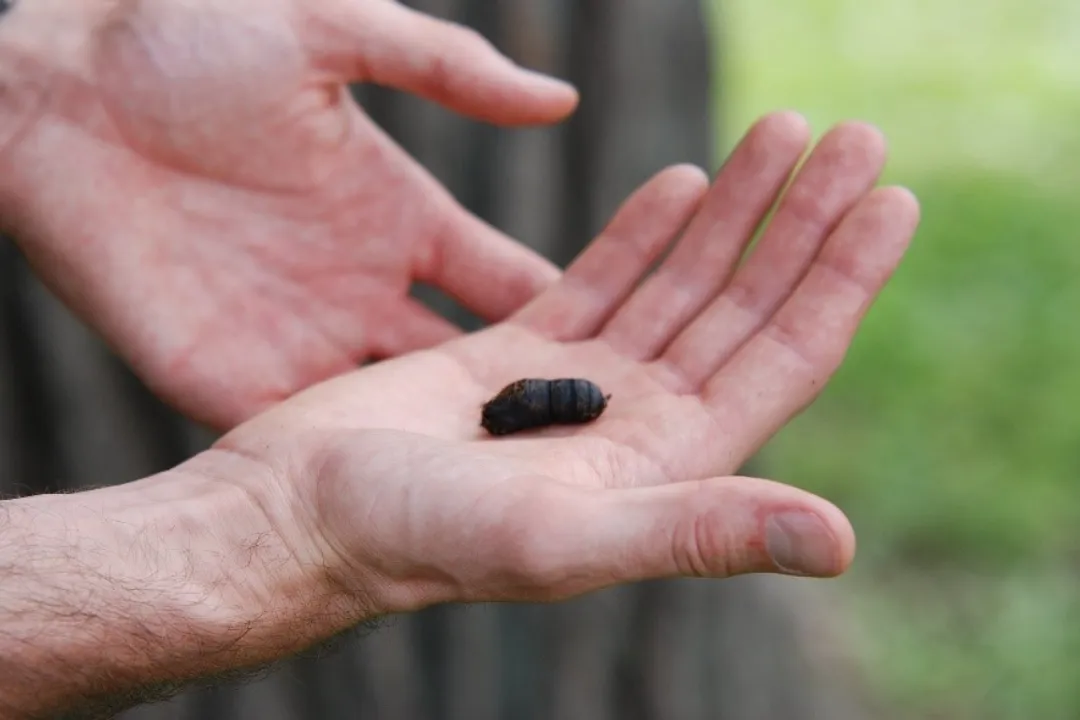
The first stage to look for, depending on the time of year, is the egg mass. These are often deposited in late summer or early fall and can overwinter until they hatch in the spring. [4] Spongy moth egg masses are generally about to inch thick and to $1.5$ inches long, though they can vary in size. [4][5] They have a distinctive, felt-like or frothy appearance, usually covered with hairs from the female's abdomen, giving them a tan or buff color. [1][4][5]
When searching for these masses, remember that the female moth is not picky about placement. While tree bark is a common spot, especially on oaks, pines, and maples, you should also inspect outdoor furniture, firewood piles, vehicles, stones, and recreational equipment. [1][5] If you are monitoring property in a region where the moth is active, a thorough inspection of any sheltered surface, even areas that might seem unusual like the underside of a deck railing, is necessary to locate all potential hatches. [4] This habit of laying eggs almost anywhere sheltered makes complete eradication of the egg masses incredibly difficult once established in an area. [5]
# Larval Appearance
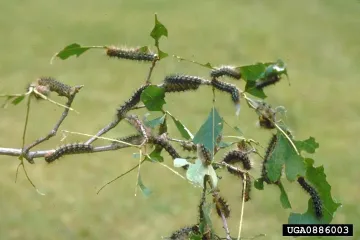
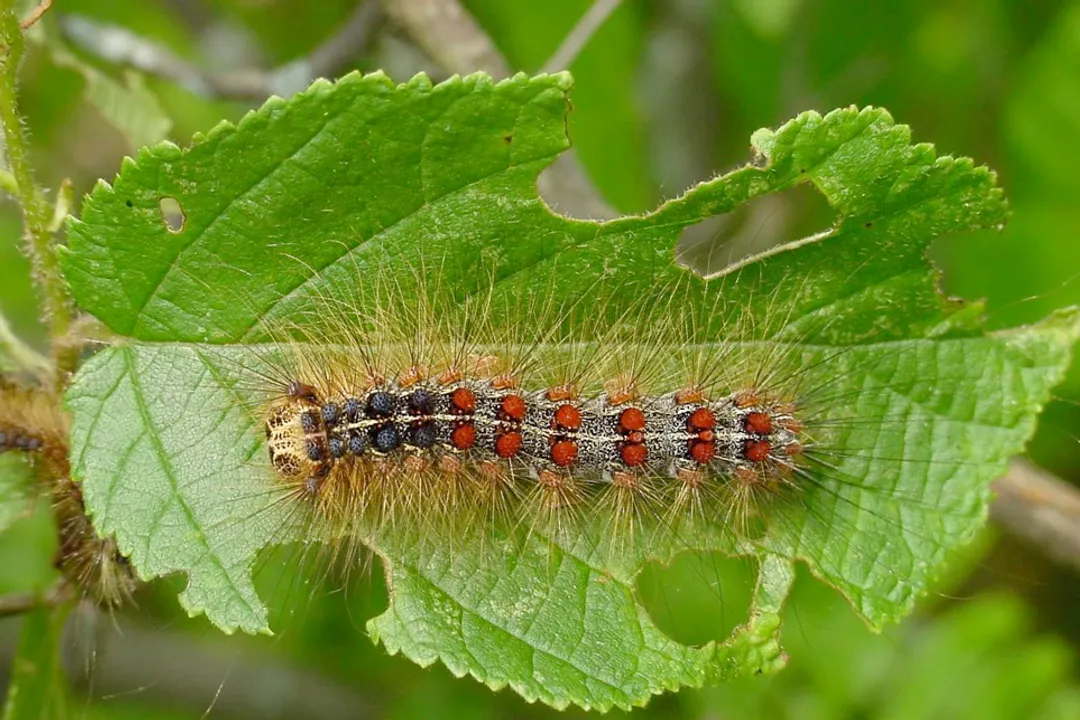
The larval stage, the caterpillar, is typically the most noticeable and damaging phase of the spongy moth's life cycle. [1] These caterpillars hatch in the spring, usually in late April or May, and can grow up to about 2 inches in length. [4] They are covered in dense, fine hair and exhibit a striped pattern that is the most reliable indicator for positive identification.
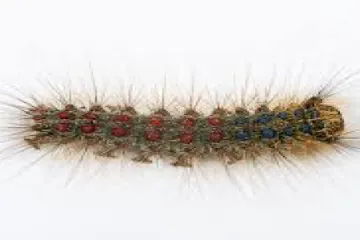
The key identifying feature of the spongy moth caterpillar is the arrangement of its colored dots, or tubercles, running down its back. Look for two distinct rows of five pairs of blue dots near the head end, followed by a row of six pairs of red dots toward the rear of the body. [2][5][8] This pattern—blue dots followed by red dots—is crucial, as other native caterpillars may share similar colors or hairiness but lack this specific arrangement. [2] The overall body color can range from pale gray or yellowish to dark brown or black, often displaying darker stripes running lengthwise along the body. [2] Because they are hairy, direct handling should be avoided, as the irritating hairs can cause rashes in sensitive individuals. [6]
# Adult Moths
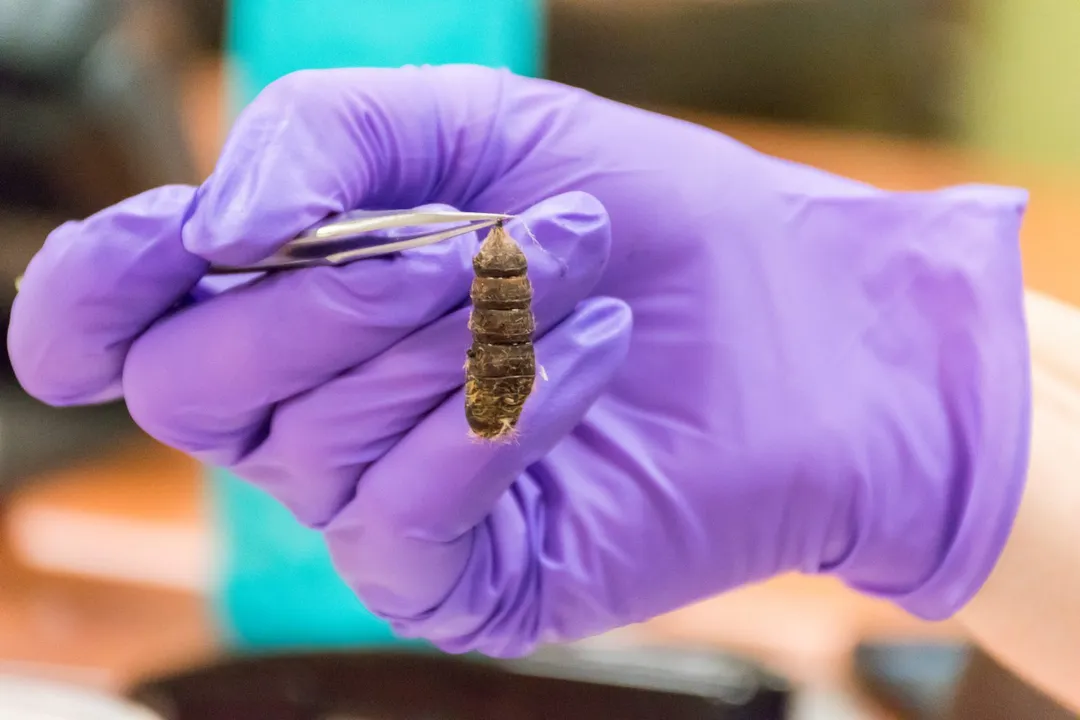
Once the caterpillars have matured, they enter the pupal stage before emerging as adults, typically between July and August. [4] The adult moths are often less frequently noticed than the caterpillars, but distinguishing between the male and female is essential for accurate identification and population assessment.
# Male Moths
The adult male spongy moth is a recognizable insect characterized by its light coloration and strong flight capability. The wings are generally creamy white to light tan, featuring several wavy, dark brown or black lines crossing them. [2][5] Males are relatively slender and possess distinctly feathery or comb-like antennae, which they use to detect pheromones released by the females. [2][5] A male moth generally has a wingspan of about 1.5 inches. [2]
# Female Moths
In contrast, the adult female is notably different. She is larger and heavier than her male counterpart, with a wingspan that can reach up to 2.5 inches. [2] Her wings are typically whitish or creamy, but the dark markings seen on the male are usually much fainter or less distinct. [2][5] Perhaps the most significant difference, particularly for spread analysis, is that the female spongy moth is a very poor flier, with wings too small relative to her body mass to sustain long flights. [2][5] Females tend to crawl only short distances after emerging to mate, often near the pupal case, before depositing their egg mass. [5]
# Life Stage Comparison
To aid in quick field identification, it is helpful to consolidate the key visual characteristics across the lifespan. Recognizing that the characteristics change so significantly is perhaps the biggest hurdle for accurate identification, as someone seeing a fuzzy caterpillar might not immediately connect it to the white, poorly flying adult female they saw weeks earlier. [4]
| Life Stage | Primary Identifying Feature | Typical Coloration/Texture | Mobility |
|---|---|---|---|
| Egg Mass | Frothy, hair-covered oval deposit | Tan or buff | Immobile |
| Larva | Two rows of tubercles: 5 blue pairs followed by 6 red pairs | Hairy; dark brown, black, or yellowish | Crawling |
| Adult Male | Feathery antennae; distinct, dark wing markings | Creamy white to light tan | Strong flier |
| Adult Female | Larger, bulkier body relative to wings; faint wing markings | Whitish or creamy | Weak flier/crawler |
This comparison highlights that the caterpillar stage, with its specific blue-and-red dot pattern, is the clearest visual signal of a positive ID, while the adults require careful attention to antennae structure (male) and flight capability (female). [2][5]
# Monitoring and Action Timing
Knowing when to look for these stages is just as important as knowing what to look for. The timing dictates the potential for immediate management action. Egg masses are present from late summer through early spring, making winter inspections an effective time to remove them before mass hatching occurs. [4] If you conduct a visual inspection of your property's trees during the dormant season, looking for those characteristic tan, felt-like patches on the trunks or branches is an excellent proactive measure against the next season's defoliation threat. [1][5]
Caterpillars emerge in the spring and feed actively until mid-summer, which is the prime time for observing feeding damage—skeletonized leaves where only the veins remain—and for applying targeted control measures if necessary. [4] By late summer, the damage has generally ceased as the adults emerge to mate and lay eggs, restarting the cycle. [4] Understanding this seasonal rhythm allows property owners to focus their identification efforts when the stages are most obvious or most vulnerable. For instance, in many northern climates, the fall cleanup of leaf litter and debris on the ground can inadvertently remove many pupae that may have dropped, reducing the next year's adult population.
Related Questions
#Citations
Spongy moth (Lymantria dispar ) - University of Minnesota Extension
Identification - Purdue College of Agriculture
Spongy Moth | Animal and Plant Health Inspection Service
Is it Spongy Moth (Lymantria dispar)? - UW–Madison Extension
Spongy Moth Identification - DATCP - Wisconsin.gov
Spongy Moth: How To Identify & Eliminate The Invasive Pest
Spongy Moth - Washington Invasive Species Council
Plant Industry - Identify the Spongy Moth | NC Agriculture
Spongy Moth | National Invasive Species Information Center